
NEWS
Purpose-Built Methane Satellites Win a Year-Long Blind Test
Purpose-built methane satellites passed a year-long Stanford blind test that land scanners failed, just as EPA moved to drop super-emitter alerts.

Dedicated methane sensors detected 92 to 100 percent of clear-day plumes in a Stanford-led blind test of 481 controlled releases over Arizona in 2025. Fifteen analysis teams in nine countries scored the images without knowing the true flow rates.
Public land scanners caught 29 to 37 percent of the same plumes, and new AI methods produced 79 percent of the false alarms. The Nature paper landed on October 14, 2026, seven days after EPA said it would try to scrap the U.S. super-emitter alert channel those satellites were built to feed.
A Year of Metered Plumes in Arizona
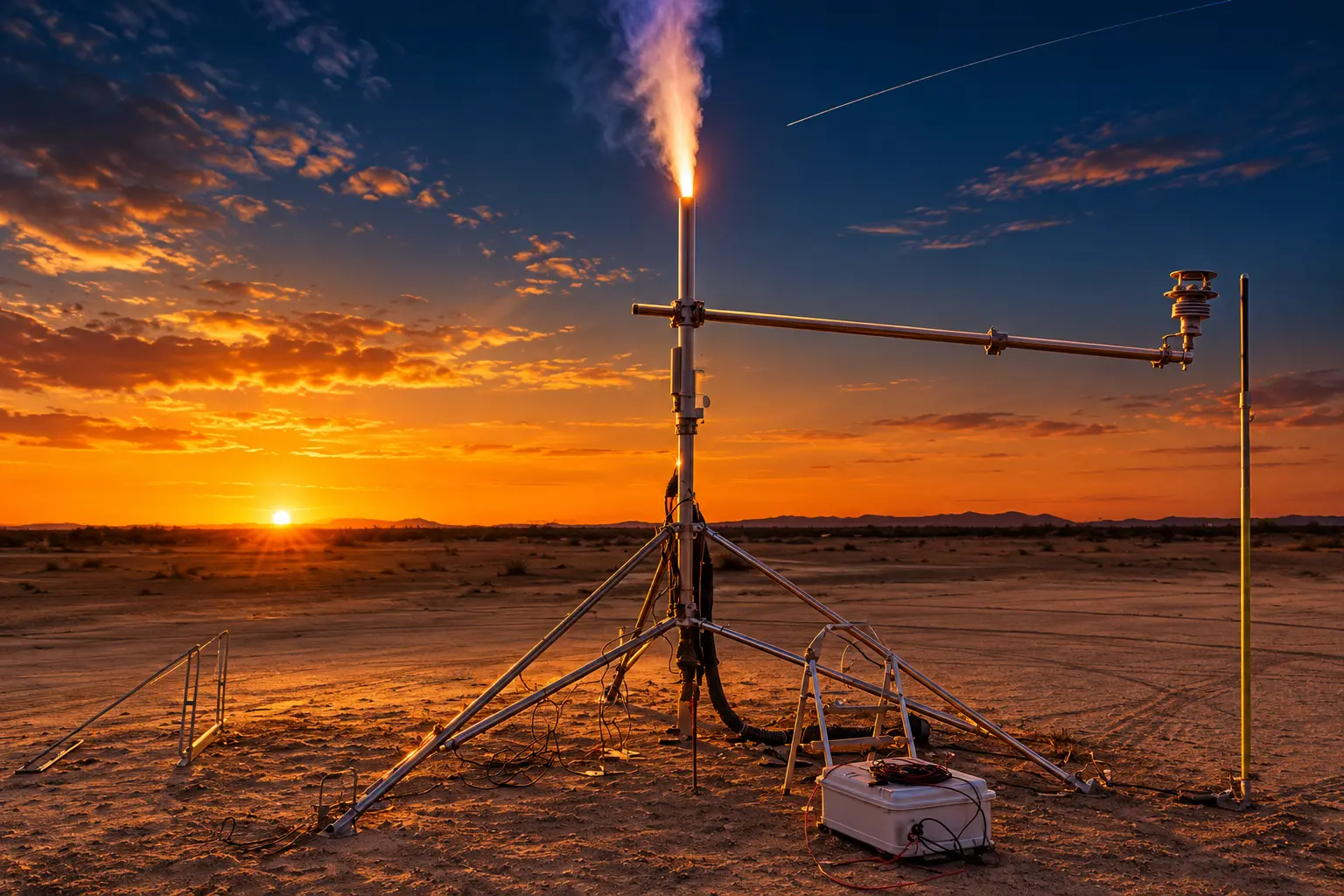
Lead author Frances Reuland, a Ph.D. student in energy science and engineering, and senior author Adam Brandt, a professor in the same department at the Stanford Doerr School of Sustainability, ran the yearlong Casa Grande methane experiment from January 1 through December 31, 2025. Compressed natural gas, mostly methane, went up a release stack at a Stanford research site in the Sonoran Desert, timed to satellite overpasses and metered at 9.5 to 1,183.7 kilograms per hour.
Each puff lasted 8 to 10 minutes. Across the year the team released less than 50 metric tons, about the annual output of 500 dairy cows, or about 13 seconds of methane from global fossil fuel operations. On 265 other overpasses they released nothing, which is how a detection system gets caught inventing a leak.
Twelve satellite systems collected at least one scene. Results came back for 11 after MethaneSAT’s mission ended. Teams filed 2,259 blind estimates. Across every sensor and every team, 70.6 percent of 1,750 unfiltered calls correctly named whether gas was present or absent, a blended pass rate that hides how far the fleet split.
Reuland said the campaign produced “orders of magnitude more controlled-source data points than we’ve ever had before for testing methane detection from space.” Co-authors sat at the University of Michigan, the University of California, Berkeley, the University of Iowa, and the Max Planck Institute for Chemistry. Analysis groups included Carbon Mapper, NASA’s Jet Propulsion Laboratory, the UN International Methane Emissions Observatory, GHGSat, Google, Kayrros, SRON, and several university and startup labs.
THE CASA GRANDE CAMPAIGN
- January 1, 2025: Blind releases and blank overpasses begin at Casa Grande, Arizona, timed to orbiting sensors.
- June 20, 2025: MethaneSAT operators lose contact with the Environmental Defense Fund satellite; no results are later filed for its 12 test passes.
- December 31, 2025: The last of 481 metered releases and 265 blanks closes the field year.
- October 7, 2026: EPA Administrator Lee Zeldin says the agency will propose rescinding the Methane Super Emitter Program.
- October 14, 2026: Nature publishes the Stanford scorecard as “Evaluating space-based methane detection through a one-year blind test.”
Only 393 of the 481 releases produced a usable image, so a large share of “misses” never reached an analyst as a clean scene.
How Accurate Are Methane Satellites From Space?
Purpose-built point-source sensors, GHGSat’s commercial constellation and Carbon Mapper’s Tanager-1, led the field on clear days. Repurposed hyperspectral craft such as Germany’s EnMAP and NASA’s EMIT, flown on the International Space Station for mineral dust, sat in the middle. Free global land scanners built for other jobs finished last.
THE THREE SATELLITE GROUPS
| Group | Systems in the test | Clear-day detection | False alarms / size error |
|---|---|---|---|
| A, built for methane | GHGSat, Tanager-1 | 92 to 100% true positive | 0 to 11% false positive; 44% mean absolute percent error; parity slopes 0.83 to 1.00 |
| B, repurposed hyperspectral | EnMAP, EMIT, PRISMA, WorldView-3, Gaofen 5, Ziyuan 1, GHOSt | 62 to 88% | 46% mean absolute error |
| C, global land scanners | Sentinel-2, Landsat 8/9 | 29 to 37% | Especially error-prone below 1,000 kg/h |
On October 15, 2026, Carbon Mapper said Tanager-1 found 100 percent of its cloud-free releases and called no false plumes. Brandt and Eric Kort, a University of Michigan and Max Planck scientist who chairs Carbon Mapper’s Science and Measurement Committee, both sit on that committee; Brandt is a member. The paper discloses those roles.
Can satellites be trusted to find methane leaks? A blind @Stanford study says yes 🛰️
Researchers staged 481 methane releases in the Arizona desert. Using Tanager-1, Carbon Mapper detected 100% of its cloud-free releases with zero false plumes.https://t.co/ByHJ9YaY0k
— CarbonMapper (@carbonmapper) October 15, 2026
Under clear skies and moderate wind, the dedicated sensors picked up plumes down to about 50 to 200 kilograms per hour. Carbon Mapper’s own Tanager sheet lists a 90 percent probability of detection at 90 to 180 kilograms per hour in a 30-meter methane image, which sits on the same band. Most size estimates ran as much as 50 percent high or low, though over- and undercounts roughly cancelled. That 50 percent swing is a single-estimate spread; the Group A mean absolute percent error in the table is the separate, tighter average.
In many cases, the detection is the important part. As long as you know approximately how big it is, then you still know you need to go fix it.
Adam Brandt, professor of energy science and engineering, Stanford University
The paper also notes Tanager-1 found more than 2,400 methane plumes worldwide in its first seven months of operations, a live catalog this Arizona trial was meant to grade.
Most False Alarms Came From AI
Blank overpasses were the trap for methods that see methane everywhere. False positives were uncommon for most teams, then clustered in one corner of the field: commercial groups running new AI on the coarse public land scanners.
WHERE THE LOSERS BROKE
- Thin spectra: Sentinel-2 and Landsat collect fewer infrared bands, so methane’s signature is harder to separate from bare dirt, roofs, and glare.
- The rate band: Those scanners were especially error-prone below 1,000 kilograms per hour, and almost every metered plume sat in that band, with the largest release only 1,183.7 kilograms per hour.
- Synthetic training: Several AI detectors had been taught on fake plumes. In a year of real blanks they generated 79 percent of all false positives in the study.
The cheap, frequent public images are the ones operators and advocates most want to automate, and that is exactly where the false alarms piled up. Reuland said the Casa Grande archive can now be used to retrain those models. Until that work is done, a red blob on a Sentinel-2 frame is a weaker claim than a GHGSat or Tanager hit.
Clouds Still Hide the Biggest Basins
These sensors read methane by watching sunlight bounce off the ground in infrared wavelengths the gas absorbs. Clouds sit in that path. Even GHGSat and Tanager-1 struggled to see plumes through overcast, and ground-measured cloud cover above 20 percent dragged down every class of instrument.
The authors flag the practical hole: tropical oil and gas producers such as Nigeria and Venezuela, and cold, cloudy basins in Canada and Russia, will keep handing satellites whiteouts. A blank map from those regions is often “we never got a look,” not “there is no leak.”
The Arizona site is bright desert with a known stack and a known wind mast. The paper says work is still needed over forests, snow, mixed industry, and open water, and through a wider set of sun angles than one latitude provides. Casa Grande graded the sensors on a generous surface. It did not grade the planet.
MethaneSAT Left the Scorecard Blank
MethaneSAT, launched in March 2024 by the Environmental Defense Fund, was built for wide-area totals rather than single-stack plumes. The Stanford team still timed 12 releases to it in the first half of 2025. No estimates came back.
On June 20, 2025, mission operators lost contact. EDF later said the satellite had lost power and was likely not recoverable. Reasons for skipping the 12 scenes were not made clear to the Stanford group. TROPOMI on Sentinel-5P was kept out of the trial for a different reason: its expected detection floor sits above the strongest puff the Arizona stack could make.
The fleet did not stand still after that loss. On October 16, 2026, Carbon Mapper said Tanager-1 had spotted a large Permian Basin plume on October 10 and that Tanager-2, already on orbit, imaged the same source two days later and saw methane again. GHGSat, for its part, remains the other Group A winner in the Stanford table, a Canadian commercial constellation selling facility-level follow-up on top of public wide-area scans.
EPA Plans to Rescind the Super-Emitter Channel
The detection floor that mattered in Arizona is the same number U.S. rules already use. EPA’s Methane Super Emitter Program treats a leak at or near an oil and gas site as a super-emitter at 100 kilograms per hour of methane or more, measured by certified third parties with approved remote sensing, including satellites.
THE SUPER-EMITTER RULE ON THE BOOKS
- The trigger: 100 kilograms per hour, inside the 50 to 200 kilograms-per-hour band where dedicated sensors held up on clear days.
- The clock: A certified notifier must file within 15 calendar days of detection; the owner must start an investigation within five days and report within 15.
- The pause: Future implementation is extended to January 22, 2027, under a July 2025 interim final rule, and the program page still described those duties as of September 16, 2026.
On October 7, 2026, speaking at the New Mexico Oil and Gas Association meeting in Santa Fe, Administrator Lee Zeldin said EPA would propose to rescind the program. The agency said it is not necessary to meet Clean Air Act requirements and is not effective, and it put the broader oil and gas rewrite at an estimated $45 billion in savings against $18 billion in costs it assigned to the 2024 rule.
Outside the United States the same class of detections still feeds a live alert machine. UNEP’s Methane Alert and Response System, which draws on more than 30 satellite instruments, has notified governments and companies since it became operational on December 1, 2023, and in 2026 it widened those alerts from oil and gas into coal and waste. The Stanford paper notes that satellite observations are also being written into European climate standards for natural gas imports.
Brandt argued the results should give regulators, policymakers, producers, and the public “a lot of confidence moving forward,” and he listed three reasons to fix a leak besides climate: saleable gas kept in the pipe, fire risk, and ground-level ozone. The dedicated sensors now have a year of blind grades behind that pitch. The U.S. channel that would have forced an operator to answer a satellite hit is the one EPA has said it wants to take down, while the Super Emitter Program page still lists January 22, 2027, as the date for future implementation.
Frequently Asked Questions
Why Was the TROPOMI Instrument Left Out of the Stanford Methane Test?
TROPOMI, the methane mapper on the European Sentinel-5P satellite, was excluded because its expected detection threshold sits above the strongest flow the Casa Grande stack could produce. The Arizona releases topped out at 1,183.7 kilograms per hour, a band aimed at facility-scale point sources, not the much larger ultra-emitters TROPOMI was built to see from a coarser grid.
How Did Earlier Stanford Satellite Methane Tests Compare in Size?
Two prior single-blind campaigns by the same research circle were far smaller. The first ran 19 days, with 16 successful releases that satellites also tasked and 49 blind estimates. A later 52-day campaign tested nine satellites and produced 132 estimates. The 2025 Arizona year was more than 15 times larger than those earlier tests and was the first to include a large set of no-release blanks.
Who Funded the Year-Long Methane Satellite Experiment?
The work was funded by the Global Methane Hub, the Grantham Foundation, Saudi Aramco, and Stanford’s Natural Gas Initiative, an industrial affiliates program supported by company membership fees. Reuland’s research time was supported by the Stanford Knight-Hennessy Scholars program. The Nature paper lists those sources and the Carbon Mapper committee roles for Brandt and Kort.
Which Methane Instruments Had Never Been Blind-Tested Before?
The campaign was the first single-blind controlled test of Tanager-1, NASA’s EMIT spectrometer, and the GHOSt hyperspectral satellites, and it was the first independent blind check of several new AI plume detectors. Older systems such as GHGSat, Sentinel-2, Landsat, EnMAP, PRISMA, and WorldView-3 had appeared in the smaller Stanford trials; the new birds and the AI pipelines had not.

Chinese Design Booms While Luxury Spending in China Falls

Abbott Spins Off Nutrition After Formula Legal Bills

French Law and Two Unions Hold Arkane Lyon’s Clock

FSSAI Brings a 1992 Formula Ban Onto Instagram Reels

Capcom ID Leak Hands Attackers a Ready Phishing Kit

The Last Manual V-12 Lamborghini Cannot Come to America

Permafrost Thaw Runs Fastest in Mountains, Not Arctic Soils

Rune Bets on Hillerød for His Achilles Comeback

The Roman Space Telescope Flies After Four Budget Fights

Software Stocks Rally as Underweight Funds Face Dreamforce
-
 AUTO2 months ago
The Last Manual V-12 Lamborghini Cannot Come to America
-
 NEWS2 months ago
Permafrost Thaw Runs Fastest in Mountains, Not Arctic Soils
-
 NEWS2 months ago
Rune Bets on Hillerød for His Achilles Comeback
-
 NEWS2 months ago
The Roman Space Telescope Flies After Four Budget Fights
-

 NEWS2 months ago
Murphy Defends a British Open Title Nobody Keeps
-

 BUSINESS2 months ago
JBS’s Pilgrim’s Pride Bid Still Needs the 18 Percent
-
 BUSINESS2 months ago
Software Stocks Rally as Underweight Funds Face Dreamforce
-

 BUSINESS2 months ago
Influencer Investors Trade Cash Fees for Illiquid Equity