
NEWS
The Roman Space Telescope Flies After Four Budget Fights
NASA’s Roman Space Telescope left Kennedy nine months early on Falcon Heavy after years of budget fights, and its coronagraph is already on.

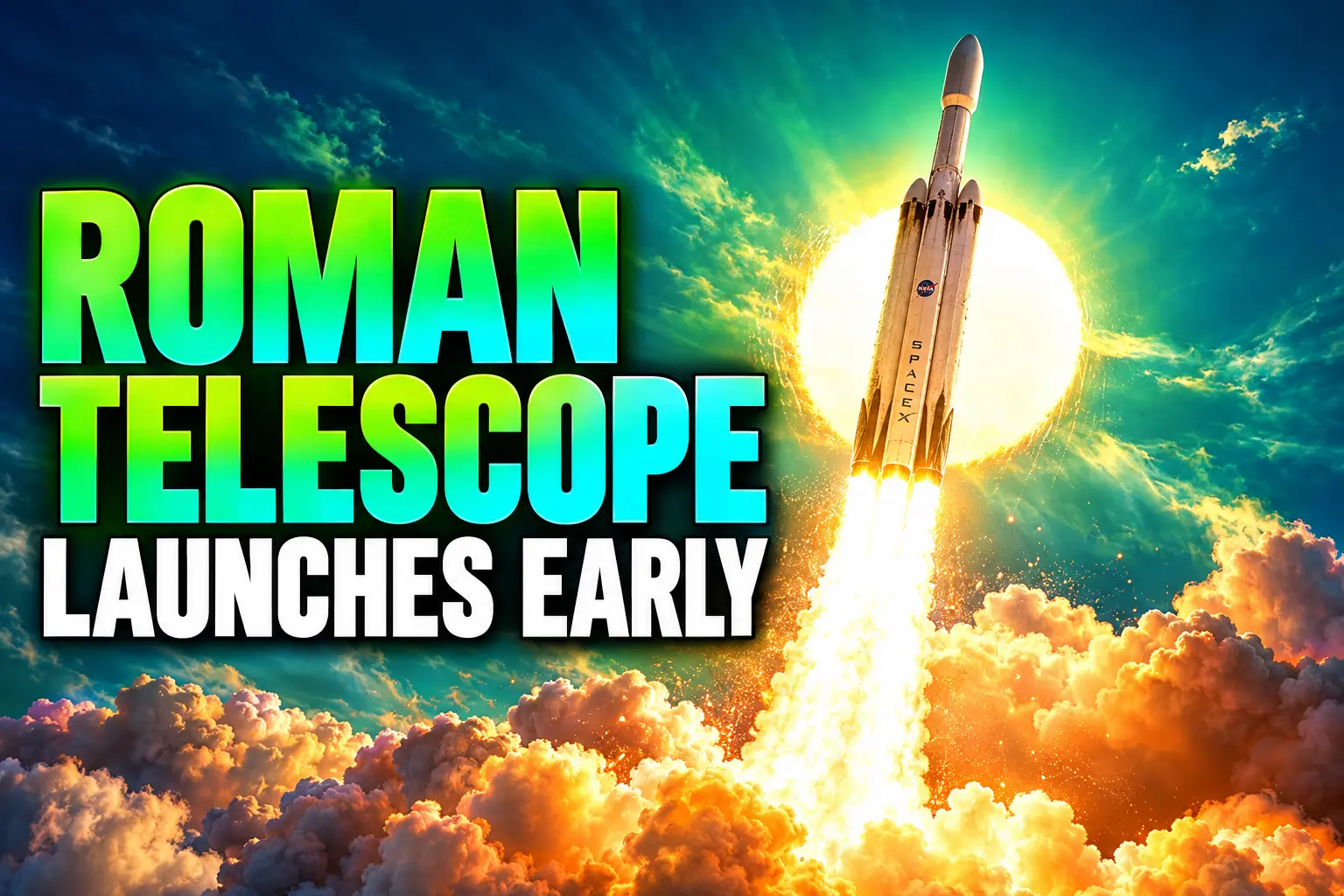
NASA’s Nancy Grace Roman Space Telescope left Earth at 7:26 a.m. EDT on Aug. 30, nine months early, after a Friday flight review at Kennedy Space Center. A SpaceX Falcon Heavy lifted the 18,000-pound observatory from Launch Complex 39A and sent it toward a halo orbit about 1 million miles away at Sun-Earth L2.
The climb cashed a long NASA wager: finish a Hubble-class survey telescope early, fly it on a commercial heavy rocket, and keep it alive through years of White House cuts. Controllers at Goddard Space Flight Center in Greenbelt, Maryland, had telemetry seven minutes after liftoff. The spacecraft separated 31 minutes in, and by Tuesday its planet-imaging coronagraph was already powered on.
Friday’s Go From Kennedy Started the Clock
Mission managers from NASA and SpaceX certified Roman at a Flight Readiness Review on Friday, Aug. 21, at Kennedy. That review, the last major paper gate before stacking, cleared the encapsulated observatory to roll to SpaceX’s hangar at pad 39A and mate to Falcon Heavy.
The U.S. Space Force’s 45th Weather Squadron posted a 70% “go” on launch morning. Falcon Heavy’s 27 Merlin engines made about 5 million pounds of thrust. Side-booster cutoff came at about 2 minutes 24 seconds, and those boosters, flying their first and third missions after GOES-U and Viasat-3 F3, were booked to land at LZ-2 and LZ-40 at Cape Canaveral Space Force Station.
NASA said this was the agency’s fourth primary Falcon Heavy mission, and that Launch Services Program had pulled the date forward once Goddard finished the spacecraft early. The same Sunday wide-field launch from Kennedy had been on the public manifest for weeks. SpaceX’s timeline has Roman deploys 31 minutes after liftoff, after a second upper-stage burn.
Falcon Heavy now treats a NASA flagship the way it treats a commercial comsat: stack, fuel, fly, recover the side cores. People watching from Clearwater Beach caught the sunrise climb as a beach show, which is the point of flying science on an operational heavy rocket rather than a one-off.
Falcon Heavy launches @NASA’s Nancy Grace Roman Space Telescope from pad 39A in Florida, beginning its more than three-month journey to its destination where it will generate never-before-seen photos of the universe pic.twitter.com/L3gHrBiQ08
— SpaceX (@SpaceX) August 30, 2026
FROM REVIEW TO FIRST BURNS
- June 21, 2026: The Pegasus barge delivers Roman to Kennedy after a road trip from Goddard to Baltimore and a coastal tow.
- August 21, 2026: NASA and SpaceX complete the Flight Readiness Review and certify final launch preparations.
- August 30, 2026: Liftoff at 7:26 a.m. EDT; telemetry at T+7 minutes; spacecraft separation at T+31 minutes; solar panels and lower instrument sunshade at T+1 hour 23 minutes; Deep Space Network handover at about T+70 minutes, starting at Canberra.
- August 31, 2026: A planned mid-course correction burn runs as expected, and the 5.6-foot, 24-pound high-gain antenna deploys in about 4 minutes at 2:03 p.m. EDT.
- September 1, 2026: The visor-like aperture cover springs open in about 8 minutes at 6:05 a.m. EDT, and the Coronagraph Instrument powers on.
Roman is more than 42 feet long and more than 14 feet wide when deployed, about the size of a tour bus, with six solar arrays rated at 4 kilowatts. About 290 gallons of hydrazine are on board for course tweaks and pointing. The Deep Space Network will hand the link from Canberra to Madrid and then Goldstone so the cruise stays in contact.
The Observatory That Kept Getting Zeroed Out
Roman’s official launch commitment was no later than May 2027. Flying on Aug. 30 put the mission nine months ahead of that date. NASA Administrator Jared Isaacman called the result the kind of execution he wants copied, and NASA’s launch statement said the mission was ahead of schedule and on budget.
That budget is about $4.3 billion across development, launch, and five years of operations, the figure NASA locked in after a pandemic-era replan. It is also the number that kept landing on the chopping block. Presidential budget requests repeatedly proposed canceling the telescope or cutting it to a stall. Congress put the money back each time, including after a fiscal 2026 request that would have slashed the remaining work rather than kill it outright.
The hardware origin is as American as the budget fight. In 2012 the National Reconnaissance Office transferred two unused 2.4-meter telescope systems that had been built for a reconnaissance program the intelligence community no longer needed. NASA did not inherit a finished spy satellite. It inherited unused optics with Hubble’s diameter and a short focal length, then spent more than a decade wrapping a new spacecraft, a 300-megapixel camera, and a coronagraph around one of those mirrors. The second donated mirror has no funded mission.
Goddard integrated and tested the whole flagship on site, a first for a NASA observatory of this class, with BAE Systems, L3Harris, and Teledyne as the main industrial partners and contributions from ESA, JAXA, France’s CNES, and the Max Planck Institute for Astronomy. The bet was that leftover glass plus a commercial heavy lift would beat the usual flagship slog. Sunday morning was the first payout.
Hubble Sharpness Across 100 Times More Sky
Roman’s primary mirror is 7.9 feet (2.4 meters) wide, the same diameter as Hubble’s. NASA’s comparison pages say each Roman image will capture a patch of sky at least 100 times larger, at similar resolution, and that in five years the new telescope will image more than 50 times as much sky as Hubble covered in 30. The European Space Agency’s mission sheet lists a 0.28-square-degree field of view for the Wide Field Instrument, about 200 times Hubble’s infrared frame even if NASA’s usual public comparison is the 100-times figure against Hubble’s sharper cameras.
It took Hubble’s Wide Field Camera 3 some 432 pointings to cover roughly the area Roman can cover with two. NASA designed the survey speed at about 1,000 times Hubble’s. The Wide Field Instrument is a 300-megapixel near-infrared camera with 18 4K detectors, each about the size of a saltine, and the spacecraft is stiff enough to slew and shoot without long settling pauses.
HUBBLE AND ROMAN AT A GLANCE
| Observatory | Primary mirror | Sky in one pointing | Survey speed | Sky covered |
|---|---|---|---|---|
| Hubble Space Telescope | 2.4 meters | Baseline | Baseline | 30 years of pointed imaging |
| Roman Space Telescope | 2.4 meters | At least 100 times Hubble’s patch | About 1,000 times faster | More than 50 times Hubble’s 30-year sky in 5 years |
| Hubble WFC3 mosaic vs Roman | Same aperture class | 432 Hubble pointings ≈ 2 Roman pointings | – | Same test field, two methods |
Hubble still owns ultraviolet work and tighter spectroscopy on small targets. Roman is tuned for visible light through 2.3 microns and for volume. Julie McEnery, Roman’s senior project scientist at Goddard, has said the new telescope can survey the Milky Way in about a month, a job Hubble would need a century to finish.
How Roman Will Hunt Dark Energy
The core science is a counting problem. Dark energy, the still-unnamed pressure that makes cosmic expansion speed up, is inferred from how fast the universe grew at different times. Roman will get there with Type Ia supernovae, a map of more than a billion galaxies, and weak lensing that traces dark matter by the way it warps background shapes. Rebekah Hounsell of the University of Maryland, Baltimore County, who co-leads the supernova survey, has called the jump from today’s nearby sample of fewer than 2,000 supernovae a massive increase in reach.
WHAT THE SURVEYS ARE BUILT TO COUNT
- Dark energy: Expansion history from supernovae plus galaxy clustering across cosmic time, aimed at whether the acceleration has changed.
- Dark matter: Weak-lensing maps over a huge area, so the clumpiness of the invisible mass can be measured rather than sampled in postage stamps.
- Microlensing planets: A Galactic bulge watch of about 100 million stars, expected to yield about 2,500 planets, including worlds smaller than Mars and free-floaters with no host star.
- Transiting worlds: NASA has said scientists should be able to identify and study about 100,000 exoplanets in the five-year archive, most of them in tight orbits that microlensing will not see.
- Daily downlink: About 1.4 terabytes a day, the highest astrophysics data rate NASA has flown, at up to 500 megabits per second through the new dish, with a planned 20,000-terabyte archive by the end of the primary mission.
Ohio State astronomer Scott Gaudi, who leads the microlensing survey, has said the method measures the demographics of planets that cannot be measured any other way. Transit work is biased toward big planets close to their stars. Microlensing is how you catch the rest, including loners drifting through the bulge. Machine learning, plus volunteer classifiers, will have to flag the needles, because no team can inspect 1.4 terabytes by eye.
Nancy Grace Roman Finally Gets Her Namesake
The telescope is named for Dr. Nancy Grace Roman, NASA’s first chief astronomer and one of the people who forced Hubble into existence as a funded program rather than a sketch. She spent years arguing that a space telescope had to be a national project, then watched Hubble fly in 1990. The observatory that carries her name is the wide-field machine Hubble could not be, built to sweep instead of stare.
McEnery told the postlaunch briefing that Sunday was an endpoint for the engineers and a starting point for the scientists. “It feels like I’m on the edge of a precipice, and we’re just about to set a foot off into the unknown,” she said. Isaacman, speaking for the agency after the Falcon Heavy cleared the tower, put the wager in management language.
Roman is exactly the kind of success story we want to see across NASA. Delivered ahead of schedule and on budget, this mission reflects more than a decade of dedication from the NASA workforce and our industry partners. Now, Roman will give us a new atlas of the universe, push the boundaries of discovery, and demonstrate what is possible when America’s space program pairs bold ambition with disciplined execution.
Jared Isaacman, NASA Administrator, after Sunday’s launch
President Donald Trump, whose budgets had targeted the mission, called into that same briefing and told the room the climb looked beautiful on television. Jackie Townsend, the Goddard project manager, said first public images should arrive before the winter holidays, a tighter window than the agency’s broader “early 2027” line. McEnery added a year-ahead claim of her own: “There’s no telling what more we’ll know and have seen by this time next year.”
The Coronagraph Came Alive on Tuesday
The Wide Field Instrument does the survey. The Coronagraph Instrument is the other half of the bet, a JPL-built technology demonstration that uses masks, prisms, detectors, and deformable mirrors to blot out starlight and take direct pictures of giant planets. NASA says it will photograph Jupiter-like worlds and prove hardware the Habitable Worlds Observatory would need to image Earth-size planets. Nicky Fox, associate administrator for the Science Mission Directorate, has already tied Roman’s stability and that coronagraph to the next flagship, not to a brochure.
NASA’s Roman account reported the instrument had activated on Sept. 1, after the visor opened and the dish was out. That is ahead of the “upcoming days” pace in the launch-day release, which had listed the coronagraph among the first-week tasks without a clock time.
We’ve got our starglasses on! 🤩
Roman’s Coronagraph Instrument has activated. This system of masks, prisms, detectors, and self-flexing mirrors will block out the glare from distant stars and directly image the planets and disks in orbit around them.https://t.co/1Rux9EC54J pic.twitter.com/V5AtBlx1VW
— Nancy Grace Roman Space Telescope (@NASARoman) September 1, 2026
STILL AHEAD ON THE CRUISE
- Wide Field Instrument: NASA says the 300-megapixel camera powers on in a couple of weeks, then enters calibration for the rest of the roughly 90-day commissioning period.
- Second course burn: Controllers still have another mid-course correction on the three-month run to L2, where Roman will share the neighborhood, not the orbit, with the James Webb Space Telescope.
- First light: The agency is aiming for public images in early 2027, with Townsend’s holiday target as the optimistic end of that range.
- Fuel life: The primary mission is five years, with a 10-year goal if the hydrazine and hardware hold.
The Wide Field Instrument still has to wake, cool, and prove it can hold focus across 18 detectors. Until those frames exist, the $4.3 billion wager is only half collected: the rocket worked, the deployments worked, and the coronagraph is on. The atlas Isaacman promised is still a million miles and a winter away.

Bass Persuades Takes the Record Drop After a No. 1 Debut

DIGITALEUROPE Says Europe Must Buy From Its Scaleups

Refugees Lose Medicaid While Green Cards Sit in Line

Ring Smart Lock Puts Your Door on Amazon Sidewalk

Sicario 3 Moves Ahead Without Taylor Sheridan Writing

The Roman Space Telescope Flies After Four Budget Fights

The Last Manual V-12 Lamborghini Cannot Come to America

Influencer Investors Trade Cash Fees for Illiquid Equity

Software Stocks Rally as Underweight Funds Face Dreamforce

Rune Bets on Hillerød for His Achilles Comeback
-
 AUTO1 month ago
The Last Manual V-12 Lamborghini Cannot Come to America
-
 BUSINESS1 month ago
Influencer Investors Trade Cash Fees for Illiquid Equity
-
 BUSINESS1 month ago
Software Stocks Rally as Underweight Funds Face Dreamforce
-
 NEWS2 months ago
Rune Bets on Hillerød for His Achilles Comeback
-

 BUSINESS2 months ago
Rubicon Research Q1 Tests Its Specialty Pharma Bet
-

 NEWS2 months ago
Hamilton’s Ferrari Upgrade Pushes Mercedes Into a Monza Bind
-

 NEWS1 month ago
Dallas Judge Blocks the SEC Ban, Coaches Still Face Fines
-

 BUSINESS1 month ago
JBS’s Pilgrim’s Pride Bid Still Needs the 18 Percent