
NEWS
DIGITALEUROPE Says Europe Must Buy From Its Scaleups
Cecilia Bonefeld-Dahl says a €5 billion Scaleup Europe Fund will not keep founders in Europe unless public buyers start taking product risk.

Cecilia Bonefeld-Dahl says Europe’s scaleups will keep leaving unless governments start buying from them. Capital helps, she argues, but a first customer matters more than another statute. The Director-General of DIGITALEUROPE made that case in an interview published 7 October 2026.
DIGITALEUROPE speaks for 137 corporate members and 45 national trade associations in 30 European countries, a net she puts at more than 56,000 businesses, mostly SMEs. The roster runs from SAP, Ericsson, Nokia, Airbus and Helsing to Microsoft, Google, Apple, Amazon, NVIDIA and OpenAI. She has spent about nine years in Brussels after IBM, Oracle and her own cloud firm, GlobeIT, and still sounds impatient with a capital that talks risk first.
The Scaleup Europe Fund Is Already Writing Cheques
The vehicle she calls a small but real win is no longer a slide. On 4 August 2026 the European Commission finished the legal steps for the Scaleup Europe Fund, targeting €5 billion, with EQT as independent manager inside the European Innovation Council Fund. Bonefeld-Dahl puts the Commission’s own commitment at €1 billion. Founding backers named by Brussels include Novo Holdings, Denmark’s EIFO, CriteriaCaixa, Santander’s Mouro Capital, Italian banking foundations with Intesa Sanpaolo, APG for Dutch pension fund ABP, Wallenberg Investments and Allianz.
President Ursula von der Leyen framed the launch as a way to stop high-potential firms looking abroad for late-stage money.
When Europe invests in its innovators, Europe invests in its future.
This is the goal of our Scaleup Europe Fund.
From today, it will ensure our scale-ups can find what they need right here in Europe to grow into world-leading companies.
To turn European innovation into our… pic.twitter.com/yDPcRkPQSz
— Ursula von der Leyen (@vonderleyen) August 4, 2026
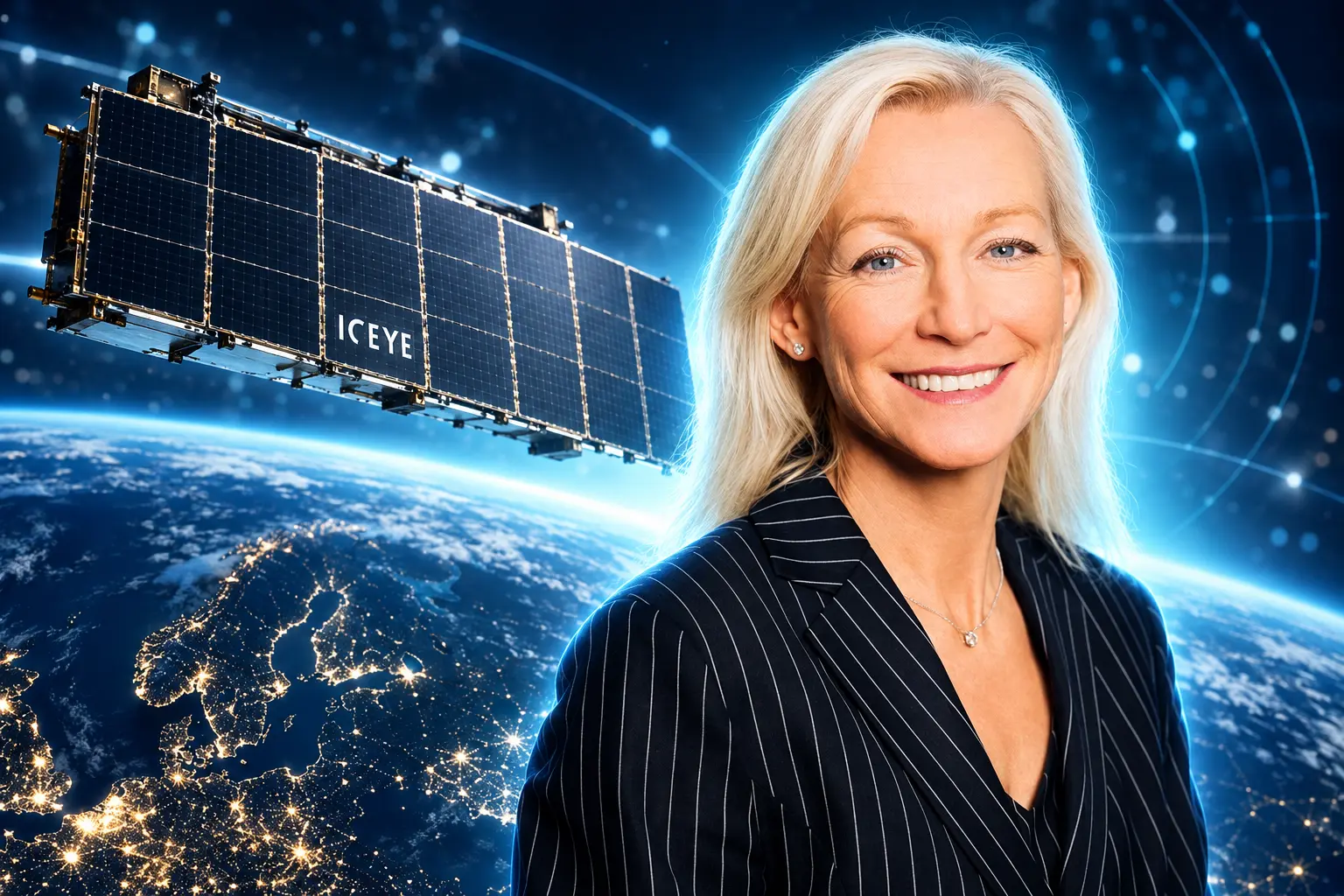
The next day, EQT said the fund had made its first investment by co-leading ICEYE’s €1 billion Series F. ICEYE, a Finnish radar-satellite company founded in 2014, said the round included €450 million of primary capital at a valuation exceeding €10 billion. EQT also said ICEYE already delivers end-to-end systems for seven European governments. That is the buyer pattern Bonefeld-Dahl wants copied outside defence and space, and it is still rare in civilian ministries.
THE FUND’S FIRST HUNDRED DAYS
- 4 August 2026: Commission completes legal setup and empowers EQT to invest on market terms.
- 5 August 2026: Fund co-leads ICEYE’s Series F, its first disclosed deal.
- September 2026: DIGITALEUROPE launches a Transatlantic Dual-Use Unicorn Award with Ukraine’s Ministry of Defence, Ukraine House and Cerberus, with Brave1 to nominate up to five Ukrainian firms.
Bonefeld-Dahl still wants three or four more growth funds, “perhaps €25 billion or €50 billion,” and a hard cap of three months from application to cash at the EIB and EIF. She said there is now a six-month commitment. The €5 billion pot does not close the hole she describes in European venture. It does show Brussels can write a late-stage cheque when a company already has states as clients.
She Puts Europe’s Venture Gap at €800 Billion
Ask her why founders still fly west and she reaches for fund size. “If you look at VC funds in Europe, I think it’s around €130 billion. If you go to the US, it’s around €930 billion. So we have this €800 billion gap that we’re not attracting, and we need to ask ourselves why.” Those are her figures, and she treats the €800 billion hole as a question about incentives, not a call for another directive.
CAPITAL POOLS SHE IS MEASURING
| Pool | Size she or Brussels cites | What it actually does |
|---|---|---|
| European VC funds (her estimate) | Around €130 billion | Early and growth cheques, thinner at late stage |
| US VC funds (her estimate) | Around €930 billion | The pool she says Europe fails to attract |
| Scaleup Europe Fund | €5 billion target | Direct late-stage equity, EQT, strategic tech |
| NATO Innovation Fund | €1 billion, 24 Allies | Equity for dual-use deep tech |
Pension money is the sleeper in that table. She says European pensions chase the cheapest entry into very large, typically American, funds, even as European startups take cheques from overseas pensions. “We could give them different incentives and make it more attractive. We could lower the costs.” ABP’s presence among the Scaleup Europe Fund’s founding investors is an early move in that direction, not a completed shift of the whole pension book.
The next EU budget is the lever she wants pulled. The Commission has proposed a Multiannual Financial Framework of nearly €2 trillion for 2028-2034, with a European Competitiveness Fund inside it. “Instead of 90 per cent of the budget going to all kinds of other things, which are nice, we need to move some of that money into European value creation, the next generation of companies, and resilience,” she said. DIGITALEUROPE’s US office exists for a related reason: members, she said, have invested €1.7 trillion in the United States in recent years, “so we need to be heard there.”
Why Public Buyers Still Treat Scaleups as a Risk
Money without orders still sends a company to a market that will place them. Bonefeld-Dahl points to the UK’s willingness to set targets for buying from scaleups and to accept some of the failure that comes with young vendors. In the EU, she says, that appetite is extremely low. She is not asking for a closed “buy European” rule. “We don’t believe the answer is simply ‘buy European’ because technology moves so fast. In some areas, such as energy technologies and connectivity, Europe leads the world. In cloud, we don’t.”
What she wants is a bias toward trying product, then buying more if it works. Defence is her working example, because Germany and Sweden already test a couple of units before a large order. She also likes the American habit, in some fields, of reserving a share of purchasing for local production, whoever the ally is.
WHAT SHE WANTS PUBLIC BUYERS TO TRY
- Set a scaleup share: Give ministries a target for purchasing from younger vendors, as she says the UK has begun to do.
- Buy two, then more: Take one or two units into a test centre, and only then place a larger order if the company can deliver.
- Cut the personal risk: Lower the career cost for a civil servant who tries a new supplier and gets a mixed result.
- Keep markets open: Work with allied vendors where Europe is behind, rather than freeze a whole category behind a flag.
Her awards programme is built to put those founders in the same room as the people who control money and rules. The Future Unicorn Awards, started in 2018, offer visibility rather than cash. DIGITALEUROPE now counts an alumni group of around 250 scaleups; she says around 50 of them raise from the EIB, EIF, EIC or private investors within a year. French photonic quantum firm Quandela took the 2026 Future Unicorn Award on 25 February at Masters of Digital in Brussels, with Executive Vice-President Henna Virkkunen presenting. Spanish satellite firm Sateliot took the Dual-Use Technology Award, after Germany’s Quantum Systems won the first of those in 2025. In 2025, she said, the EIB president, a commissioner and the EIF chief sat with the scaleup group and left talking about shorter money cycles and less paperwork.
NATO Already Runs the Customer Lab She Wants
Bonefeld-Dahl spent two years around NATO’s DIANA accelerator and the NATO Innovation Fund. The alliance already does, at transatlantic scale, the thing she wants EU defence ministries to copy together rather than country by country. NATO lists 16 accelerator sites and over 200 test centres across the Alliance, plus a €1 billion Innovation Fund backed by 24 Allies. For 2026 it selected 150 companies from 24 countries, from more than 3,600 proposals, and sent them into that test network across 32 nations.
The design is simple. A young firm gets a modest non-dilutive grant, time in a lab or field site, and a path to people who might actually buy. In April 2026, DIANA’s Rapid Adoption Service recorded a first research-and-development contract between an Ally and a technology company. Bonefeld-Dahl’s next ask is consolidation: five or six large joint test centres instead of a Danish way, a German way and a Finnish way, with two, three or four products bought and tried together.
That is also why ICEYE is a revealing first cheque for the EU fund. The company already sells to governments. The civilian public sector, from hospitals to tax offices to city networks, still defaults to the safest incumbent. Until those buyers change, late-stage equity is a bridge to a market that may not be at home.
Medtech Still Faces Two Rulebooks After the AI Deal
She treats the AI Act as the cautionary file. A political deal in May 2026, later locked in as the Digital Omnibus on AI, Regulation (EU) 2026/1744, which entered into force on 27 July 2026, moved machinery out of a double conformity trap. DIGITALEUROPE said that shift can save a typical SME up to €600,000 in duplicative first-year costs. The same deal left AI-enabled medical devices under both the Medical Device Regulation and the AI Act. DIGITALEUROPE, with MedTech Europe and COCIR, had asked for one coherent path. In its 7 May statement it was blunt that medical devices, however, were left out, and that 95 per cent of Europe’s medtech firms are SMEs and scaleups.
This is what happens when legislators listen to industry: European manufacturers just got a regulation that allows them to innovate with AI. Europe can lead on AI safety without adding additional burden to its companies. Unfortunately, the co-legislators dropped the ball for our medtech innovators and connectivity champions.
Cecilia Bonefeld-Dahl, Director-General, DIGITALEUROPE, 7 May 2026 statement
She used the same logic in the October interview. “We already have very strict rules in this area. It becomes a never-ending story of trying to avoid risks that are already covered.” DIGITALEUROPE also notes, citing Stanford’s 2025 AI Index, that Europe accounts for less than 10 per cent of global AI investment, so extra process in the one industrial niche where Europe still makes devices is a direct hit on scale. The omnibus delayed the strictest high-risk duties, but it did not give medtech the single assessment machinery received.
Fragmented company law sits in the same pile. She backs the EU Inc idea, the so-called 28th regime, in the form first intended: one voluntary company statute so a firm can hire, raise and sell across the Union without reinventing itself in each capital. The Commission published that proposal on 18 March 2026. The file is still in Parliament and Council, with a political target of agreement by the end of 2026. Employment rules and the tax treatment of capital, she says, do as much as any AI clause to decide whether a company spreads across Europe or incorporates once and then goes to the United States.
Industry Wants the Digital Fairness Act Paused
The next layer on her desk is the Digital Fairness Act, a planned consumer law aimed at dark patterns, subscription traps, addictive design and related online practices. DIGITALEUROPE’s view is that the DSA, GDPR, the Unfair Commercial Practices Directive and the Consumer Rights Directive already cover that ground, and that the failure is enforcement. On 16 March 2026 the association joined other industry groups in a letter asking the Commission to pause and reset the DFA’s trajectory.
The letter argues that the 2024 fitness check behind the file predates full use of the DSA, the Digital Markets Act and the AI Act, and that the Commission’s own Regulatory Scrutiny Board found the evidence base weak. “Europe is not short on rules in the digital sphere,” the signatories wrote. Bonefeld-Dahl called the file a hot potato inside her own membership, which includes both consumer-facing platforms and industrial firms. “In principle, we are pro-open markets and pro-competition, and our position will be along those lines.”
Data access is the other fight she will not concede. “We are basically asking European companies to share data with competitors. I think it’s private property, and I’m ready to defend that.” Crisis sharing is a different case, she said. Forced sharing as a daily rule, in her view, is how you talk a European firm out of building a data advantage at all.
She Wants Founders to Stay Because Business Is Easy
Bonefeld-Dahl does not describe Europe as a place investors should avoid. She describes a ten-year bet: that a founder will stay because the market works, not because a slogan told them to. The awards, the CEO roundtables, the US office and the budget lobbying are all aimed at that outcome. “Our mission is also to showcase companies that are staying and scaling in Europe and use them as spearheads to make politicians listen.”
I stay in Europe because it’s so attractive here. There’s a great framework. It’s easy for me to do business. It’s easy to attract risk capital. Procurement is simple. We basically maintain our liberal, open markets, but we’re just so attractive that nobody can get around us.
Cecilia Bonefeld-Dahl, Director-General, DIGITALEUROPE, interview published 7 October 2026
That sentence is a design spec, not a present-tense description. The €5 billion fund is live and has already backed a satellite company that governments already pay. The AI omnibus cut a double process for machinery and left it in place for medical devices. The DFA is still coming. EU Inc is still a proposal. The MFF fight is where she wants “old investments” moved into the next generation of firms. Until a ministry can buy two units from a scaleup without ending a career, the cheque from EQT is only half of the job she assigned to Europe.

Bass Persuades Takes the Record Drop After a No. 1 Debut

DIGITALEUROPE Says Europe Must Buy From Its Scaleups

Refugees Lose Medicaid While Green Cards Sit in Line

Ring Smart Lock Puts Your Door on Amazon Sidewalk

Sicario 3 Moves Ahead Without Taylor Sheridan Writing

Influencer Investors Trade Cash Fees for Illiquid Equity

The Roman Space Telescope Flies After Four Budget Fights

Software Stocks Rally as Underweight Funds Face Dreamforce

Permafrost Thaw Runs Fastest in Mountains, Not Arctic Soils

Dallas Judge Blocks the SEC Ban, Coaches Still Face Fines
-
 BUSINESS1 month ago
Influencer Investors Trade Cash Fees for Illiquid Equity
-
 NEWS1 month ago
The Roman Space Telescope Flies After Four Budget Fights
-
 BUSINESS1 month ago
Software Stocks Rally as Underweight Funds Face Dreamforce
-
 NEWS1 month ago
Dallas Judge Blocks the SEC Ban, Coaches Still Face Fines
-

 AUTO1 month ago
The Last Manual V-12 Lamborghini Cannot Come to America
-

 BUSINESS1 month ago
JBS’s Pilgrim’s Pride Bid Still Needs the 18 Percent
-
 NEWS1 month ago
Permafrost Thaw Runs Fastest in Mountains, Not Arctic Soils
-

 BUSINESS1 month ago
Cargill Restarts Fort Morgan After an 89-Day Lockout