
NEWS
Rubio Restricts South Africa Visas Over an Unused Land Law
Marco Rubio’s South Africa visa curbs hit officials over an expropriation law that is still unproclaimed, after aid cuts and Afrikaner refugee flights.

Secretary of State Marco Rubio announced visa restrictions on September 15 targeting South Africans behind the land expropriation law. South Africa’s official gazette still lists that statute as awaiting a start date.
The United States is now treating the unused Act as the offense, 19 months after it cut aid and opened a refugee lane for Afrikaners. No public list of banned names came with the announcement.
Rubio Ties the Ban to a Statute Still Waiting
Rubio’s statement pointed back to President Donald Trump’s Executive Order 14204 and said Pretoria had not answered earlier US concerns. Those concerns, as he listed them, were racially motivated crime, government-sponsored discrimination against Afrikaners and other minorities, race-based laws, threats of land expropriation without compensation, and “incitement of racial violence through dehumanizing chants and slogans.”
The targeting language is broader than a single bill. It covers foreign nationals “responsible for, or complicit in, the enactment or implementation of laws or policies that enable uncompensated land seizures, race-based discrimination, and/or the incitement of imminent violence against members of minority ethnic or racial groups in South Africa.”
The United States will not allow such behavior to go unchecked. These actions directly undermine peace, economic stability, and the rule of law, and they are incompatible with the pillars of America’s foreign policy.
Marco Rubio, Secretary of State, September 15 statement
On X he went further, writing that South Africa’s government is “destroying its economy through an obsessive pursuit of racial grievance against the Afrikaner minority,” and that “those responsible for these injustices have no place in the United States.”
As @POTUS has made clear, the South African people are being failed by a government that is destroying its economy through an obsessive pursuit of racial grievance against the Afrikaner minority. The South African government has consistently failed to adequately address rural…
— Secretary Marco Rubio (@SecRubio) September 15, 2026
Ernst J. van Zyl, AfriForum’s head of public relations, thanked Rubio and said the Trump administration’s five asks in 2025 were “reasonable, rational, and straightforward,” and that “the Ramaphosa regime has flat-out ignored them.” That is the leverage theory of the visa list: personal travel pain for officials who would not move on rural crime and the 2024 Act.
The mismatch on the other side is just as plain. Most South African households live with ordinary violent crime, not a completed land grab, which is why a US penalty framed around Afrikaner title deeds lands as a foreign argument about a bill that has not been switched on.
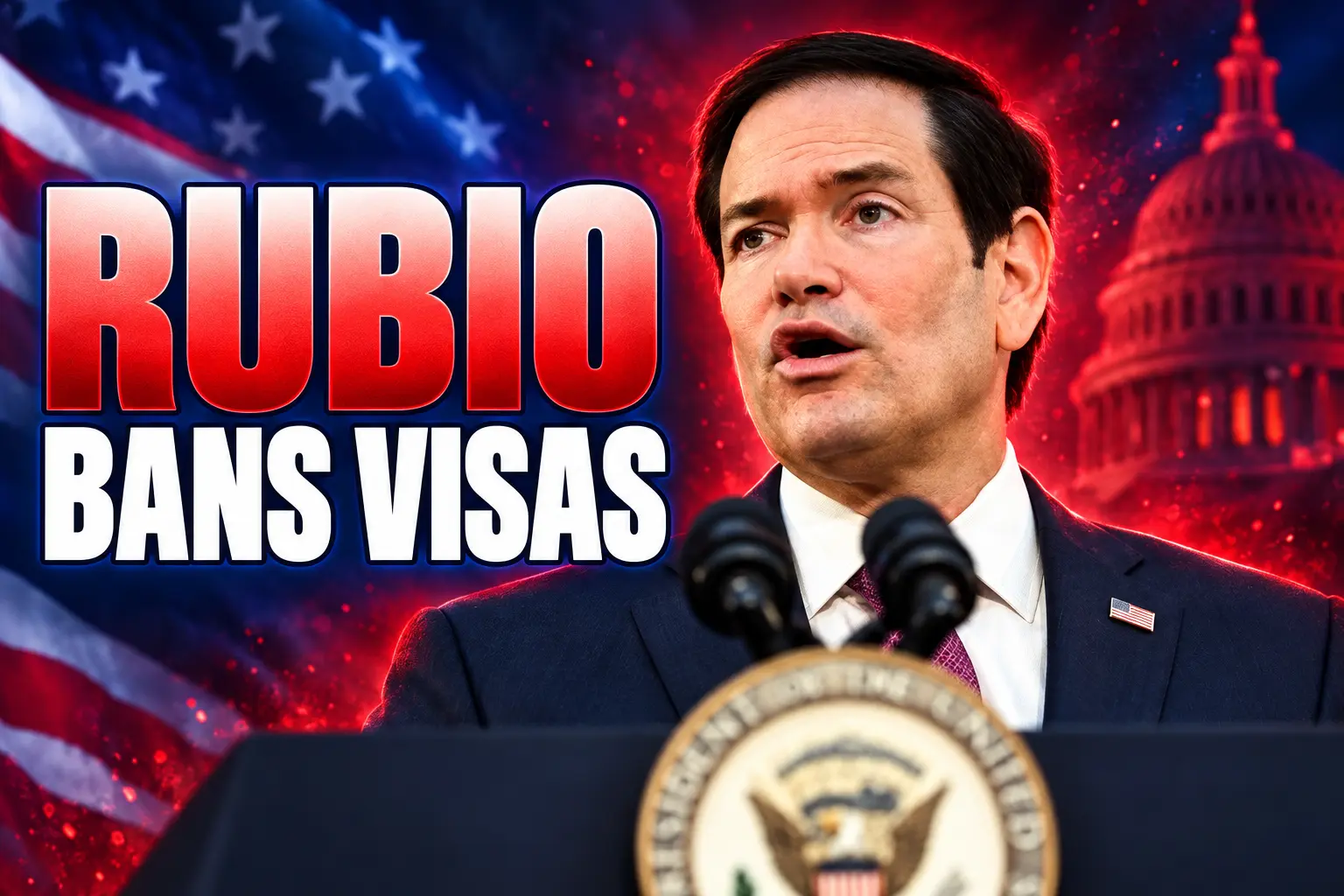
What the New Visa Restrictions Cover
The legal hook is a visa restriction policy under Section 212(a)(3)(C) of the Immigration and Nationality Act. That clause lets the secretary of state bar a foreign national whose entry “would have potentially serious adverse foreign policy consequences for the United States.”
It is not a blanket ban on South African passports. It is a classified lookout list aimed at people who wrote, voted, or must now carry out the contested policies, and at people Washington says incite imminent violence against minorities. Certain family members may also be covered. Rubio did not name a minister, a legislator, or a party leader.
WHAT WE KNOW
- The tool: Section 212(a)(3)(C) makes a person inadmissible on foreign-policy grounds, and the State Department says relatives can be swept in.
- The triggers: Uncompensated land seizures, race-based discrimination, and incitement of imminent violence against minority ethnic or racial groups in South Africa.
- The paper trail: The policy is written as a follow-on to Executive Order 14204, not as a new finding that farms have already been taken under the 2024 Act.
WHAT IS UNCONFIRMED
- The names: No public designation list was released with the September 15 statement.
- Pretoria’s reply: The South African embassy in Washington did not immediately respond that day.
- The court clock: The Act’s start date is still a presidential proclamation, and a live constitutional case is the stated reason it has not been issued.
A lookout list with no published names still changes behavior. Officials who need UN meetings, investor roadshows, or medical trips through the United States now have to guess whether they are already coded as complicit.
Four Cases Where Compensation Can Be Nil
The Expropriation Act 13 of 2024 is the statute Washington keeps describing as a seizure machine. President Cyril Ramaphosa assented to it on 20 December 2024. It was published in Government Gazette No. 51964 on 24 January 2025. Section 31 says it comes into operation on a date the president determines by proclamation.
On September 15, the same day as Rubio’s statement, the South African government page for the Act still showed commencement still listed as to be proclaimed. Until that proclamation, the Presidency told Parliament on 19 December 2025, the Expropriation Act 63 of 1975 “remains applicable.”
The 2024 Act does create a path to pay nothing. Compensation must be “just and equitable,” balancing public interest and the people affected, including market value and the history of how the land was acquired. Public interest is defined to include land reform that redresses past racial laws. Section 12(3) then says nil compensation “may be just and equitable” in listed cases.
WHERE NIL COMPENSATION CAN APPLY
- Idle speculation: Land that is not being used, where the owner’s main aim is market-value gain rather than development or income.
- Unused state land: Property an organ of state is not using for its core work, bought for no consideration, and not likely to be needed.
- Abandoned land: Land an owner has failed to control despite being reasonably able to do so, even if the title is still registered.
- State money already in it: Land whose market value is equal to or less than the present value of direct state investment or subsidy.
Those are narrow on the page, and they are still theoretical. The Democratic Alliance filed in the Western Cape High Court on 7 February 2025, the same day Trump signed his South Africa order, challenging sections of the Act. The Presidency’s December 2025 reply named that case as the reason no commencement date has been set. No seizure under the new law has been recorded because the new law is not in force.
The 2017 Audit’s 72 Percent Farm Figure
The political fuel for the statute is older than the gazette. The Department of Rural Development and Land Reform’s 2017 land audit of individually owned farms, using 2015 deeds data, found that White owners held 26,663,144 ha, or 72%, of farms and agricultural holdings owned by individuals. African owners held 1,314,873 ha, or 4%. Coloured owners held 5,371,383 ha (15%) and Indian owners 2,031,790 ha (5%).
INDIVIDUAL FARM OWNERSHIP IN THE 2017 AUDIT
| Owner group | Hectares | Share of individual farms |
|---|---|---|
| White | 26,663,144 | 72% |
| Coloured | 5,371,383 | 15% |
| Indian | 2,031,790 | 5% |
| African | 1,314,873 | 4% |
| Other | 1,271,562 | 3% |
| Co-owners | 425,537 | 1% |
That 72% figure is not 72% of South Africa. It is 72% of 37,078,289 ha of farms and holdings held by named individuals. The same White slice is 22% of the country’s 121,924,881 ha. Companies, trusts, and community bodies, which hold a large share of private land, were not racially coded because those entities have no race in the deeds record.
Statistics South Africa’s mid-year population estimates for 2025 put the White population at 4,497,485, or 7.1%, of 63,100,945 people. Black Africans were 51,604,376, or 81.8%. A 7.1% group holding 72% of individually titled farms is the disparity Pretoria cites when it talks about redress. It is also the disparity Washington now reads as race discrimination against Afrikaners.
Both readings can sit on the same table. The audit does not say who bought land after 1994, who inherited it, or how much sits in trusts controlled by the same families. It does say the racial split on individual farm title remains extreme more than two decades after apartheid’s end, which is why the ANC kept writing a new expropriation statute, and why commercial farmers kept funding a fight against nil compensation.
SAPS Counted 44 Rural-Community Murders
Rubio’s statement pairs the land law with “racially motivated crime” and rural insecurity. Farm attacks are real, and they are ugly. They are also counted in more than one ledger, and none of those ledgers is a genocide docket.
A police reply to Parliament listed 44 people murdered “during attacks on the rural community” in 2024/25, down from 55 the year before and 69 in 2020/21. Of those 44, 26 victims were African and 16 were White (13 men and 3 women). White victims were 36% of that rural-community tally, far above the 7.1% White share of the population, while African victims were 59% of the same list.
RURAL MURDERS IN THE POLICE RECORD
- 2024/25 count: SAPS recorded 44 rural-community murders, 16 of them White and 26 African.
- AfriForum 2025: The group logged 184 farm attacks and 29 farm murders in the 2025 calendar year, against 176 attacks and 37 murders in 2024.
- Violence share: AfriForum classed 36% of its 2025 attack file as serious violence with a substantial risk of death.
- The US word: Trump has called the situation a genocide; the police year-count of 44 rural-community murders does not carry that label.
AfriForum’s 2025 file shows attacks up by 8 and murders down by 8 compared with 2024. Jacques Broodryk, the group’s community-safety spokesman, has argued that the brutality of the attacks, including torture in a smaller studied set, is the part officials keep minimizing. SAPS, for its part, still folds farm killings into a rural-community total that includes Black victims, farm workers, and dwellers, which is why the two series should not be stacked as if they measured one thing.
Over-representation of White victims in a small rural tally can be true at the same time as a national “White genocide” claim is false. The visa policy collapses those into one foreign-policy finding: Pretoria has not done enough on rural crime or on rhetoric. Julius Malema’s Economic Freedom Fighters have long sung the apartheid-era chant “Kill the Boer,” which is the slogan US officials have in mind when they talk about dehumanizing chants. The September 15 notice still did not put Malema on a published ban list.
Aid Cuts and Afrikaner Flights Came First
The visa list is the third tool, not the first. Trump’s February 7, 2025 executive order on South Africa accused Pretoria of enacting the 2024 Act “to seize ethnic minority Afrikaners’ agricultural property without compensation,” ordered agencies to halt aid “to the maximum extent allowed by law,” and directed the secretaries of state and homeland security to prioritize Afrikaner refugee resettlement.
The order also dragged in a separate fight: South Africa’s case at the International Court of Justice accusing Israel, “not Hamas,” of genocide, plus closer ties with Iran. US assistance to South Africa had been about $440 million in 2023, much of it health money. The first Afrikaner refugee party of 54 people landed at Washington Dulles International Airport on 12 May 2025. The program was still being described in early September 2026 as a priority track, even as the wider US refugee system stayed tightly shut.
THE 19 MONTHS BEFORE THE VISA LIST
- 20 December 2024: Ramaphosa assents to the Expropriation Act 13 of 2024.
- 24 January 2025: The Act is gazetted; section 31 still requires a separate commencement proclamation.
- 7 February 2025: The DA files in the Western Cape High Court, and Trump signs Executive Order 14204 cutting aid and prioritizing Afrikaner refugees.
- 12 May 2025: 54 Afrikaner refugees arrive at Dulles on the first dedicated flight.
- 21 May 2025: Trump meets Ramaphosa in the Oval Office and presses the White farmer persecution claim.
- 19 December 2025: The Presidency tells Parliament the Act’s start date is held by the High Court case and that the 1975 Act still governs.
- 15 September 2026: Rubio announces the visa restrictions; the government Act page still reads “To be proclaimed.”
By the time the visa tool arrived, the aid tap was already closed and the refugee channel was already running. The unused statute had become a standing indictment. That is the oddity the wire copy keeps flattening into a simple “latest escalation” line. Washington did not wait for a farm to be taken under section 12(3). It treated the existence of section 12(3), plus farm murders and Malema’s chorus, as enough.
A Personal Penalty Leaves the Farm Map Unmoved
The people who feel a US visa first are not the 588,045 landowners on the farm register. They are ministers, directors-general, prosecutors, and party officials who fly. A complicity test written that way is meant to split the ANC’s overseas life from its domestic land rhetoric. It does not retitle a hectare in the Northern Cape, and it does not put a patrol in a Free State farm lane.
Land claimants who have waited through two expropriation statutes still wait under the 1975 Act. Commercial farmers still farm under that older law, with the 2024 nil-compensation clauses hanging over refinancing talks even while the courts keep the switch off. Farm workers, Black and White, still sit on the same isolated roads where AfriForum counted 184 attacks in 2025. The visa list does not enter those roads.
Ramaphosa has said there is no evidence of persecution of White people and has asked other governments to reject that story. Pretoria’s answer to the 72% individual-farm figure remains a reform statute it has not proclaimed. Washington’s answer to a statute it calls a seizure law is to keep Afrikaner refugee files moving and to close US ports to the officials who wrote the bill.
On the South African government page for Act 13 of 2024, under commencement, the line is unchanged: to be proclaimed. The farms in the 2017 audit are still held by the owners on that register. The officials who drafted the replacement statute now have to ask whether a US consular computer already has their names.

Kelly Restored 78 White House Passes, Not the Plane

Delta Adds Venice and Athens Routes as Cities Tighten Access

Build a Rocket Boy Enters Administration After the MindsEye Collapse

King Signs a Candy Crush Union Deal Delayed to 2027

Rubio Restricts South Africa Visas Over an Unused Land Law

Rune Bets on Hillerød for His Achilles Comeback

Permafrost Thaw Runs Fastest in Mountains, Not Arctic Soils

The Last Manual V-12 Lamborghini Cannot Come to America

The Roman Space Telescope Flies After Four Budget Fights

Software Stocks Rally as Underweight Funds Face Dreamforce
-
 NEWS2 months ago
Rune Bets on Hillerød for His Achilles Comeback
-
 NEWS1 month ago
Permafrost Thaw Runs Fastest in Mountains, Not Arctic Soils
-
 AUTO1 month ago
The Last Manual V-12 Lamborghini Cannot Come to America
-
 NEWS1 month ago
The Roman Space Telescope Flies After Four Budget Fights
-
 BUSINESS1 month ago
Software Stocks Rally as Underweight Funds Face Dreamforce
-

 NEWS1 month ago
Dallas Judge Blocks the SEC Ban, Coaches Still Face Fines
-

 BUSINESS1 month ago
Influencer Investors Trade Cash Fees for Illiquid Equity
-

 BUSINESS2 months ago
Rubicon Research Q1 Tests Its Specialty Pharma Bet