
BUSINESS
Software Stocks Rally as Underweight Funds Face Dreamforce
Salesforce seats grew and software stocks ripped, but the bid is coming from funds that used SaaS as a chip hedge and now face Dreamforce.

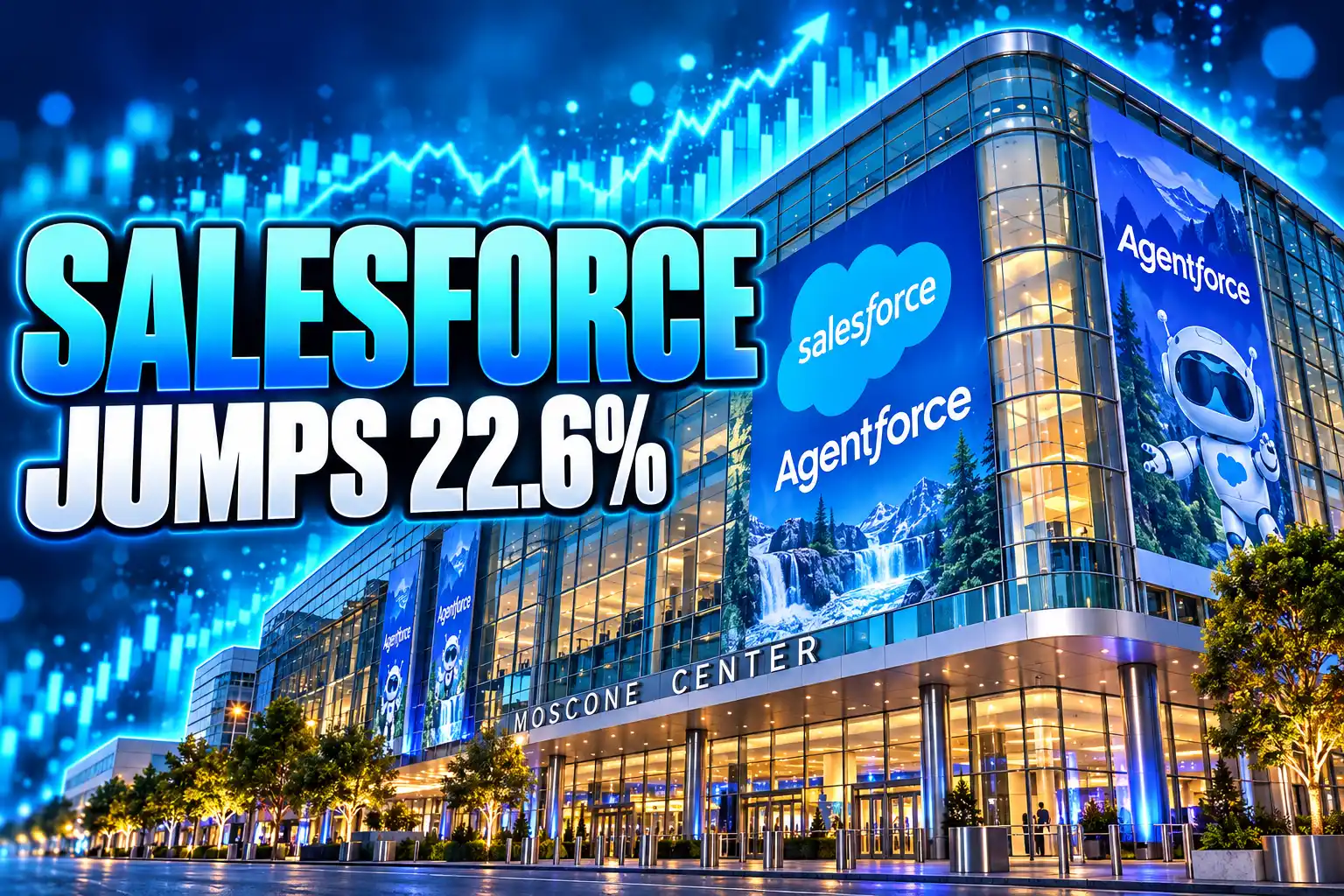
Salesforce stock jumped 22.6% last Thursday after current remaining performance obligations rose 14% and Agentforce annual recurring revenue topped $1.5 billion. Seats in sales, service and Slack grew. By Monday the iShares Expanded Tech-Software Sector ETF had a year-to-date NAV return of 4.19%.
For a year the tape treated AI as a headcount cut that would shrink subscriptions. The companies that already hold the customer file just started billing for the agents that were supposed to replace them.
A 14% Backlog Beat and a $1.5 Billion Agent Line
Salesforce reported fiscal second-quarter results on August 26 for the period ended July 31. Revenue was $11.3 billion, up 11% year over year, including $456 million from Informatica. Subscription and support was $10.8 billion, up 12%, or 11% in constant currency.
SALESFORCE Q2 FY27
- Backlog: Current remaining performance obligations reached $33.5 billion, up 14% year over year and in constant currency, while total remaining performance obligations were $66.3 billion, up 11%.
- Agent line: Agentforce annual recurring revenue exceeded $1.5 billion, up over 240%, and Agentforce plus Data 360 ARR reached nearly $3.9 billion, up over 210%.
- Usage: Customers ran 3.2 billion agentic work units in the quarter, up 97% from the prior quarter, bringing the all-time total to 7.0 billion.
- Cash: Free cash flow was $1.1 billion, up 81%, and the company returned $364 million in dividends while a $25 billion accelerated repurchase still runs.
Robin Washington, president and chief financial and operating officer, said net new annual order value growth was the strongest in four years and that the firm remains on track for second-half organic revenue reacceleration. The company raised full-year revenue guidance to $46.1 billion to $46.4 billion.
That raise is $200 million as reported and $300 million in constant currency. Salesforce split it as $100 million of organic growth, $200 million from pending Contentful and Fin deals, and a $100 million foreign-exchange headwind. Informatica is already inside the year, contributing slightly more than three points of growth. The agent story is real. It is not the whole print.
Customers Paid for Agents, Then Bought More Seats
The fear that ruled software stocks was simple. If staff got more done with AI, companies would buy fewer seats. If coding got cheaper, they would skip packaged apps. Marc Benioff, Salesforce chair and chief executive, answered that on the call in one stroke.
Our seats were supposed to decline. Instead, Agentforce sales, service and Slack all saw year-over-year growth.
Marc Benioff, Chair and CEO, Salesforce earnings call
Slackbot users rose over 150% quarter over quarter, and Slack posted its fastest quarterly net new annual order value growth since the acquisition. Bookings from Agentforce 1 Edition and Agentforce for Apps, the premium bundles that fold agentic features into sales and service, more than doubled quarter over quarter. Data 360 ingested 104 trillion records, up 355%, including 82 trillion through Zero Copy. Attrition sat near its lowest level on record.
Benioff also said nine of the 10 leading AI companies now run on Salesforce and Slack, and that their combined spend is up 435% year over year. Model-context-protocol calls rose sixfold. The labs that were supposed to make CRM optional are paying more for it. Vibe coding still produces a demo. It has not produced a system of record with permissions, objects and an audit trail.
Effective this quarter, Agentforce ARR also includes Slackbot and Headless 360, so the 240% rate sits on a wider perimeter than a year ago. That footnote does not erase the mix. Agents are attaching to the existing graph, not opening a parallel stack that starves the suite.
#1 Q2 in Salesforce history.
$11.3B Revenue. +11%
$33.5B cRPO growth. +14%
$5.90 Non-GAAP EPS. +103%
$15.2B TTM Free Cash Flow.
$3.9B Agentforce + Data 360 ARR.
7.0B AWUs delivered all-time.
Raising FY27 guidance to $46.1–$46.4B. 3.2B AWUs in Q2 (+97% q/q) 6x growth in MCP… pic.twitter.com/sTpQMpQm7q— Marc Benioff (@Benioff) September 1, 2026
Workday, ServiceNow and CrowdStrike Printed the Same Inversion
Salesforce was the loudest tape, not the only one. Workday, ServiceNow and CrowdStrike each showed AI adding contract value on top of the core subscription, in different units and on slightly different calendars.
FOUR PRINTS, ONE MIX SHIFT
| Company | Quarter revenue | Growth | AI or platform metric | What the core did |
|---|---|---|---|---|
| Salesforce | $11.3 billion | +11% | Agentforce ARR above $1.5 billion | Seats grew in sales, service and Slack |
| Workday | $2.649 billion | +12.8% | AI ARR near $600 million | AI was more than 25% of new ACV |
| ServiceNow | $3.987 billion | +24% | AI ACV above $1 billion | Agentic deployments up 9 times in 9 months |
| CrowdStrike | $1.47 billion | +26% | Falcon Flex ARR $2.29 billion | Record $332.8 million net new ARR |
Workday’s quarter also ended July 31. Subscription revenue was $2.471 billion, up 13.9%. AI products produced more than $100 million of new annual contract value, more than a quarter of all new ACV closed. AI annual recurring revenue approached $600 million, up more than 200% year over year and more than 20% from the prior quarter. More than 5,500 customers now use at least one organic Workday agent, up over 35% quarter over quarter. Twelve-month subscription backlog was $9.03 billion, up 14.2%. Shares rose 5.8% on Friday. Aneel Bhusri, co-founder and chief executive, said AI is already showing up in win rates, not only in a side metric.
ServiceNow reported earlier, for the quarter ended June 30. Subscription revenue was $3.877 billion, up 24.5%, or 23% in constant currency. Current remaining performance obligations were $13.20 billion, up 21%. In that 8-K, ServiceNow AI crossed $1 billion in annual contract value. The company counted 123 transactions over $1 million of net new ACV, up nearly 40%, and 658 customers above $5 million of ACV. Agentic deployments rose ninefold over nine months. That print is a month older than Salesforce’s, and the stock still caught last week’s bid.
CrowdStrike’s quarter ended July 31. Total revenue was $1.47 billion, up 26% from $1.17 billion a year earlier, and subscription revenue was $1.40 billion, up 27%. Annual recurring revenue reached $5.84 billion, up 25%. Net new ARR was $332.8 million, up 51%. Falcon Flex accounts, the bundle that lets customers add modules without a new contract fight, reached $2.29 billion of ending ARR, up 101%. George Kurtz, founder and chief executive, called it the best quarter in CrowdStrike history in the filing, and said enterprises now treat AI adoption as a security problem CrowdStrike gets paid to solve. The company lifted its full-year net new ARR growth outlook by 630 basis points, to 34% at the midpoint.
How Agentforce Charges When a Seat Would Have Been Cut
The old software bill was a headcount tax. The new one can rise after the headcount falls, because the agent is a separate meter. Salesforce already sells Agentforce on Flex Credits, on conversations, and on user licenses. Help Agent billing is written as outcome-based: the company charges when a session qualifies as resolved, and that resolution consumes 400 Flex Credits.
THREE WAYS THE METER RUNS
- Per action: A standard Agentforce action draws 20 Flex Credits. Credits sell at $500 per 100,000, so one action is $0.10.
- Per resolution: A qualifying Help Agent resolution draws 400 Flex Credits, or $2.00, and abandoned or escalated sessions do not bill.
- Per bundle: Agentforce 1 Edition and Agentforce for Apps fold agentic features into sales and service seats, which is how bookings more than doubled without a collapse in the seat line.
CIOs who ask whether the CRM invoice shrinks next quarter are asking the wrong question. An agent that closes cases or writes the first draft of an email can reduce human tickets and still add a consumption line on the same account. Workday is already moving part of the sales motion toward consumption. ServiceNow has said customers pay for resolutions, not tokens. The displacement thesis assumed the unit of value was the seat. These firms are selling the work the seat used to do, then keeping the seat.
Thin Software Still Has a Vibe-Coding Problem
None of last week’s prints save every name in a 106-holding software fund. Horizontal systems of record (the customer file, the employee file, the ticket graph, the threat graph) look complementary to agents because the agent needs somewhere to land. Vertical tools that are mostly a workflow on top of someone else’s data still look easy to rebuild, especially if the buyer already pays a frontier lab.
Salesforce itself flagged ongoing weakness in Marketing and Commerce and softer Tableau bookings in the prior quarter’s guide, a reminder that not every cloud inside the same company caught the agent bid. Nicholas Frasse, a thematic ETF product manager at VanEck, has argued that entrenched firms with a proprietary data set are the likely beneficiaries, and that the tape is finally treating names differently instead of buying or dumping the whole category. That split is the live risk inside a green ETF.
Application software is 52.73% of the iShares fund and systems software 43.41% as of August 31. A fund that just flipped positive can still house issuers whose product is a thin wrapper. Last week’s winners own the objects the agents query. The rest of the sleeve has not proved that.
The Rally Still Looks Like a Cover Trade
Software had already bounced in prior months when chip stocks sold off and money rotated. Jordan Klein, a desk-based analyst at Mizuho, wrote last Friday that this move still has more to do with positioning than with a fresh fundamental regime. Hedge funds and long-only growth books had run software underweight versus the sector’s weight in the market, using it as a funding short for larger bets on semiconductors and AI hardware.
On that underweight, Klein said software could keep climbing through September and October. He expects Salesforce to work into its conference, and he also said he would not chase the stock here, preferring ServiceNow and Microsoft. Michael Monaghan, a partner and portfolio manager at Founder ETFs, had the other book: even in March he thought these companies would print a strong back half, and he called the Salesforce report an early validation that vibe-coding away packaged software was not a working thesis.
WHERE THE TAPE DISAGREES
- Positioning first: Klein treats the bid as an underweight cover that can run into autumn, then stall once books look normal, which is why he will not chase Salesforce after a 22.6% day.
- Fundamentals first: Monaghan treats the same print as proof the March scare was early, because seats grew and premium bundles sold.
- Name by name: Frasse’s version is that the category trade is over and only data-rich models deserve the rerating.
Tuesday offered a small version of Klein’s caution. The ETF closed at $106.18, down 3.46% from Monday’s $109.98, after a week in which it had finally pushed the year into the black. Net assets were $15.74 billion as of August 31. A fund that traded as low as $73.93 on April 10 can rally hard and still give a day back when the cover is the buyer.
Moscone Week Is the First Real Audience for Agentforce
Salesforce will take the agent pitch to Dreamforce, September 15 to 17, at Moscone Center in San Francisco. Investor Day is Wednesday, September 16, at 1:00 p.m. Pacific. Third-quarter revenue guidance is $11.42 billion to $11.50 billion, and current remaining performance obligation growth is guided at about 14%, excluding Contentful and Fin. Those deals are written into most of the year only if they close in the fiscal third quarter. The $25 billion accelerated repurchase is due to settle in October, the same month Klein’s window runs to.
FROM THE APRIL LOW TO MOSCONE
- April 10, 2026: The software ETF prints a year-to-date low at $73.93 while the seat-cut thesis still dominates.
- July 22, 2026: ServiceNow reports, with AI annual contract value above $1 billion and agentic deployments up ninefold in nine months.
- August 26, 2026: Salesforce and CrowdStrike report after the close; Agentforce ARR is above $1.5 billion and CrowdStrike books record net new ARR.
- August 27-28, 2026: Salesforce shares rise 22.6%, Workday reports and rises 5.8%, and the software ETF finishes the week in positive year-to-date territory.
- September 1, 2026: The ETF drops 3.46% in one session, a reminder that a cover bid can reverse without a new fundamental fact.
- September 15-17, 2026: Dreamforce and Investor Day put live bookings, agent deployments and the Contentful and Fin closes in front of the same buyers who just chased the print.
- October 2026: The accelerated repurchase settles, and the positioning window Klein described either extends or looks finished.
A conference cannot replay a 14% backlog print. It can show whether Agentforce remaining performance obligations keep compounding off a larger base, or whether the easy pilots were the quarter. If the labs in the front row are still expanding Salesforce and Slack spend, the inversion holds. If the audience treats agents as a demo hall, Tuesday’s tape is the preview.
The companies that were supposed to lose seats are now selling the labor those seats used to perform, and they still sold the seats. That is the quarter. October will show whether the buyers of the stock believe it, or whether they were only covering a short they used to fund chips.
Disclaimer: This article is news reporting and analysis for information only. It is not investment advice, a recommendation to buy or sell any stock, ETF or other security, and it is not a forecast of future prices or returns. Readers should consult a licensed financial adviser or broker who can review their own holdings, time horizon and risk before acting on any name mentioned here, including Salesforce, Workday, ServiceNow, CrowdStrike, Microsoft or the iShares Expanded Tech-Software Sector ETF. Figures, guidance, conference dates and market prices reflect the company filings, fund data and trading sessions cited as of September 2, 2026, and those items can change with the next print, filing or session.

Bass Persuades Takes the Record Drop After a No. 1 Debut

DIGITALEUROPE Says Europe Must Buy From Its Scaleups

Refugees Lose Medicaid While Green Cards Sit in Line

Ring Smart Lock Puts Your Door on Amazon Sidewalk

Sicario 3 Moves Ahead Without Taylor Sheridan Writing

Influencer Investors Trade Cash Fees for Illiquid Equity

The Roman Space Telescope Flies After Four Budget Fights

The Last Manual V-12 Lamborghini Cannot Come to America

Rune Bets on Hillerød for His Achilles Comeback

Rubicon Research Q1 Tests Its Specialty Pharma Bet
-
 BUSINESS2 months ago
Influencer Investors Trade Cash Fees for Illiquid Equity
-
 NEWS2 months ago
The Roman Space Telescope Flies After Four Budget Fights
-
 AUTO2 months ago
The Last Manual V-12 Lamborghini Cannot Come to America
-
 NEWS2 months ago
Rune Bets on Hillerød for His Achilles Comeback
-
 BUSINESS2 months ago
Rubicon Research Q1 Tests Its Specialty Pharma Bet
-

 NEWS2 months ago
Hamilton’s Ferrari Upgrade Pushes Mercedes Into a Monza Bind
-
 BUSINESS2 months ago
JBS’s Pilgrim’s Pride Bid Still Needs the 18 Percent
-

 NEWS2 months ago
Murphy Defends a British Open Title Nobody Keeps