
LIFESTYLE
The Intercon Hand Soap Recall Hit Workplaces First
FDA ranked Intercon’s six hand soaps Class II on Sept. 11. Most of the 2,696 cases went to wholesalers, not grocery aisles, and pumps may not say Intercon.

The FDA on Sept. 11 classified a recall of 2,696 cases of Intercon Chemical Co. hand soap as Class II after tests flagged bacteria. The St. Louis maker had started the pull on June 29. Four of the six soaps shipped in bulk sizes, and 19 of 20 consignees were wholesalers, not grocery stores.
The household alert is real for one Ingles house brand. The larger pile sits with unnamed distributors who stock sinks in shops, kitchens and clinics, where a pump often carries no maker’s name at all.
Nineteen Wholesalers and One Grocery Chain
Intercon Chemical, founded in 1982 by Jim Epstein, makes cleaning chemicals at a 300,000-square-foot EPA- and FDA-registered plant at 1100 Central Industrial Drive in St. Louis. It does not run a store aisle. The company says it sells through authorized janitorial and foodservice distributors, plus foodservice equipment houses and independent chemical service firms across North America.
That channel matches the recall math. The FDA’s enforcement report on the six soaps lists 20 consignees in 15 states: 19 wholesale accounts and one retailer. The retailer is Ingles Markets of Asheville, North Carolina, which received the Laura Lynn bottles. The other 19 names were not published, so a school, kitchen or clinic that bought through a jobber has no public list to check against.
Intercon’s own “who we serve” line is broader than a bathroom cabinet. The firm says it supplies distributors and OEM customers in cleaning, sanitary maintenance, industrial work, food service, laundry, warewashing, and the medical and healthcare industries it names, along with food plants, bottling, pharmaceutical and cosmetic sites. A foaming pear soap on that roster is as likely to sit in a dispenser as under a residential sink.
WHO INTERCON SAYS IT SUPPLIES
- Janitorial buyers: Sanitary maintenance and restroom care sold through authorized distributors, not a national drugstore chain.
- Food service: Warewashing, kitchen sanitation and no-rinse sanitizers sit in the same catalog as hand care.
- Medical accounts: The company lists medical and healthcare among the industries its distributors and OEM customers serve.
- Private labels: Intercon formulates and packs other companies’ brands, which is how Summit, Vestis, Clearly Better and Laura Lynn share this recall.
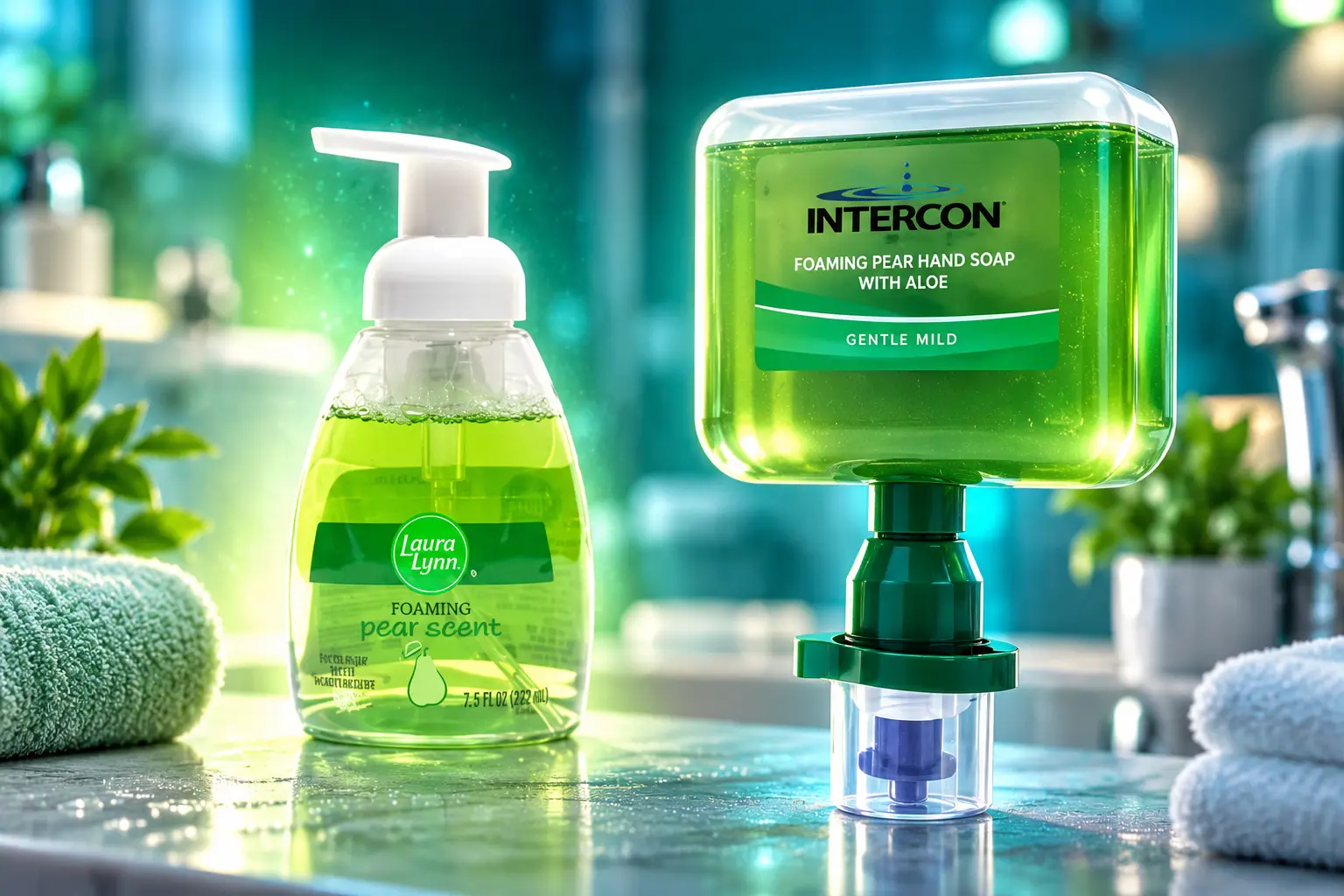
Of the 2,696 cases, 2,101 carried Intercon, Clearly Better, Summit 150 or Vestis labels. The two Laura Lynn SKUs account for 595 cases. A shopper checking a grocery receipt is hunting the smaller share.
2,696 Cases and the Lot Codes to Match
Only two products, both pear-scented Intercon foaming soaps, are listed with named organisms. The other four were pulled for potential bacterial contamination without a public strain list. Match the UPC, then the lot. A matching size with a different code is outside this action.
THE SIX RECALLED SOAPS
| Product | Size / UPC | Lot codes | Best-by | Cases | Named bacteria |
|---|---|---|---|---|---|
| Intercon Foaming Pear Hand Soap With Aloe | 28.7 fl oz / 789745002981 | AF97312, 26-01001, 26-01803 | 01/12/2028, 03/13/2028, 03/28 | 693 | Yes, five strains |
| Clearly Better by Intercon Foaming Pear Hand Soap With Aloe | 1000 mL (34 fl oz) / 789745002615 | 26-01001, 26-01803 | 03/13/28, 03/28 | 143 | Yes, five strains |
| Summit 150 Foaming Hand Soap | 28.7 fl oz / 810080570030 | BF97303, BF97304, BF97305 | 02/03/2028, 02/04/2028, 02/05/2028 | 1,040 | Not named |
| Vestis Foaming Hand Soap, Fresh Pear Scent | 33.8 fl oz / 810080570405 | 26-03091 | 05/28 | 225 | Not named |
| Laura Lynn Honey Apple Crisp Liquid Hand Soap | 8 fl oz / 086854074305 | C3576, 26-01804 | 11/05/26, 03/28 | 301 | Not named |
| Laura Lynn Foaming Pear Scent Hand Soap with Moisturizers | 7.5 fl oz / 08685407408 | 26-01001 | 03/13/28 | 294 | Not named |
Summit 150 is the single largest line, 1,040 cases packed for R.I. Williams Company of Conover, North Carolina. Vestis, listed at an Alpharetta Street address in Roswell, Georgia, took 225 cases of 33.8-ounce Fresh Pear. Clearly Better’s 1000 mL bottle is a dispenser fill, not a travel pump. Those three SKUs alone explain why a wall unit in a break room can hold recalled soap after the cardboard case is gone.
The five organisms named on the two Intercon pear soaps are Pseudomonas aeruginosa, Pseudomonas putida, Pseudomonas monteilii, Serratia marcescens and Serratia nematodiphila. The 15 states on the distribution list are California, Georgia, Illinois, Iowa, Maryland, Mississippi, Nebraska, New York, North Carolina, North Dakota, Pennsylvania, South Carolina, Texas, Washington and Wisconsin. Cities and store names were not released.
The FDA Ranked the Hazard in September
Intercon started the voluntary recall on June 29. The agency assigned Class II on Sept. 11, 74 days later. In that window the product still carried best-by dates that run into 2028, which is long enough for a case to move from a warehouse into a dispenser and stay there.
HOW THE RECALL MOVED
- June 29, 2026: Intercon Chemical Co. begins a voluntary recall of six liquid and foaming hand soaps over possible bacterial contamination.
- Sept. 11, 2026: FDA classifies the action as Class II, the middle of its three hazard ranks, on enforcement Event 99466.
- Sept. 16, 2026: The classified report reaches a wide consumer audience, months after the company pull and with best-by dates still printed into 2028.
A Class II under FDA recall rules is a situation in which use of or exposure to a violative product may cause temporary or medically reversible adverse health consequences, or where the probability of serious adverse health consequences is remote. That is not a Class I finding, which the same page defines as a reasonable probability of serious harm or death. It is also not a clean bill. The rank arrived after summer, and the bottles were not short-dated leftovers.
Facility staff who swapped a refill in July had no Class II flag to work from. The public list of lots and UPCs is what they have now, and it still has to be walked to each sink.
Hospital Water, Catheters, and Open Wounds
The two pear soaps are flagged for organisms that live in water and on wet surfaces. CDC material on P. aeruginosa puts the heavy burden in healthcare, not in a typical home with intact skin. The same page is blunt about who gets hurt when the germ does take hold.
P. aeruginosa can cause infections in the blood, lungs (pneumonia), urinary tract, or other parts of the body after surgery.
Centers for Disease Control and Prevention, About Pseudomonas aeruginosa
CDC says those infections typically occur in healthcare settings and that patients on ventilators and catheters, and people with open surgical wounds or burns, sit at the top of the risk list. Some strains resist nearly all antibiotics. In 2017, multidrug-resistant P. aeruginosa caused an estimated 32,600 infections among hospitalized patients and 2,700 deaths in the United States, according to that CDC page.
If contaminated soap is used, bacteria can enter through cuts, scrapes or cracked skin. S. marcescens is grouped with the same opportunistic pattern: pneumonia, urinary tract infections and, in vulnerable patients, bloodstream infection. Intercon’s catalog already lists medical and healthcare among the trades it serves, so the organism and the customer list occupy the same buildings.
A Class II label still treats serious outcomes as remote. That ranking does not change who should treat a leftover bottle as trash rather than inventory, especially beside a wound, a catheter or a food line.
Private-Label Pumps Hide Intercon’s Name
Intercon’s FAQ states that the company does private branding. This recall is that model in practice. Summit 150 was manufactured for R.I. Williams. Vestis distributed the Fresh Pear foam. Ingles received Laura Lynn. Clearly Better is an Intercon sub-brand on a 1000 mL fill. A maintenance worker looking for the word “Intercon” on a wall pump will miss five of the six labels.
Lot 26-01001 also repeats across Intercon Foaming Pear, Clearly Better and Laura Lynn Foaming Pear, a reminder that these SKUs share a production stream even when the front label changes. Searching a storeroom by brand name is the wrong filter. The UPC and lot line on the bottle or the bag-in-box are the match.
Because 19 consignees were not named, the people who can actually finish the recall are distributor reps, janitorial supervisors and kitchen managers. They have the packing slips. Shoppers at Ingles can check two Laura Lynn sizes. Everyone else in those 15 states is guessing unless the bottle is still in the case with the code visible.
Check the Pump Before the 2028 Date
Best-by dates on the six soaps run from Nov. 5, 2026, on one Laura Lynn Honey Apple lot through May 2028 on the Vestis Fresh Pear line. A bottle that survived the June pull can still look like current stock. Stop using a matching UPC and lot, throw it out, and ask the place of purchase about a refund. The FDA’s classified report did not publish a consumer hotline; the purchase record is the path for money back.
WHAT TO DO WITH A MATCHING BOTTLE
- Match the code: Confirm UPC and lot before you dump a whole brand. Same name, different lot, is outside this list.
- Empty the pump: Bulk sizes (28.7, 33.8 and 34 fl oz, plus 1000 mL) are dispenser fills. The wall unit can hold recalled soap after the case is gone.
- Discard, then call: Stop use, throw the product away, and contact the seller or distributor about a refund.
- Watch the skin: If you used a matching lot and develop signs of infection, especially with a weak immune system, a wound or a medical device, contact a clinician.
- Log the workplace: Supervisors in the 15 states should pull packing slips for Intercon, Clearly Better, Summit 150, Vestis and Laura Lynn from late spring onward.
The classified report still does not name the 19 wholesale accounts, and it still does not say how many bottles were filled from those 2,696 cases. What it does say is enough to end the guess at the sink: six labels, posted lots, a middle-tier hazard rank, and a maker whose soaps were built for distributors who stock other people’s bathrooms. The dates on the back run to 2028. The pumps that never saw a grocery circular are the ones left to clear.
Frequently Asked Questions
What Does a Class II Soap Recall Mean Compared With Class I?
Class I, on the same FDA definitions page, is a reasonable probability that use or exposure will cause serious adverse health consequences or death. Class II, the rank assigned here on Sept. 11, means temporary or medically reversible harm is possible and the chance of serious harm is remote. This soap action is the middle tier, not the death-risk tier, and it is still a reason to stop using a matching lot.
Should Workplaces Check Wall-Mounted Soap Pumps?
Yes. Clearly Better shipped as 1000 mL (34 fl oz), Vestis as 33.8 fl oz, and Intercon and Summit 150 as 28.7 fl oz, which are bulk fills for dispensers rather than purse-size bottles. A wall pump can hold recalled product after the cardboard case has been thrown out, and those four labels account for 2,101 of the 2,696 cases.
Why Do Four Products Lack Named Bacteria?
The enforcement report names P. aeruginosa, P. putida, P. monteilii, S. marcescens and S. nematodiphila only on Intercon Foaming Pear and Clearly Better Foaming Pear. Summit 150, Vestis Fresh Pear and both Laura Lynn SKUs are listed for potential bacterial contamination with no public strain list, and they were still pulled in the same six-product action.
Who Is the Only Retailer Named in the Recall?
Ingles Markets, Inc., of Asheville, North Carolina, is the one retail consignee, and it received the two Laura Lynn soaps (8 fl oz Honey Apple Crisp and 7.5 fl oz Foaming Pear). The other 19 consignees are wholesale accounts whose names were not published, which is why a packing slip, not a store directory, is the workplace search tool.
Disclaimer: This article is news reporting on an FDA-classified product recall and is for information only. It is not medical advice, a diagnosis, or a substitute for care from a licensed clinician, and it is not legal advice about refunds or liability. Anyone who used a matching lot and has symptoms, a wound, a medical device or a weakened immune system should contact a physician or other qualified health professional before deciding what to do next. Lot lists, case counts and recall ranks reflect the FDA enforcement report and company materials as published around the Sept. 11, 2026, classification and may change if the firm or the agency updates the action.

Chinese Design Booms While Luxury Spending in China Falls

Abbott Spins Off Nutrition After Formula Legal Bills

French Law and Two Unions Hold Arkane Lyon’s Clock

FSSAI Brings a 1992 Formula Ban Onto Instagram Reels

Capcom ID Leak Hands Attackers a Ready Phishing Kit

The Last Manual V-12 Lamborghini Cannot Come to America

Permafrost Thaw Runs Fastest in Mountains, Not Arctic Soils

Rune Bets on Hillerød for His Achilles Comeback

The Roman Space Telescope Flies After Four Budget Fights

Software Stocks Rally as Underweight Funds Face Dreamforce
-
 AUTO2 months ago
The Last Manual V-12 Lamborghini Cannot Come to America
-
 NEWS2 months ago
Permafrost Thaw Runs Fastest in Mountains, Not Arctic Soils
-
 NEWS2 months ago
Rune Bets on Hillerød for His Achilles Comeback
-
 NEWS2 months ago
The Roman Space Telescope Flies After Four Budget Fights
-

 NEWS2 months ago
Murphy Defends a British Open Title Nobody Keeps
-
 BUSINESS2 months ago
JBS’s Pilgrim’s Pride Bid Still Needs the 18 Percent
-
 BUSINESS2 months ago
Software Stocks Rally as Underweight Funds Face Dreamforce
-

 BUSINESS2 months ago
Influencer Investors Trade Cash Fees for Illiquid Equity