
NEWS
Yandex Pay Stays Frozen After Three Data Center Strikes
Ukrainian drones hit three Yandex data centers in four days, freezing Pay and pushing 64,000 cloud clients toward rival sites with no restore date.

Ukrainian drones hit three Yandex data centers in four days, freezing Yandex Pay and leaving the public cloud in limited mode.
Two sites, in Sasovo and Vladimir, were halted outright. Several modules at Kaluga were knocked out. Dima Pirogov, head of Yandex fintech, said the money is safe and that he still cannot name a restore date.
Sasovo, Kaluga and Vladimir Went Dark in Four Days
The first strike landed overnight on October 7-8 at Sasovo in the Ryazan region, a hall opened in 2014 that holds tens of thousands of servers. A fire followed. Yandex shut the site completely and later called its data centers the iron heart of the company.
Kaluga was hit on the morning of October 9. Yandex said several modules were completely disabled. Governor Vladislav Shapsha said 26 drones were shot down over the region and that others still got through, injuring nine people. Yandex said no staff were hurt at Sasovo or Kaluga. Ukrainian drone maker Fire Point said its FP-1 one-way drones flew the Kaluga raid and later needled the company with a line aimed at Pirogov: “Dima, have you tried turning it off and on again?”
Vladimir was next, in the early hours of October 11. Yandex said the site’s operation was fully stopped. Governor Aleksandr Avdeev said the raid wrecked two substations serving 5,000 residents and that power was back to 80% within an hour. That grid repair is not the same as bringing the servers up.
THE THREE SITES
| Site | Date | Cloud zone | Company status |
|---|---|---|---|
| Sasovo, Ryazan region | October 8 | ru-central1-b | Fully halted after fire |
| Kaluga, Grabtsevo | October 9 | No zone taken down | Several modules disabled |
| Vladimir | October 11 | ru-central1-a | Fully halted |
Yandex has six major Russian data centers. Three others, in Ivanteyevka, Mytishchi and a second Vladimir-region location, were still standing on October 12. Kaluga is a 63 MW campus southwest of Moscow, sold with the rest of the Russian group in 2024.
Netblocks, which watches network reachability, put Yandex Cloud at 30% of normal on October 11.
⚠️ Confirmed: Metrics show a second collapse in the networks of Russian tech giant Yandex after a new Ukrainian drone attack on data centers in Vladimir this morning. The campaign comes not long after Russia's threat to give Ukraine a "digital detox." pic.twitter.com/jOVL5BjYNR
— NetBlocks (@netblocks) October 11, 2026
Cloudflare Radar, which counts automated requests from Yandex’s own network, showed that traffic at 0.4% of its two-week high after the third hit, after a first drop to about 57% on October 8. Those crawler numbers are not a map of human users, and they are not a connectivity score.
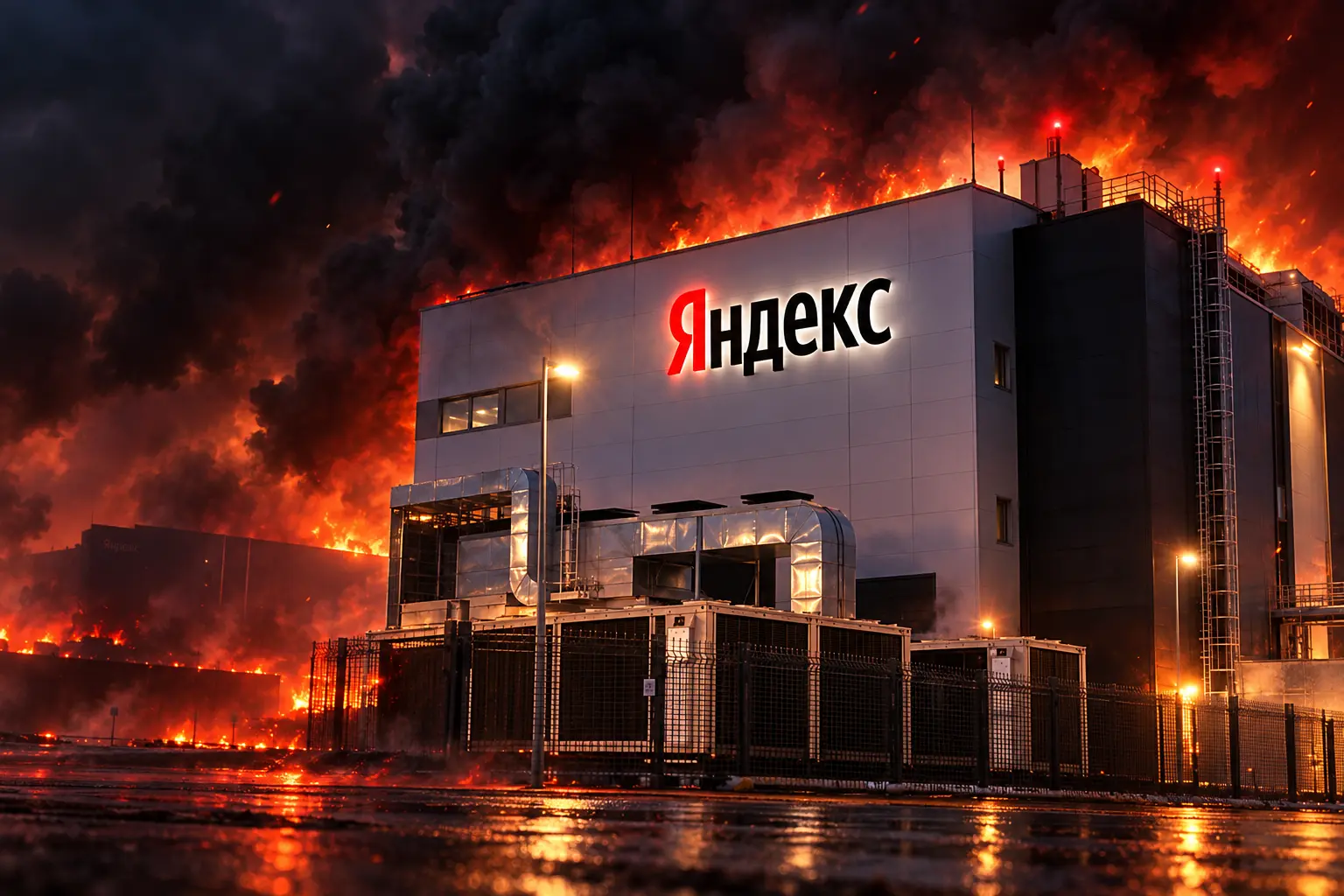
Yandex Pay Users Are Still Waiting on Their Money
Yandex Pay is the wallet inside shopping, stores, installments and split bills, in the same job as Apple Pay or Google Pay. After Vladimir went dark, people said they could not see balances, pay, or send money. Taxi drivers and couriers said they could not cash out fares.
Pirogov wrote on Telegram on October 11 that users’ money is not stored there, only the servers that run the product, and that no booking was lost. He still would not give a clock.
I understand that you’re not waiting for words, but for access to your money. And I understand how hard it is to wait when you can’t use it. We can’t give you a precise timeline for the restoration yet, but we promise: we won’t stop until the service is back online.
Dima Pirogov, head of Yandex fintech, Telegram
One user put the bind in a single line: “All my money’s on Yandex, so I have no money for food.” On October 11 the company said Alice, Search, Maps, Mail and Taxi were coming back, with features still missing. It throttled Yandex Disk downloads so the busier apps could keep running. Yandex Pro told taxi drivers to switch to Google Maps or Waze when its own navigation failed.
That last instruction is the second-order cost. A company built as Russia’s domestic answer to Google had to send its own drivers onto Google’s maps because the buildings behind the app were on fire.
Yandex Told 64,000 Cloud Clients to Use Other Sites
Yandex Cloud is the public platform under a large share of Russian banking, shops and software. Company figures list 64,000 clients in the first half of 2026, up 36% from a year earlier. Revenue in that half was 16.7 billion roubles, up 30%. Grigory Atrepyev, the cloud chief, has been the name on those reports.
Those 64,000 are not the 51,000 counted at the end of 2025. The older figure is a year-end headcount. The newer one is a first-half count against the same period in 2025.
CLOUD LOAD BEFORE THE STRIKES
- Full-year 2025: Revenue reached 27.6 billion roubles in 2025, up 39%, with 93% from outside customers.
- Who consumes it: Large firms took 50% of use, mid-size firms 29%, small and mass customers 21%.
- Which trades: Banking and fintech, retail and IT together took 83% of consumption.
- What went dark: The October 11 incident list named 84 platform services, from Compute and Object Storage to the YandexGPT API.
After Sasovo, zone ru-central1-b stayed down. After Vladimir, zone ru-central1-a joined it. Virtual machines were left in ru-central1-d and ru-central1-e. Some managed databases flipped to read-only. Object Storage reads often worked; writes did not. New compute and disk quotas went to manual review on October 10. The company told customers the leftover layout was unstable and that they should run disaster plans outside Yandex Cloud.
It then cut deals with VK Cloud, Selectel and K2Cloud for faster moves, using the code word CloudBro on tickets. The domestic cloud that was meant to replace Western hosts now has a waiting list at its own rivals.
The 2024 Split Left the Servers Inside Russia
This map is a product of the divorce. In 2024 the Dutch parent, then Yandex N.V., sold the Russian business to Consortium.First, a group led by local managers and four funds. The first close sold 72% for $5.2 billion. The second, on July 15, 2024, sold the remaining 28% for $2.8 billion in cash plus shares. The Dutch leftover became Nebius Group and kept a data center in Finland, along with international AI units. The Yandex name, the apps, and the Russian halls stayed with the buyers.
Five of those halls were listed at the sale: Kaluga, Vladimir, Sasovo, Ivanteyevka and Mytishchi. By October 2026 the working count of large sites was six. All of them sit inside Russia. The Finland campus cannot pick up Yandex Pay or a Moscow bank’s Kubernetes cluster. Sanctions and the split saw to that on purpose. Isolation was the point. Isolation is also why a fire in Sasovo has nowhere Western to fail over to.
Yandex shares on the Moscow Exchange fell more than 7.6% after the raids. Other hall owners started shopping for anti-drone kit. Yadro, part of X Holding, sells mobile data halls and is already in that queue. Russia’s digital development minister called the Yandex hits a first of their kind. The State Duma said firms, not the army, are on the hook for defending their own sites. The Kremlin said nothing.
Glucose Monitors and Airport Pages Failed With the Cloud
Search and maps can limp on a spare cluster. The quieter failures show how far the same halls reach.
WHAT ELSE WENT DOWN
- Health gear: Continuous glucose monitors used by people with diabetes stopped reporting, because their back end sat on the same cloud.
- Travel and food: Pulkovo Airport’s site failed. The Vkusno i Tochka cafe app failed with it.
- Mail as a lock: Fans trying to refund cancelled Kanye West dates in St. Petersburg could not get confirmation codes out of Yandex Mail.
- Nearby countries: Taxi and food apps broke in Kazakhstan, Kyrgyzstan, Uzbekistan, Armenia, Belarus and Serbia, which still ride Russian Yandex.
- Homes and inboxes: Alice and some smart-home devices went mute. Media sites that rented the same cloud loaded in pieces or not at all.
Margarita Simonyan, editor-in-chief of RT, wrote that the outage kept demanding she prove she was not a robot, then deleted the post. The gag wrote itself. The glucose monitors did not.
Kyiv framed the raids as payback. In September, Russian drones hit a business center in the capital, killed four people, and damaged a data center, leaving around 100,000 households without internet. Boards in Lutsk stopped showing buses. Volodymyr Zelensky said Ukraine was answering in kind and that he could not share every detail.
Zelenskyy’s Bot Claim Does Not Match Crawler Data
On October 12, speaking by video to the Warsaw Security Forum, Zelensky went further than tit-for-tat. He tied the Yandex hits to a quieter social web.
When we began responding to Russia’s operation against our data centers and when our strikes reached Yandex’s data centers, it suddenly became easier to breathe on many social media platforms. Many people noticed that there was less hatred, discord, and provocation, because there were fewer bots.
Volodymyr Zelensky, President of Ukraine, Warsaw Security Forum
He added that if the bots vanished when Yandex stopped, Europe was not the source of the problem. The Cloudflare slide to 0.4% of recent automated traffic is real. It is also the wrong exhibit for that claim. Those requests are mostly search crawlers and uptime checks leaving Yandex’s own network, not a census of troll accounts. A Ukrainian social media monitor said its logs showed no clean drop in bot posting. Disinfo shops that do not live in Sasovo keep posting.
WHERE EXPERTS DISAGREE
- Zelensky: Strikes on Yandex cut hate, division and provocation because fewer bots were online.
- Network data: Automated HTTP from Yandex’s network fell to 0.4% of a two-week peak, after 57% on October 8.
- Traffic researchers: That series tracks crawlers, not a proven collapse of state influence accounts.
The useful reading is narrower. When the crawler fleet dies, you are looking at a search company that cannot fetch the web. That is a real wound to Yandex. It is not proof that a troll farm unplugged.
Replacement Hardware Is Months Away
Consumer apps were patched in pieces on October 11. The halls are another matter. Industry estimates put replacement of ruined gear at about six months, on a market where servers already cost more than they did before the war. Cloud prices rose in May 2025 and again on May 1, 2026. Those bills will move again if whole modules are scrap.
On October 10, while ru-central1-b was still dark, Yandex rewrote its user terms so drone and missile attacks sit inside force majeure. The company is restoring what it can and, in the same week, telling customers the outage is an act of war it does not have to make whole.
WHAT WE KNOW
- The hits: Sasovo and Vladimir are halted. Kaluga lost several modules. Cloud is in limited mode with zones a and b down.
- The money: Pirogov says balances are intact and not held in the damaged halls, with no date for Pay.
- The overflow: VK Cloud, Selectel and K2Cloud are the named landing spots for clients told to leave.
WHAT IS UNCONFIRMED
- The supercomputers: Chervonenkis and Lyapunov sat at Sasovo. Galushkin sat at Vladimir. Yandex has not said whether any of the three still run.
- The customer count: The firm has not said how many of the 64,000 cloud clients were actually parked in the dead zones.
- The next raid: Ivanteyevka, Mytishchi and the untouched Vladimir-region hall are now the spare capacity for a country that just watched the primary sites burn.
Hours around the Vladimir strike, Donald Trump said Russia and Ukraine had agreed an “energy ceasefire” on oil and power plants. Kyiv said it had not heard of a deal before he posted it, and that it would stop hitting Russian energy sites if Moscow did the same. Russia then launched a missile at a Ukrainian power plant. None of that text names data centers. Pirogov’s thread on October 11 still had no clock, and public posts on October 13 still showed none.

Chinese Design Booms While Luxury Spending in China Falls

Abbott Spins Off Nutrition After Formula Legal Bills

French Law and Two Unions Hold Arkane Lyon’s Clock

FSSAI Brings a 1992 Formula Ban Onto Instagram Reels

Capcom ID Leak Hands Attackers a Ready Phishing Kit

The Last Manual V-12 Lamborghini Cannot Come to America

Permafrost Thaw Runs Fastest in Mountains, Not Arctic Soils

Rune Bets on Hillerød for His Achilles Comeback

The Roman Space Telescope Flies After Four Budget Fights

Software Stocks Rally as Underweight Funds Face Dreamforce
-
 AUTO2 months ago
The Last Manual V-12 Lamborghini Cannot Come to America
-
 NEWS2 months ago
Permafrost Thaw Runs Fastest in Mountains, Not Arctic Soils
-
 NEWS2 months ago
Rune Bets on Hillerød for His Achilles Comeback
-
 NEWS2 months ago
The Roman Space Telescope Flies After Four Budget Fights
-

 NEWS2 months ago
Murphy Defends a British Open Title Nobody Keeps
-

 BUSINESS2 months ago
JBS’s Pilgrim’s Pride Bid Still Needs the 18 Percent
-
 BUSINESS2 months ago
Software Stocks Rally as Underweight Funds Face Dreamforce
-

 BUSINESS2 months ago
Influencer Investors Trade Cash Fees for Illiquid Equity