
NEWS
Japan Sends MMX to Mine Mars Dust on Phobos
Japan’s MMX launch aims to return Phobos soil in 2031 that may already hold Mars ejecta, while NASA’s Mars sample return is cancelled and China races the same year.

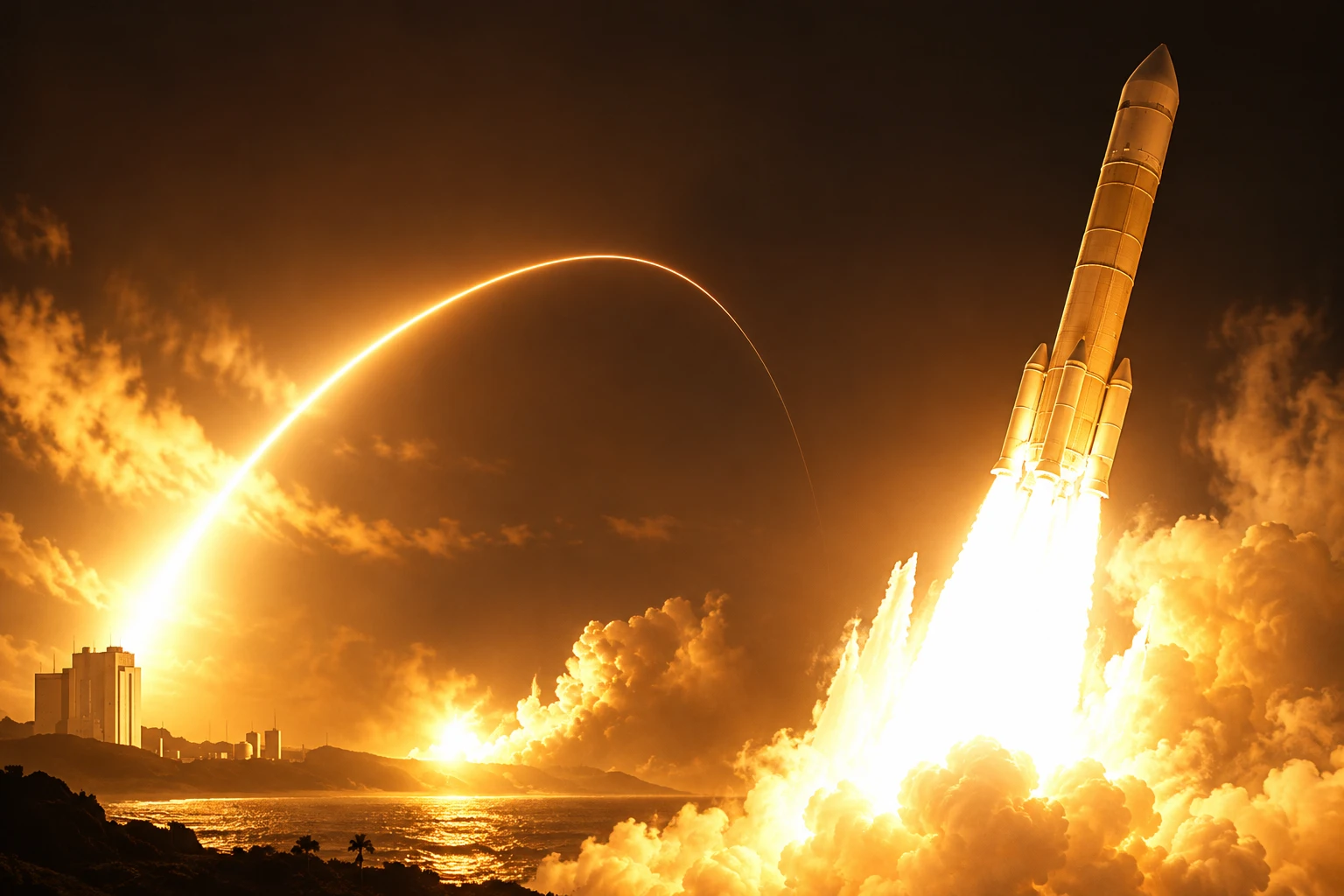
Japan’s H3 rocket sent the MMX spacecraft toward Phobos at 4:41:03 a.m. on October 20, opening a five-year bid to bring soil home from a Martian moon. The $578 million probe left Tanegashima Space Center on Flight No. 10, and JAXA confirmed the separation of the MMX spacecraft 71 minutes 13 seconds after liftoff.
The public goal is more than 10 grams of Phobos dust, due back in 2031. The quieter prize is Mars itself. Billions of years of impacts have thrown planetary crust onto that moon, so a cheap sample from Phobos can carry grains no one has ever lifted off the Red Planet on purpose.
Phobos Soil May Already Hold Mars
Phobos is a lumpy body about 14 miles (22.5 km) across, looping Mars three times a day at roughly 6,000 km. It looks like a dark asteroid. It orbits like a piece of Mars. That split has kept two origin stories alive for decades. A 2019 study in Scientific Reports added a third, more useful fact: whatever Phobos is made of, its loose surface should already hold Mars ejecta mixed into Phobos soil.
The team modelled how often Mars gets hit and how much debris reaches the moon. Over the last 500 million years, they put the median Mars fraction at about 340 ppm in the top metre of Phobos dust, a conservative figure after they shrank the catch for the moon’s older, wider orbit. In a returned haul of more than 10 grams, that works out to at least about 34 Martian grains. Those grains are less shocked than the meteorites that already fall on Earth, and they can include sedimentary rock as well as lava, a mix Martian meteorites do not give us.
THE PHOBOS HAUL IN FIGURES
- Target mass: JAXA wants more than 10 grams of Phobos soil back in 2031.
- Mars fraction: About 340 ppm is the statistical share modelled for the last 500 million years.
- Grain count: That share implies at least about 34 Martian grains in a 10-gram scoop.
- Hayabusa2 bar: Japan’s last sample capsule, from asteroid Ryugu in December 2020, held 5.4 grams.
Kiyoshi Kuramoto, the mission’s principal investigator, has said the same thing in plainer words. MMX will watch Mars from its moons and study dust thrown out of Martian craters, not only the moon’s own bedrock.
The mission will also investigate the processes that led to Mars losing its atmosphere and water, through atmospheric observation and analysing the material ejected from Martian craters.
Kiyoshi Kuramoto, MMX principal investigator, JAXA
If the model holds, Japan does not need a Mars ascent rocket to put Mars in a lab. It needs a short hop onto a moon that has been catching the planet for eons.
The Clock From Tanegashima to Australia
MMX is a three-module craft 5.3 metres high and 9.0 metres long once its panels are out, built to cruise, hover, land and come home. Five agencies are on the flight: JAXA, NASA, France’s CNES, Germany’s DLR and ESA. Arrival at Mars is set for August 2027, with a quasi-satellite path around Phobos from September 2027, a track that keeps the probe near the moon while both circle the planet.
THE MMX CLOCK
- October 20, 2026: H3 Flight No. 10 lifts off from Tanegashima and puts MMX on a path to Mars.
- August 2027: The craft enters Mars orbit after a cruise of about 10 months.
- September 2027: It settles into a quasi-satellite orbit of Phobos and starts mapping the ground.
- December 2028: NASA says sampling will not start before this month; DLR lists rover landing and sampling in 2029.
- 2030: The return module leaves the Mars system for a year-long flight home.
- 2031: A capsule is due over Australia, with recovery planned in South Australia.
Two brief touchdowns are planned, using a corer and a gas scoop. NASA’s P-Sampler, built by Honeybee Robotics at Blue Origin, sits on one landing leg and uses high-pressure nitrogen to lift dust in seconds. JAXA’s own sampler takes a more classic bite. Neither stay is a camp-out. The science is in the jar.
Before those landings, Europe’s Idefix rover drops from tens of metres up. Markus Grebenstein, DLR’s rover lead, has said the fall lasts 60 to 80 seconds and hits at under 1 metre per second. On Phobos the 25-kilogram machine weighs about 15 grams. It then has to right itself like a thrown die and crawl at about 1 millimetre per second.
IDEFIX IN NUMBERS
- Mass: 25 kilograms at launch, with 2.5 kilograms of science kit.
- Surface time: DLR lists 100 days on the surface.
- Pace: About 1 millimetre per second, under solar power of at least 60 watt-hours per 7-hour Phobos day.
- Drop: Released from 40 to 100 metres, then a slow fall in gravity near 1/1,700 of Earth’s.
Control rooms in Cologne and Toulouse will share the driving. The rover’s job is to read the soil and flag safe ground so the mother ship does not sink, bounce away or sample a bland patch.
What 10 Grams From Phobos Can Settle
The origin fight is the reason MMX exists as a flagship, not a technology demo. Spectra make Phobos look like a primitive D-type asteroid, rich in dark, carbon-like material. The orbit argues the other way. Both moons ride nearly circular paths above Mars’s equator, a layout that is hard to get from a random capture and easy to get from a debris disk.
Tom Statler, MMX program executive at NASA, put the clash in one line at a briefing on October 15: it is two totally different lines of evidence pointing in two different directions. A 2025 Icarus paper led by Jacob Kegerreis added a middle path, in which an asteroid that passed too close was torn by tides and later rebuilt into the two moons.
WHERE RESEARCHERS SPLIT
- Captured asteroid: The samples should look like primitive chondrites, with volatiles such as hydrogen, sodium and potassium still in the rock, and isotopes that do not match Mars.
- Giant impact: The bulk should mix Mars crust and impactor, cooked and partly dried, with a Mars-like isotopic stamp.
- Tide-torn capture: Chemistry can lean asteroid while the orbits still look neat, which is why a returned sample, not another photo, is the test.
NASA’s MEGANE instrument is built for that test from orbit. The gamma-ray and neutron spectrometer, assembled at Johns Hopkins Applied Physics Laboratory under David Lawrence, reads elemental makeup tens of centimetres down, including potassium that would be scarce if the moon were baked in a giant smash. Lab work on the returned grains goes further: oxygen, chromium and titanium isotopes, plus organics, on hardware that cannot fly.
Makoto Arita, JAXA’s H3 project manager, said after the launch that the rocket placed MMX on the planned path with exceptional precision, and that he was happy to see a project that has drawn worldwide attention leave the pad. The attention is not only about a moon. It is about which story of rocky planets, water and habitability those grams support.
NASA Sent Eyeglasses and Scrapped the Bigger Haul
Lindsay Hays, acting director of NASA’s Planetary Science Division, said the agency’s 14-year cost through the end of MMX is $87 million. That pays for MEGANE, the P-Sampler, Deep Space Network tracking and U.S. scientists on the team. NASA is due at least 15 percent of the returned sample for analysis and long-term storage. MEGANE even takes its name from the Japanese word for eyeglasses: it is how the spacecraft will “see” Phobos in elements before it lands.
The same agency has no funded path to bring home the cores already cached by Perseverance, which has been driving on Mars since 2021. The White House moved to end Mars Sample Return in its fiscal 2026 request. Congress left the existing program unfunded in January 2026. Later spending text said it does not support that program, while shifting some money into a Mars Future Missions pot. Published cost bands for the old plan ran from $7 billion to $11 billion. Lockheed Martin has floated a cheaper commercial return, with no NASA go-ahead attached.
On launch day, NASA Administrator Jared Isaacman posted a short public note to JAXA. It was courtesy, and it was also a picture of the new order: Washington is a partner on a Japanese moon grab, not the lead on a Mars return.
Good luck @JAXA_en MMX on the great adventure ahead.
— NASA Administrator Jared Isaacman (@NASAAdmin) October 19, 2026
Statler, who is on the Japanese-led team, summed up the mood around MMX in the only way that still fits: a lot of adrenaline, a lot of excitement and a lot of wow. The wow is cheaper than a Mars ascent.
Tianwen-3 Targets 500 Grams in the Same Year
China is not sampling a moon. Tianwen-3 is built to lift rock off Mars, with a launch around 2028 and a return around 2031, the same year MMX is due. Hou Zengqian, the mission’s chief scientist, has kept that window. Plans call for two Long March 5 launches, a lander that can drill as deep as 2 metres, an orbiter that catches the canister and a target of at least 500 grams, fifty times MMX’s floor.
That is a different product. MMX offers a mixed bag of moon bedrock plus, if the models are right, a pinch of Mars from many ages. Tianwen-3 offers a planned, sealed draw from one landing site on the planet. No one has yet flown the full chain of digging on Mars, launching from Mars and catching the can in orbit. Japan has flown sample return twice from small bodies. China has flown it from the Moon, including the far side on Chang’e-6 in 2024.
THE SAMPLE RACE TO 2031
| Mission | Target | Sample goal | Return |
|---|---|---|---|
| MMX (JAXA-led) | Phobos | more than 10 grams | 2031 |
| Tianwen-3 (CNSA) | Mars surface | at least 500 grams | around 2031 |
| NASA Mars Sample Return | Perseverance cache | not funded | cancelled |
If both flights work, 2031 becomes a crowded year on the curators’ benches: a jar of Phobos fines that may hide Mars, and a larger Mars cache with no Japanese moon dust in it. If only MMX works, the first planned samples from the Martian system will still be moon dirt, with Mars as a contaminant that scientists will hunt grain by grain.
Flight 10 Ends a Wait Forced by H3
MMX was aimed at 2024 until H3 failed on its debut. On March 7, 2023, the second stage did not light; the vehicle was destroyed about 14 minutes after liftoff, and the ALOS-3 satellite went with it. The rocket reached orbit in February 2024. Mars launch windows open about every 26 months, so the probe sat through a full cycle while JAXA finished tests on a craft that had already slipped.
[プレスリリース]
H3ロケット10号機による火星衛星探査機(MMX)の打上げ結果https://t.co/OrRspFy3GA
— JAXA(宇宙航空研究開発機構) (@JAXA_jp) October 19, 2026
Flight No. 10 flew the H3-24L, the 63-metre layout with four solid boosters, JAXA’s most powerful H3 stack. Yasuhiro Kawakatsu, the MMX project manager, has spent almost a decade on the flight and has said the aim is the origin of the moons, the history of the Mars sphere and the water and organics that helped make rocky planets livable, plus the engineering for later human trips.
Japan already knows how to drop a capsule in Australia. Hayabusa brought Itokawa particles home in 2010. Hayabusa2 brought 5.4 grams from Ryugu in December 2020, far above its 0.1-gram design target. MMX copies that recovery plan and raises the mass floor by a hundred times over Hayabusa2’s original goal, while swapping an asteroid for a moon that sits in Mars’s gravity well.
Grebenstein called the rover ride a once-in-a-lifetime chance to join the first sample return from the Martian system. The chance is now in cruise. The 10 grams, and whatever Mars is hiding in them, still have to be grabbed, sealed and flown back through a 2031 sky that China intends to use as well.

Chinese Design Booms While Luxury Spending in China Falls

Abbott Spins Off Nutrition After Formula Legal Bills

French Law and Two Unions Hold Arkane Lyon’s Clock

FSSAI Brings a 1992 Formula Ban Onto Instagram Reels

Capcom ID Leak Hands Attackers a Ready Phishing Kit

The Last Manual V-12 Lamborghini Cannot Come to America

Permafrost Thaw Runs Fastest in Mountains, Not Arctic Soils

Rune Bets on Hillerød for His Achilles Comeback

The Roman Space Telescope Flies After Four Budget Fights

Software Stocks Rally as Underweight Funds Face Dreamforce
-
 AUTO2 months ago
The Last Manual V-12 Lamborghini Cannot Come to America
-
 NEWS2 months ago
Permafrost Thaw Runs Fastest in Mountains, Not Arctic Soils
-
 NEWS2 months ago
Rune Bets on Hillerød for His Achilles Comeback
-
 NEWS2 months ago
The Roman Space Telescope Flies After Four Budget Fights
-

 NEWS2 months ago
Murphy Defends a British Open Title Nobody Keeps
-

 BUSINESS2 months ago
JBS’s Pilgrim’s Pride Bid Still Needs the 18 Percent
-
 BUSINESS2 months ago
Software Stocks Rally as Underweight Funds Face Dreamforce
-

 BUSINESS2 months ago
Influencer Investors Trade Cash Fees for Illiquid Equity