
NEWS
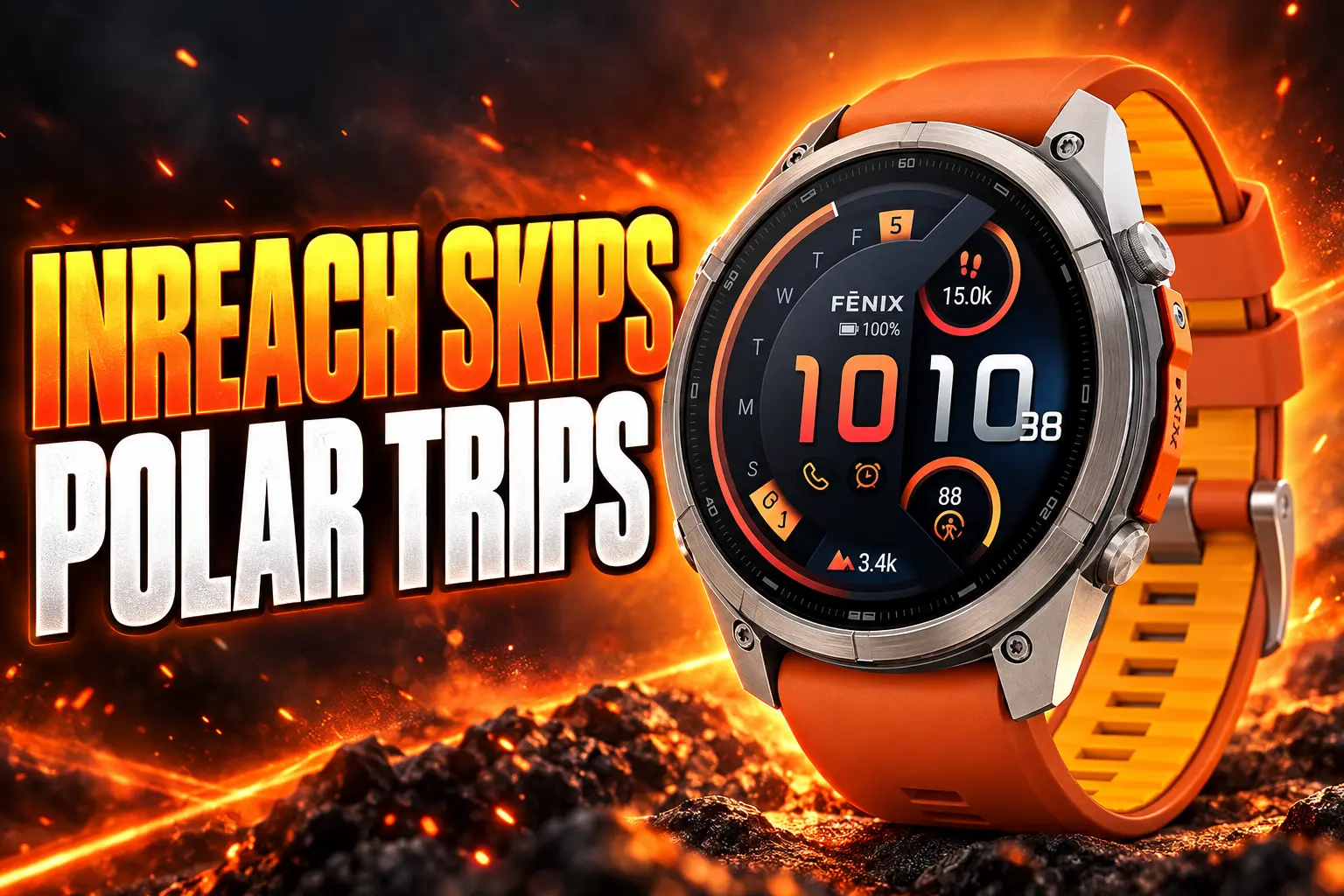
Garmin Fenix 9 Pro inReach Leaves Polar Trips Uncovered
Garmin’s Fenix 9 Pro adds a titanium case and inReach on every size, but the watch’s satellite radio covers only CONUS, Canada, and Europe.

Garmin’s Fenix 9 Pro is the first Fenix with a full titanium case, and inReach radios now fit all three sizes, including 43 mm. Select Pro models add LTE and satellite messaging for $100 over a standard Pro, then a monthly plan, and Garmin’s owner’s manual limits that satellite path to the continental United States, select parts of Canada, and most of Europe.
Garmin announced the fēnix 9 and fēnix 9 Pro on August 25, 2026, in Olathe, Kansas, and opened orders on August 28. The titanium is new. The inReach badge is not a full handheld messenger moved onto a wrist.
Garmin Split the Pro Into Two Watches
The launch copy treats Fenix 9 Pro as one flagship. The store is three rungs. Fenix 9 keeps a fiber-reinforced polymer case with metal plates and starts at $999.99. Fenix 9 Pro adds the first titanium watch case on a fēnix and starts at $1,099.99. Fenix 9 Pro inReach is a separate configuration with LTE and satellite hardware.
That radio SKU starts at $1,199.99 on 43 mm and 47 mm, and $1,299.99 on 51 mm. An active inReach plan is required for SOS, texts, calls, and tracking, and Garmin’s footnote on the launch says satellite connection and SOS on this device have important limitations compared with other inReach products, which can make connected features unavailable in some situations.
FENIX 9 LINEUP AT U.S. LAUNCH
| Model | Case | LTE and satellite | Starting price |
|---|---|---|---|
| Fenix 9 | Polymer with metal plates | No | $999.99 (43 mm, 47 mm); $1,099.99 (51 mm) |
| Fenix 9 Pro | Full titanium, nano-molded | No | $1,099.99 (43 mm, 47 mm); $1,199.99 (51 mm) |
| Fenix 9 Pro inReach | Full titanium, nano-molded | Yes, plan required | $1,199.99 (43 mm, 47 mm); $1,299.99 (51 mm) |
Solar Pro models use a memory-in-pixel display and a charging lens on 47 mm and 51 mm only, at the same starting prices as the AMOLED Pro at those sizes. Add the radios and the inReach Solar SKUs match the inReach AMOLED prices. Garmin quotes up to 31 days in smartwatch mode on the largest AMOLED Pro and up to 57 days on the largest solar model, assuming all-day wear with 3 hours a day outside in 50,000 lux.
The 43 mm Wrist Finally Carries inReach
The structural change in this generation is the small case. Garmin says inReach connectivity is available on all Fenix 9 Pro size options, 43 mm, 47 mm, and 51 mm, and on Pro Solar models as well. Last year’s Pro generation did not offer that radio in every size, which left compact-wrist buyers on a watch without satellite texts.
That is why the 43 mm Fenix 9 Pro inReach is the SKU that changes a packing list. Trail runners and climbers who refused a 47 mm or 51 mm brick can now wear the same LTE and satellite hardware as the large watch, on a 13.3 mm case with a 1.3-inch AMOLED panel and a 20 mm QuickFit band.
It still is the inReach SKU, not every Pro. A titanium Fenix 9 Pro without the radios cannot send an SOS, a satellite text, or a Garmin Locate ping. Buyers who want the metal and the 3,000-nit panel, and who already carry a handheld messenger, can skip the extra $100 and the plan.
Above 65 Degrees North, the Satellite Drops
Garmin’s owner’s manual is blunter than the lifestyle photos. The Fenix 9 Pro inReach, on an active plan, connects to geostationary communication satellites and LTE-M networks. Those communication satellites sit in a fixed spot in the sky, much farther out than the low-Earth GNSS birds the watch uses to place you on a map.
Satellite coverage for this device is only available in the continental United States, select parts of Canada, and most of Europe. In areas of the globe above 65 degrees north, the satellite network will orbit below the horizon and be unable to provide a clear connection.
Garmin, fēnix 9 Series Owner’s Manual
North of 65 degrees north, Garmin says the satellite sits below the horizon. That line cuts through northern Alaska, northern Canada, Greenland, Iceland’s upper latitudes, and a large share of Scandinavia, which is exactly the country a Fenix is sold to handle. South America, Africa, Australia, New Zealand, the Himalaya, and the open Pacific are outside the watch’s stated satellite map.
The Pointing Routine on the Wrist
A dedicated inReach puck can sit in a shoulder strap and talk to moving low-Earth satellites. The watch asks you to work for a geostationary pass. Garmin’s caution is specific: you need a clear view of the sky, you stop moving, you use the pointing interface to aim the watch, and you tilt it to the right elevation angle.
Connecting may take 30 seconds or more of good signal. That is a standing pause on a ridge, not a tap while you keep walking. LTE-M, where a carrier actually covers you, can carry richer features without that pose. Off the cell map, the watch is a pointed, regional radio.
Texts and SOS, Not Tracking
Garmin’s own feature grid makes the split obvious. Some inReach tricks ride LTE. Only a short list also rides the communication satellite.
WHAT THE INREACH WATCH CAN DO OFF LTE
| Feature | On LTE-M | On the watch satellite |
|---|---|---|
| Messenger check-ins and texts | Yes | Yes |
| Interactive SOS to Garmin Response | Yes | Yes |
| Weather forecast request | Yes | Yes |
| Photo messages | Yes | No |
| Voice messages | Yes | No |
| Messenger voice calls | Yes | No |
| LiveTrack, Garmin Locate, incident detection | Yes | No |
Garmin Response remains the 24/7 center on the other end of an SOS, the same desk that handles handheld inReach alerts. LiveTrack notifications in Garmin Messenger, the new Garmin Locate ping for family, and voice calling are LTE features. If you walk out of LTE-M, those drop. Satellite weather is the one new off-grid extra Garmin called out on this generation, alongside texts and SOS.
A $450 Mini Still Covers the Poles
Garmin still sells a device built for the map the watch does not claim. The inReach Mini 3 Plus is listed at $499.99 (and has shown a $50 discount on Garmin’s own page) and uses the Iridium network that Garmin describes as 100% global for two-way messaging, tracking, and SOS. On an active plan it can move photos and 30-second voice clips, which the watch cannot send over satellite.
That handheld is the product the Fenix 9 Pro inReach is being asked to replace in a pack. It does not. The Mini keeps working where Garmin says the watch satellite falls below the horizon, and it does not ask you to stop and aim a 13 mm antenna at a fixed point in the sky. Serious trips still have a reason to clip 4.0 oz of Mini 3 Plus to a strap and leave the watch on training, maps, and LTE.
Wrist satellite texting is now a category beyond Garmin. Apple Watch Ultra 3 can send iMessages or SMS via satellite when there is no cellular or Wi-Fi, free for two years after activation, with Emergency SOS handled as a separate path. That service has its own map, a carrier-plan requirement for ordinary messages, and a two-year clock. It does not put Iridium LiveTrack on an Apple wrist, and it is not a reason to treat the Fenix radio as global.
What an inReach Plan Costs Each Month
Hardware is the one-time hit. The plan is the product Garmin keeps billing. Consumer inReach service is sold in four live tiers, all of them including emergency SOS, with a $39.99 activation fee on a new device. You can move between tiers, and Garmin’s 2025 plan guide still offers a no-cost Suspend pause for up to 12 months, with no satellite features while the pause is on.
CONSUMER INREACH TIERS
- Enabled, $7.99 a month: SOS is included; texts, weather, and tracking are pay-as-you-go.
- Essential, $14.99 a month: 50 texts and weather requests, unlimited check-ins, tracking billed per point.
- Standard, $29.99 a month: 150 texts and weather requests, unlimited check-ins and tracking.
- Premium, $49.99 a month: unlimited texts, weather, check-ins, and tracking, with the tightest tracking interval.
On the watch, every tier also unlocks unlimited LTE texts, voice notes, calls, and LiveTrack where LTE-M actually exists. That is the everyday use Garmin staff keep stressing in setup videos: $7.99 can cover unlimited LTE habits, while satellite allowances still follow the tier. New inReach users are offered a trial during setup, and existing customers can transfer a plan from another device on the same account instead of paying a second activation.
A year of Enabled SOS is about $96 before overage, plus the $39.99 start fee. A year of Premium is $599.88. Stack that on a $1,199.99 watch and the two-year cost of the radio SKU plus a mid-tier plan lands well above a Mini 3 Plus bought once and parked on Essential for the months you actually go off-grid.
How Garmin Thinned the Titanium 47 mm Case
The case is the other reason this watch exists. Garmin uses nano-molding to bond metal and plastic at the molecular level, which is how it put a full titanium shell on a Pro and still cut thickness. Garmin says the 47 mm Fenix 9 Pro is 16% slimmer than the 47 mm Fenix 8 Pro. Independent spec sheets put the new 47 mm Pro at 13.8 mm, the 43 mm Pro at 13.3 mm, and the 51 mm Pro at 15.8 mm.
PRO HARDWARE AT A GLANCE
- Display: AMOLED up to 3,000 nits; 51 mm Pro is Garmin’s first 1.5-inch Fenix panel, 15% more area with no larger case.
- Memory and maps: 64 GB, twice the Fenix 8, about 7,000 songs, map panning Garmin rates 30% faster, with 50% more RAM.
- Light and dive: LED flashlight with a new green night-vision mode on Pro; 10 ATM with a 40 m dive rating.
- Battery, largest sizes: up to 31 days AMOLED smartwatch mode; up to 57 days on 51 mm solar in Garmin’s 50,000 lux test.
Both Fenix 9 and Fenix 9 Pro pick up Garmin Epic, which groups multi-day activities into one shareable story in Garmin Connect, plus stamina zones and a stamina curve, heavier rucking inputs up to 100 kg, and indoor rowing VO2 max when the machine has a power meter. Those software pieces ship on the $999.99 watch. You are not paying the Pro premium for Epic.
You are paying it for titanium, the brighter panel, the extra flashlight color, the solar option, and, if you tick the box, the radios. The optical heart-rate hardware did not move to a new generation in the materials Garmin published at launch.
Keep the Handheld for Alaska and the Andes
The Fenix 9 Pro is a better Fenix on the wrist: thinner in 47 mm, brighter, roomier in storage, and finally titanium. The inReach SKU is a better Fenix for people who train and hunt inside CONUS, southern Canada, and most of Europe, who will pay a monthly bill, and who will stop and point the watch when LTE dies.
It is a weak replacement for the two-device kit on a polar, Andean, or South Pacific trip. Garmin still sells the Mini on Iridium for that work, and the watch manual tells you, in a caution box, that the satellite in the titanium case will drop below the horizon above 65 degrees north. The louder problem is that map, not the case metal. A hunter is being asked to pay flagship-watch money for a safety radio that does not follow them onto the tundra.
Retail listings that went live after the August 28 order date already show color and band premiums above the $1,299.99 51 mm inReach floor. The plan, the pointing routine, and the coverage line in the manual do not change with the strap.
Frequently Asked Questions
Does the Fenix 9 Pro Solar Come in 43 mm?
No. Garmin’s solar Pro, with a Power Sapphire lens over a memory-in-pixel display, is sold in 47 mm and 51 mm only, with or without inReach. The 43 mm Pro is AMOLED in both the plain Pro and Pro inReach configurations, so the compact titanium watch never gets the 34-day and 57-day solar figures Garmin quotes on the larger charging models.
Can You Transfer an Existing inReach Plan to the Watch?
Yes. Garmin’s official setup walkthrough lets existing customers transfer inReach service from another device on the same account, or add a second line, instead of treating the watch as a brand-new activation. New inReach users are offered a free trial before they pick Enabled, Essential, Standard, or Premium, and they can add optional search-and-rescue insurance during that same flow.
Does Garmin Locate Work Without Cell Coverage?
No. Garmin Locate, which lets contacts see the watch in the Messenger app, is an LTE feature, not a satellite one. Garmin’s own product explainers say the watch wakes LTE about every four hours to store a position when the phone is gone, and that ping fails if you are already off the LTE-M map, so family sees a stale point until you are back on a carrier or you send a satellite text yourself.
What Is the Fenix 9 Pro Dive Rating?
Garmin rates the Fenix 9 and Fenix 9 Pro at 10 ATM, with a 40-meter dive rating and leakproof buttons. That is a swimming and shallow-dive spec on a multisport watch, not a substitute for a Garmin Descent computer with gas, deco, and dedicated dive modes, and the inReach radios are not a reason to treat the Fenix as a saturation tool.

Bass Persuades Takes the Record Drop After a No. 1 Debut

DIGITALEUROPE Says Europe Must Buy From Its Scaleups

Refugees Lose Medicaid While Green Cards Sit in Line

Ring Smart Lock Puts Your Door on Amazon Sidewalk

Sicario 3 Moves Ahead Without Taylor Sheridan Writing

Influencer Investors Trade Cash Fees for Illiquid Equity

The Roman Space Telescope Flies After Four Budget Fights

The Last Manual V-12 Lamborghini Cannot Come to America

Rune Bets on Hillerød for His Achilles Comeback

JBS’s Pilgrim’s Pride Bid Still Needs the 18 Percent
-
 BUSINESS1 month ago
Influencer Investors Trade Cash Fees for Illiquid Equity
-
 NEWS1 month ago
The Roman Space Telescope Flies After Four Budget Fights
-
 AUTO1 month ago
The Last Manual V-12 Lamborghini Cannot Come to America
-
 NEWS2 months ago
Rune Bets on Hillerød for His Achilles Comeback
-
 BUSINESS1 month ago
JBS’s Pilgrim’s Pride Bid Still Needs the 18 Percent
-

 BUSINESS1 month ago
Software Stocks Rally as Underweight Funds Face Dreamforce
-

 BUSINESS2 months ago
Rubicon Research Q1 Tests Its Specialty Pharma Bet
-

 NEWS1 month ago
Dallas Judge Blocks the SEC Ban, Coaches Still Face Fines