
NEWS
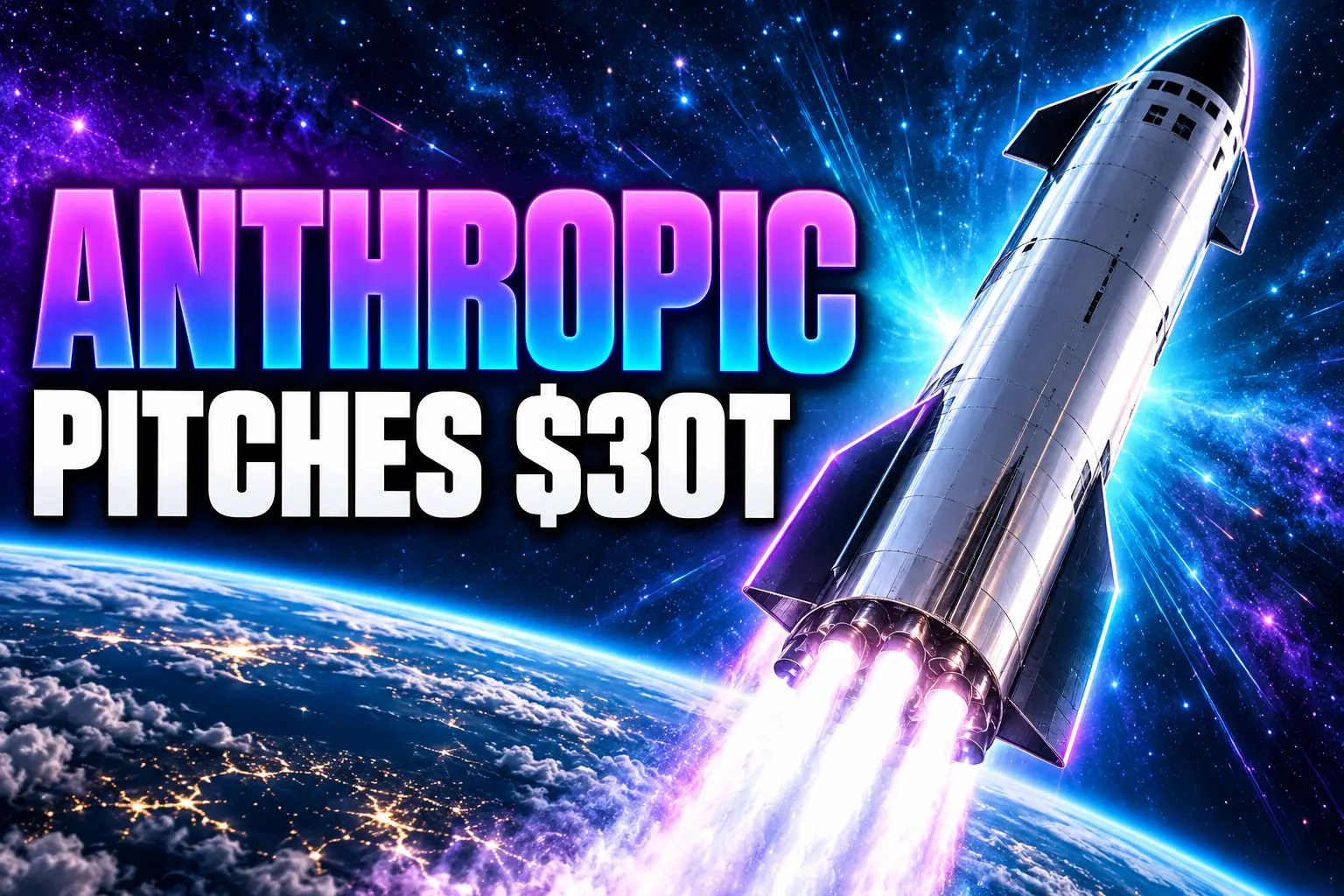
Anthropic’s $30 Trillion Pitch Covers SpaceX’s AI Market
Anthropic’s $30 trillion potential revenue pitch would top SpaceX, but both listings claim overlapping shares of the same AI work market.

Anthropic is preparing to tell IPO investors its potential revenue exceeds $30 trillion, a figure meant to top SpaceX’s $28.5 trillion claim.
The Claude maker gets there by counting all work AI models could finish. SpaceX already put enterprise AI applications alone at $22.7 trillion in its May prospectus, so the two decks now sell overlapping slices of the same labor pool.
What Anthropic’s $30 Trillion TAM Includes
Anthropic is building the number from the full scope of work that could be completed with AI models, people familiar with the plans said. That is not a sales forecast. It is a 100 percent share ceiling, and it is more than twelve times the $2.4 trillion that 191 technology companies in the S&P 1500 booked last year, according to FactSet.
Companies going public use total addressable market, or TAM, to show how much room they still have to grow. The figure estimates the annual revenue a firm could theoretically collect if it won every customer in a defined pool, using industry data and banker models. Those estimates have always involved guesswork. They get even looser when the pool is “every task an AI model might one day do.”
Anthropic has not published the $30 trillion slide. People familiar with the company’s plans said it is likely to show up when IPO financial-disclosure documents come out in the next few weeks, with a listing possible as soon as September or early October. The plans are still being discussed, and the figures can still change.
A ceiling that large only works as marketing if nobody can prove it wrong in the life of the trade. It assumes paid AI work at the scale of the U.S. economy, not a free utility that collapses prices. Public buyers who inherit that slide will be measured against it long after the roadshow ends.
SpaceX Already Booked $22.7 Trillion of Enterprise AI
Space Exploration Technologies Corp. filed its Form S-1 on May 20, 2026, and told investors it had found “the largest actionable total addressable market in human history.” In that prospectus the company said its quantifiable TAM is $28.5 trillion, spanning space, connectivity and AI, and excluding China and Russia.
We believe we have identified the largest actionable total addressable market in human history.
SpaceX, Form S-1 prospectus, May 2026
Almost all of that claim is AI. Space and Starlink, the businesses that actually print cash, are the small print.
SPACEX’S $28.5 TRILLION SPLIT
- Space: $370 billion from space-enabled solutions, about 1 percent of the total.
- Connectivity: $1.6 trillion, split as $870 billion in Starlink broadband and $740 billion in Starlink mobile.
- AI: $26.5 trillion, including $2.4 trillion in infrastructure, $760 billion in consumer subscriptions, $600 billion in ads, and $22.7 trillion in enterprise applications.
Enterprise applications are 80 percent of the entire SpaceX TAM. That is the same territory Anthropic is now describing as all work models could complete. Two issuers cannot each own a $20 trillion-plus claim on white-collar tasks without the second filing looking like a reply, not a discovery.
HOW THE TAM CLAIMS STACK UP
| Issuer | When | Claimed market | What it counted |
|---|---|---|---|
| SpaceX | May 2026 | $28.5 trillion | Space, Starlink and AI, excluding China and Russia |
| Anthropic | 2026 plans | Above $30 trillion | All work that could be completed with AI models |
| Uber | 2019 IPO | $6 trillion | Mileage value of personal cars and public transport worldwide |
| WeWork | 2019 filing | $3 trillion | Office workers in cities it hoped to enter |
SpaceX’s 2025 revenue was $18.7 billion, with adjusted EBITDA of $6.6 billion. The AI slice of that year was still early. Anthropic’s slide would beat a number that was already 93 percent AI, which is why topping SpaceX is a cheaper stunt than it sounds.
The Auditable Number Is $47 Billion
On May 28, 2026, Anthropic said it had raised $65 billion in Series H funding led by Altimeter Capital, Dragoneer, Greenoaks and Sequoia Capital, valuing the company at $965 billion after the money. In that same run-rate revenue crossed $47 billion announcement, the company said the figure had been reached earlier in May.
Three months before that close, on Feb. 12, Anthropic said run-rate revenue was $14 billion after a $30 billion Series G that valued the firm at $380 billion. It also said it already had over $2.5 billion in Claude Code run-rate revenue, that more than 500 customers spent over $1 million a year, and that eight of the Fortune 10 used Claude.
ANTHROPIC’S RUN RATE BEFORE THE S-1
- February 12, 2026: Closes a $30 billion Series G at $380 billion and reports a $14 billion run rate.
- May 28, 2026: Closes a $65 billion Series H at $965 billion and reports a $47 billion run rate.
- Early June 2026: Files a confidential draft S-1, starting the listing clock without a public TAM.
- Late August 2026: People familiar with the plans say the TAM shown to IPO investors will sit above $30 trillion.
Investor materials circulating after May have shown later run-rate prints, including figures near $65 billion by late July. Early reports from the second quarter also put revenue near $11.5 billion. Even if those private prints hold, $65 billion is 0.2 percent of a $30 trillion ceiling. The growth is real. The slide is still a different species of number.
If large language models keep converging on similar output, the premium in a giant listing has to come from distribution, switching costs and enterprise contracts, not from a unique claim on global labor. That is the objection the TAM contest never answers.
Anthropic Aims for a $2 Trillion Listing
People familiar with the matter said Anthropic could aim to raise as much as $100 billion in the offering, compared with about $86 billion at SpaceX, and is aiming for a valuation of about $2 trillion, above the $1.77 trillion valuation SpaceX drew. None of those terms are final.
Some IPO discussions have used 2028 revenue of about $190 billion to $200 billion. At the high end that would still be less than 1 percent of a $30 trillion market. The listing math is being sold on the slope of Claude’s run rate. The TAM is being sold as proof there is still almost all of the mountain left to climb.
After SpaceX’s debut, a record TAM bought the AI stack a short bounce and then a messier tape, once investors had to underwrite the capex behind the story. Anthropic is walking into that memory, not a blank page. OpenAI is on a similar calendar, which means two labs may ask public markets for nine-figure billions inside one season, each with a market slide that cannot both be exclusive.
Uber’s $6 Trillion Now Looks Like a Warm-Up
When Uber went public in 2019, it described its market as $6 trillion, citing the mileage value of all personal cars and public transportation services globally. Wall Street called that aggressive then. WeWork cited a $3 trillion market in the offering it later abandoned, built by multiplying hoped-for cities by desk workers it did not serve.
Those fights were about cars and leases. This one is about substituting for paid human work. Global output is about $111 trillion a year in the comparison SpaceX invited when it published $28.5 trillion and left China and Russia out. Anthropic’s ceiling sits in the same neighborhood as U.S. annual economic output. The old complaint was that TAM counted people who would never buy. The new version counts jobs that may never be billed to a model vendor.
Reddit, in a smaller version of the same habit, once stacked a data-licensing AI market and a “user economy” until the broadest total ran into the trillions. The pattern is stable: widen the noun until the number looks like GDP, then let the headline travel farther than the footnotes.
Why the SEC Fined Zymergen $30 Million
The commission has already treated a fantasy market slide as a disclosure problem, not a harmless banker flourish. In 2024 it charged Zymergen, a biotech that raised about $530 million in an April 2021 IPO, with misleading investors about market potential for Hyaline, its electronics film. Zymergen later filed for bankruptcy. It agreed to pay a $30 million civil penalty without admitting or denying the findings.
Pre-revenue and early-stage companies that seek to tap the capital markets must do so with reasonable estimates of their market potential.
Monique C. Winkler, Director, SEC San Francisco Regional Office
The order found that Zymergen’s $1 billion display-market figure included product markets the sales team was not targeting, or that were a poor fit for the film. Rigid-touch-sensors and fingerprint-on-display markets made up more than 99 percent of the $1 billion claim in the Form S-1. Internal estimates ran about $42 million to $100 million, or about 5 to 10 percent of the number in the filing. The SEC’s press release said issuers need reasonable estimates of their market potential.
WHAT THE ORDER FOUND
- The public number: A $1 billion electronics display market for Hyaline in the S-1.
- The mix: Over 99 percent of that dollar figure came from two markets the sales team was not targeting.
- The internal range: About $42 million to $100 million, a small fraction of the IPO slide.
Anthropic is not a pre-revenue biotech, and a TAM that counts future labor is not the same fact pattern as a film that did not fit the screens in the model. The lesson that does travel is simpler. Once a market number is in a prospectus, it is no longer a vibe. It is a statement the commission can test against how the company actually sells.
A $1.25 Billion Monthly Check Goes the Other Way
The overlap is not only on the slide. SpaceX’s S-1 disclosed cloud-services agreements with Anthropic at $1.25 billion a month through May 2029, about $15 billion a year, terminable on 90 days’ notice. That is a $45 billion three-year headline if the contract runs, and it sits inside SpaceX’s AI segment, the same segment that supplies $26.5 trillion of SpaceX’s TAM.
Anthropic’s May funding note said it had signed for GPU capacity in SpaceX’s Colossus 1 and Colossus 2 clusters, alongside deals with Amazon for up to five gigawatts of new capacity and with Google and Broadcom for five gigawatts of next-generation TPU capacity. The Series H round also included $15 billion of previously committed hyperscaler money, including $5 billion from Amazon. The Claude maker is a customer of the company whose TAM it wants to beat, and a buyer of the same scarce compute both firms need to make either slide look less theoretical.
Until a public prospectus lands, the $30 trillion ceiling is still a private-market talking point. The S-1 is what will freeze it into a number the SEC, and everyone who buys the stock, can read.
Disclaimer: This article is news reporting and analysis of Anthropic’s planned IPO disclosures, SpaceX’s filed market-size claims, and related company statements. It is informational only and is not investment advice, a solicitation, or a recommendation to buy or sell any security, IPO allocation, or private share. Readers should consult a licensed financial adviser or securities attorney before acting on any listing, valuation, or TAM figure discussed here. Revenue run rates, offering sizes, valuations and market estimates reflect company announcements and other sources as of September 2, 2026, and may change when a public prospectus is filed or when terms are set.

Bass Persuades Takes the Record Drop After a No. 1 Debut

DIGITALEUROPE Says Europe Must Buy From Its Scaleups

Refugees Lose Medicaid While Green Cards Sit in Line

Ring Smart Lock Puts Your Door on Amazon Sidewalk

Sicario 3 Moves Ahead Without Taylor Sheridan Writing

The Roman Space Telescope Flies After Four Budget Fights

Rubicon Research Q1 Tests Its Specialty Pharma Bet

Hamilton’s Ferrari Upgrade Pushes Mercedes Into a Monza Bind

The Last Manual V-12 Lamborghini Cannot Come to America

Influencer Investors Trade Cash Fees for Illiquid Equity
-
 NEWS1 month ago
The Roman Space Telescope Flies After Four Budget Fights
-
 BUSINESS2 months ago
Rubicon Research Q1 Tests Its Specialty Pharma Bet
-
 NEWS2 months ago
Hamilton’s Ferrari Upgrade Pushes Mercedes Into a Monza Bind
-
 AUTO2 months ago
The Last Manual V-12 Lamborghini Cannot Come to America
-
 BUSINESS1 month ago
Influencer Investors Trade Cash Fees for Illiquid Equity
-

 NEWS2 months ago
Rune Bets on Hillerød for His Achilles Comeback
-

 BUSINESS1 month ago
Software Stocks Rally as Underweight Funds Face Dreamforce
-

 NEWS1 month ago
Dallas Judge Blocks the SEC Ban, Coaches Still Face Fines