
NEWS
Nickelate Films Keep Superconductivity Alive Past 65 Tesla
A 1962 compensation bet is now on the table: Eu-bearing nickelate films recovered zero resistance past 65 tesla after weaker fields first killed it.

Samarium-based nickelate films held at Los Alamos kept zero electrical resistance to at least 65 tesla, a field that usually wrecks superconductivity.
The National University of Singapore and Los Alamos National Laboratory team reported the result on July 31, 2026, in Nature Communications. Superconductivity in the films first collapsed at about 1 tesla, then returned as the field rose, and the authors read that comeback as a 1962 compensation effect now working in an oxide family that can already superconduct near 40 K.
Zero Resistance Survives Past 65 Tesla
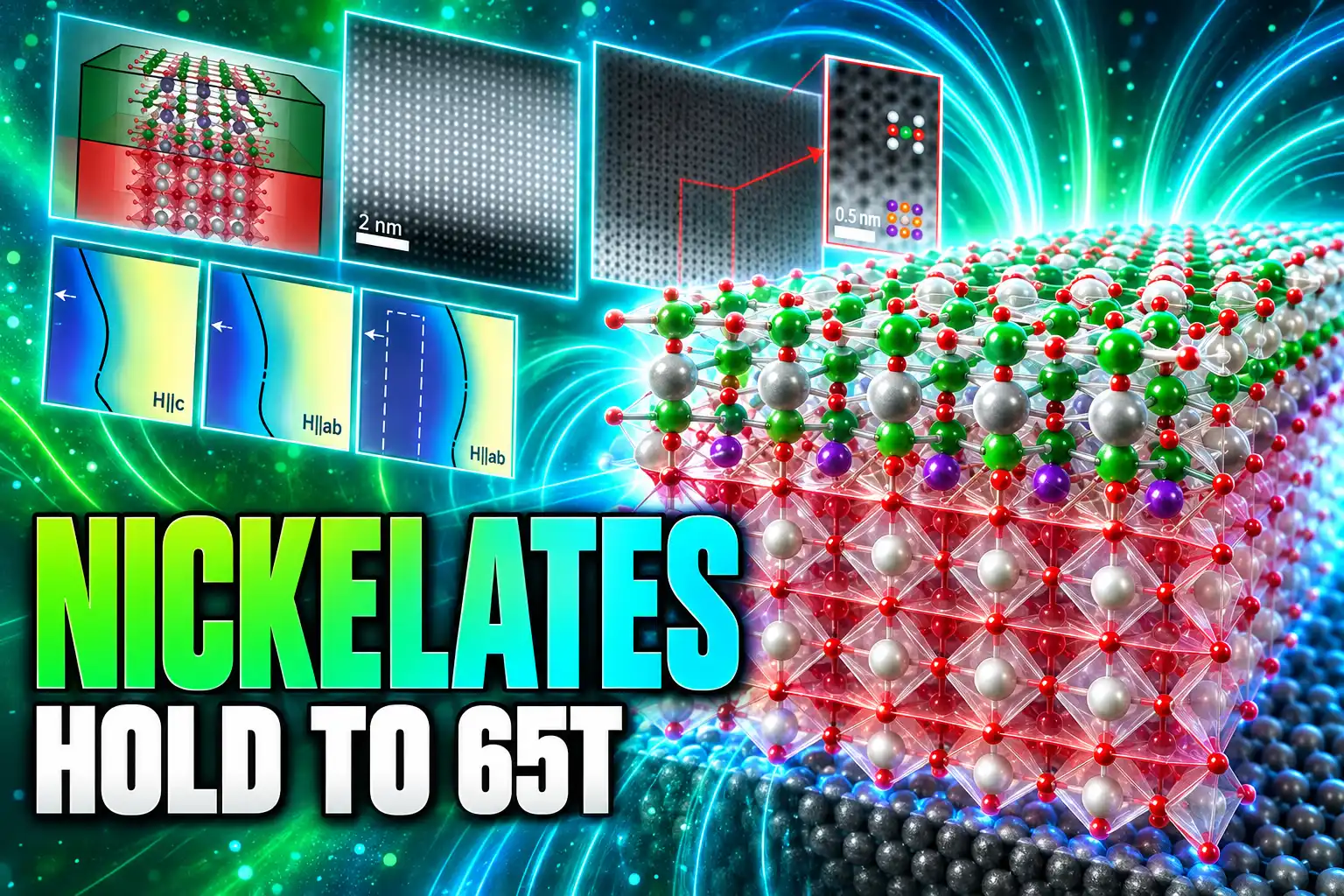
The samples are 4 to 7 nanometer films of (Sm, Eu, Ca, Sr)NiO2, called SECNO in the paper, grown as infinite-layer nickelates. In the high-field-stabilized reentrant superconductivity study, resistance in the highest-transition sample, S5, stayed vanishingly small to at least 65 tesla with the field along the crystalline c axis.
Lower-transition pieces show the comeback more cleanly. In samples S1 and S2, with transitions of 9.6 K and 11.7 K, a sharp jump out of the superconducting state appears near 1 tesla, a small dip near 2 tesla tracks a spin-flop of neodymium moments in the NdGaO3 substrate, and a broad resistance minimum then opens around 20 tesla in S1 and 15 tesla in S2.
On a log plot the resistivity falls by about four orders of magnitude in that high-field pocket, and at the lowest temperatures the signal is lost in noise, which is what zero resistance looks like in a pulsed-field shot. Radio-frequency inductive measurements at about 20 MHz on S1, taken at 0.5 K, found a diamagnetic shift from screening currents in the high-field state comparable to the shift below 1 tesla, so the drop is not only a lucky percolation path.
| Sample | Transition temperature | High-field behavior |
|---|---|---|
| S1 | 9.6 K | Low-field state dies near 1 T; reentrant minimum near 20 T; exchange field about 59 T |
| S2 | 11.7 K | Reentrant minimum near 15 T; exchange field about 71 T |
| S3 | 16.8 K | Low-field and high-field pockets begin to merge |
| S4 | 22.1 K | In-plane field to 42 T cuts the transition by about 1 K |
| S5 | 31.7 K | Vanishing resistivity to at least 65 T along the c axis |
As the transition is raised from 11.7 K to 31.7 K, the two superconducting pockets merge. The map keeps a kink below 10 tesla, which the authors treat as the crossover between the low-field and high-field states, and for fields turned into the planes a sweep from zero to 42 tesla, already above the Pauli limit they extract from a modified Werthamer-Helfand-Hohenberg fit, knocks only about 1 K off the transitions of S4 and S5.
The Jaccarino-Peter Bet Dates to 1962
Magnetic fields destroy superconductivity in two ordinary ways. The Pauli, or Zeeman, channel lines up electron spins and breaks spin-singlet Cooper pairs, and the orbital channel lets flux in as vortices until phase coherence dies. Field-induced superconductivity is the rare workaround, and until this year it lived in Chevrel-phase crystals, organic conductors, uranium heavy-fermion metals, and moiré graphene, hosts whose transitions sit at a few kelvin.
The nickelate paper puts the older limit in writing: previous reentrant superconductors typically showed low-field transitions below 4 K. SECNO, in the same samarium family that Chow, Luo, and Ariando pushed near 40 K at ambient pressure in 2025, is the first host they can point to that is also a high-temperature superconductor by cuprate standards. The first cuprate, reported by Bednorz and Müller in 1986, sat below that 40 K mark.
THE COMPENSATION TIMELINE
- 1962: V. Jaccarino and M. Peter publish the prediction that a negative exchange field from local moments can cancel an applied field on conduction-electron spins.
- 1975: Øystein Fischer and coworkers in Geneva show that europium doping in Chevrel phases raises the upper critical field by about 50 to 100 kilogauss and pushes it toward 700 kilogauss.
- 1984: H. W. Meul, C. Rossel, and colleagues report a superconducting state that appears only after an external field is applied in Eu-Sn molybdenum chalcogenides.
- 2019: Danfeng Li and coworkers at Stanford report superconductivity in infinite-layer NdNiO2 films, opening the nickelate family.
- July 31, 2026: The NUS-Los Alamos paper reports reentrant superconductivity in SECNO films, with vanishing resistivity to 65 tesla in the 31.7 K sample.
Meul’s group recorded field-induced superconductivity in 1984 in those europium-tin Chevrel crystals, and Fischer’s earlier letter had already described Chevrel-phase fields near 700 kilogauss once europium was added. The physics is old. The temperature scale is what changed.
How Europium Cancels an External Field
Jaccarino and Peter predicted the compensation effect in 1962. Localized moments, here Eu2+ with angular momentum 7/2, produce an internal exchange field HJ that points opposite the applied field. When the two cancel, Pauli pair-breaking is reduced and a high-field superconducting pocket can open near H equal to the size of HJ.
Fits to the SECNO maps give HJ of about -59 tesla in S1 and about -71 tesla in S2, with a Pauli limit near 20 tesla in S1. Independently of that model, the vanishing-resistivity region for in-plane field sits near 30 tesla, which the authors take as a lower bound on the size of HJ. X-ray absorption finds about 67% of the europium sites in the Eu2+ configuration, a mixed-valence state, and the anomalous Hall signal above the transition tracks a Brillouin function for that Eu2+ moment.
Dr. Km Rubi, lead researcher at Los Alamos National Laboratory and an NUS physics Ph.D. alumnus, said the work shows nickelates can sustain superconductivity in magnetic fields far beyond conventional limits. Co-first author Dr. King Yau Yip, a research fellow at NUS, said the Jaccarino-Peter fit is a step toward the physics of nickelate superconductors. Both comments were carried in a Phys.org summary of the NUS account on August 26.
Other explanations exist, including spin-fluctuation pairing, spin-triplet states, Fermi-surface reconstruction, and physics near the quantum limit. The authors argue that the Chevrel-like maps, the Eu2+ spectroscopy, and the WHH-plus-exchange-field curves point to compensation. Because that WHH framework sits on BCS theory, they also read the pairing as even, not triplet, while leaving room for unconventional s- or d-wave details and non-phonon pairing.
The Samples Are Only a Few Nanometers Thick
The films are 4 to 7 nanometers thick. A magnet you can leave on is wound from kilometers of tape or wire, and these samples were never that object. The 65 tesla figure is a pulsed-field measurement at the National High Magnetic Field Laboratory in Los Alamos, funded in part by the Department of Energy’s “Science of 100 tesla” project, not the operating field of a nickelate coil.
WHAT THE 65 TESLA NUMBER IS NOT
- A wound magnet: The nickelate result is a film on a crystal, measured in a pulse, with no nickelate tape in the paper.
- A unique high-field superconductor: Niobium-tin and rare-earth barium copper oxide already carry current in very large fields, and the MagLab’s own coil work is the comparison that matters.
- A clinical imaging part: The paper names magnets, sensors, and quantum devices as a pathway. It does not present a scanner magnet.
The same laboratory complex already has a different answer to high field. In August 2025, researchers at the Applied Superconductivity Center in Tallahassee reached a 48.7 tesla superconducting test coil by putting a small REBCO winding inside a 31 tesla Bitter magnet. That coil is salt-shaker sized and uses more than 720 feet of tape. Nb3Sn, the workhorse for many high-field low-temperature magnets, has an upper critical field of about 23.5 tesla in subcooled liquid helium.
So the nickelate bet is not that pulsed 65 tesla is a new record for any superconductor. It is that a 40 K-class oxide, with rare-earth moments written into the spacer layer, can be made to stop dying in fields that should Pauli-limit it. Rubi’s “new frontier for high-field superconducting technologies” is that design claim, and it still has to survive a jump from a few nanometers of film to a conductor you can wind.
Why Cuprates Have Not Shown This Comeback
Professor Ariando of NUS, a corresponding author, went further in the same NUS comments. He said the team sees a path toward still higher temperatures, including a try at high-temperature cuprates.
Our work shows that nickelates can sustain superconductivity far beyond conventional limits, but what excites us even more is the broader possibility this opens up. We see a path to pushing this concept toward even higher temperatures, including by exploring how it may be implemented in high-temperature cuprates.
Professor Ariando, Department of Physics, National University of Singapore, comments carried by Phys.org
The paper’s own discussion is cooler. Rare-earth ions sit in cuprate spacer layers too, and Gd3+ has the same magnetic configuration as Eu2+, yet magnetic-field-induced superconductivity has not been reported in gadolinium cuprates. Europium iron-based superconductors show only a weak field enhancement, and not by compensation.
The distinction the authors name is electronic. In nickelates, rare-earth 5d states take part in the conduction bands, which gives a plausible 4f to 5d to nickel 3d exchange path. That path, they write, is unlikely in the cuprates or the iron-based materials. Whether it can really produce an exchange field as large as 70 tesla is, in their words, an open theoretical question. The cuprate transplant is the louder public bet. The manuscript files a doubt in the same week.
Other Groups See the Same Reentrance
The NUS-Los Alamos paper is not a lone sighting. A Yale-led Nature Communications study on Nd1-xEuxNiO2 films, published in March 2026, reported reentrant behavior in fields up to 60 tesla and also invoked a Jaccarino-Peter-type exchange between europium 4f moments and nickel 3d electrons. A University of Geneva team led by L. Varbaro, writing in Nature Communications in June 2026, found reentrance in Nd0.7Eu0.3NiO2 on LSAT, with a midpoint transition of 9.5 K, a collapse at a few tesla, and recovery that they followed to 30 tesla at the LNCMI pulsed-field lab in Grenoble.
Geneva does not treat the cancelation as a single-ion europium effect. The authors argue for a balance between Eu2+ and Nd3+, with opposite influence on the field seen by the conduction electrons, and they say the phenomenology shows up in relatively low-transition films, where the rare-earth moments can polarize. A Nature paper from Mingwei Yang and coworkers on Eu-rich Sm-Ca-NiO2, published in 2026, says the high-field state is only partly consistent with compensation and shows clear deviations at the highest doping.
That split is the live argument. NUS and Los Alamos fit a Chevrel-style Jaccarino-Peter model across a ladder of transitions up to 31.7 K. Geneva wants two rare-earth species. The Yang group keeps the high-field superconducting pocket and loosens the model. There was no visible public fight on X in the day after the Phys.org write-up; the disagreement is in the journals, which is where a 60-year-old condensed-matter bet belongs.
Los Alamos can already put 65 tesla on a film for a pulse. A magnet you can leave on, wound from this chemistry, is a different machine, and it has not been built.
Frequently Asked Questions
What Is the Jaccarino-Peter Effect?
In 1962, V. Jaccarino and M. Peter argued that a negative exchange field from local magnetic moments can point opposite an applied field, so the two can cancel on the conduction-electron spins. They originally framed it as a way a weak ferromagnet might be driven into superconductivity by a strong external field. In the nickelate films the material is already superconducting at zero field, and the same cancelation is used to explain a high-field pocket that opens after a low-field collapse.
What Are Infinite-Layer Nickelates?
They are oxide films in which NiO2 planes have had their apical oxygen atoms stripped away, leaving nickel in a 1+ state that is isoelectronic with copper in the cuprates. Superconductivity in this family was reported in 2019 in strontium-doped NdNiO2 by Danfeng Li and coworkers at Stanford, and later pushed near 40 K in samarium-based films by Ariando’s group in work published in Nature in 2025.
Why Do Magnetic Fields Usually Destroy Superconductivity?
Two processes break Cooper pairs: the Pauli or Zeeman effect, which aligns electron spins, and orbital pair breaking, in which magnetic flux enters as vortices until phase coherence dies. The Pauli-limit papers of A. M. Clogston and of B. S. Chandrasekhar were published in 1962, the same year as the Jaccarino-Peter proposal that offers a workaround when local moments supply an opposing exchange field.
How Does 65 Tesla Compare With Working Superconducting Magnets?
Niobium-tin wire, still the standard for many low-temperature high-field coils, has an upper critical field of about 23.5 tesla in subcooled liquid helium. Compact REBCO windings have already produced nearly 49 tesla in a test coil inside a resistive background magnet. The nickelate 65 tesla figure is a pulsed measurement on a few-nanometer film, not a demonstration that nickelate tape can be wound into a persistent magnet.

Bass Persuades Takes the Record Drop After a No. 1 Debut

DIGITALEUROPE Says Europe Must Buy From Its Scaleups

Refugees Lose Medicaid While Green Cards Sit in Line

Ring Smart Lock Puts Your Door on Amazon Sidewalk

Sicario 3 Moves Ahead Without Taylor Sheridan Writing

The Roman Space Telescope Flies After Four Budget Fights

The Last Manual V-12 Lamborghini Cannot Come to America

Influencer Investors Trade Cash Fees for Illiquid Equity

Rune Bets on Hillerød for His Achilles Comeback

Software Stocks Rally as Underweight Funds Face Dreamforce
-
 NEWS1 month ago
The Roman Space Telescope Flies After Four Budget Fights
-
 AUTO1 month ago
The Last Manual V-12 Lamborghini Cannot Come to America
-
 BUSINESS1 month ago
Influencer Investors Trade Cash Fees for Illiquid Equity
-
 NEWS2 months ago
Rune Bets on Hillerød for His Achilles Comeback
-
 BUSINESS1 month ago
Software Stocks Rally as Underweight Funds Face Dreamforce
-

 BUSINESS2 months ago
Rubicon Research Q1 Tests Its Specialty Pharma Bet
-

 NEWS1 month ago
Dallas Judge Blocks the SEC Ban, Coaches Still Face Fines
-

 NEWS2 months ago
Hamilton’s Ferrari Upgrade Pushes Mercedes Into a Monza Bind