
BUSINESS
Oxford Study Would Pull Breakfast Foods Into UK Ad Bans
An Oxford study finds the 2018 nutrient profiling model would fail 72% of supermarket products, folding drinks, cereal and yogurt into live UK ad bans.

An Oxford study of 15,514 supermarket products found 72% would fail the UK’s updated nutrient profiling model, up from 58%. The extra fails sit in drinks, cereals and yogurts that still pass the 2004/5 score.
That older score already decides which foods may be advertised before 9pm on TV and in paid online ads. The 2018 model is written. It is not yet the law that polices those bans.
Oxford’s 15,514 Products Put 72% in the Fail Column
Dr Barthélemy Sarda, Prof Peter Scarborough and Dr Lauren Bandy, at the University of Oxford’s Nuffield Department of Primary Care Health Sciences, ran both models over 15,514 products across 13 categories already covered by high fat, salt or sugar rules. The work was funded by the National Institute for Health and Care Research, with questions co-developed with the Office for Health Improvement and Disparities.
Product data came from Tesco, Sainsbury’s, Asda, Ocado and Marks & Spencer websites. Discounters and food sold out of home were left out, and the counts were not weighted by sales, so a slow-selling SKU counts the same as a household staple.
The two models agreed on 84% of products. Of the 2,498 that changed class, 93% moved from a pass under the 2004/5 model to a fail under NPM 2018. That is about 24% more failing products on a SKU count, because 72% is 24% higher than 58%.
PASS RATES UNDER EACH MODEL
| Category | Pass, 2004/5 model | Pass, 2018 model |
|---|---|---|
| Soft drinks | 66.2% | 5.9% |
| Breakfast cereals | 79% | 39% |
| Yogurts | 77.8% | 36% |
| Pizzas | 50.7% | 28.9% |
| Morning goods | 32% | 13% |
Ice cream and desserts also lost a large share of passes. Ready meals and savoury snacks fell more gently. Processed potatoes did not move.
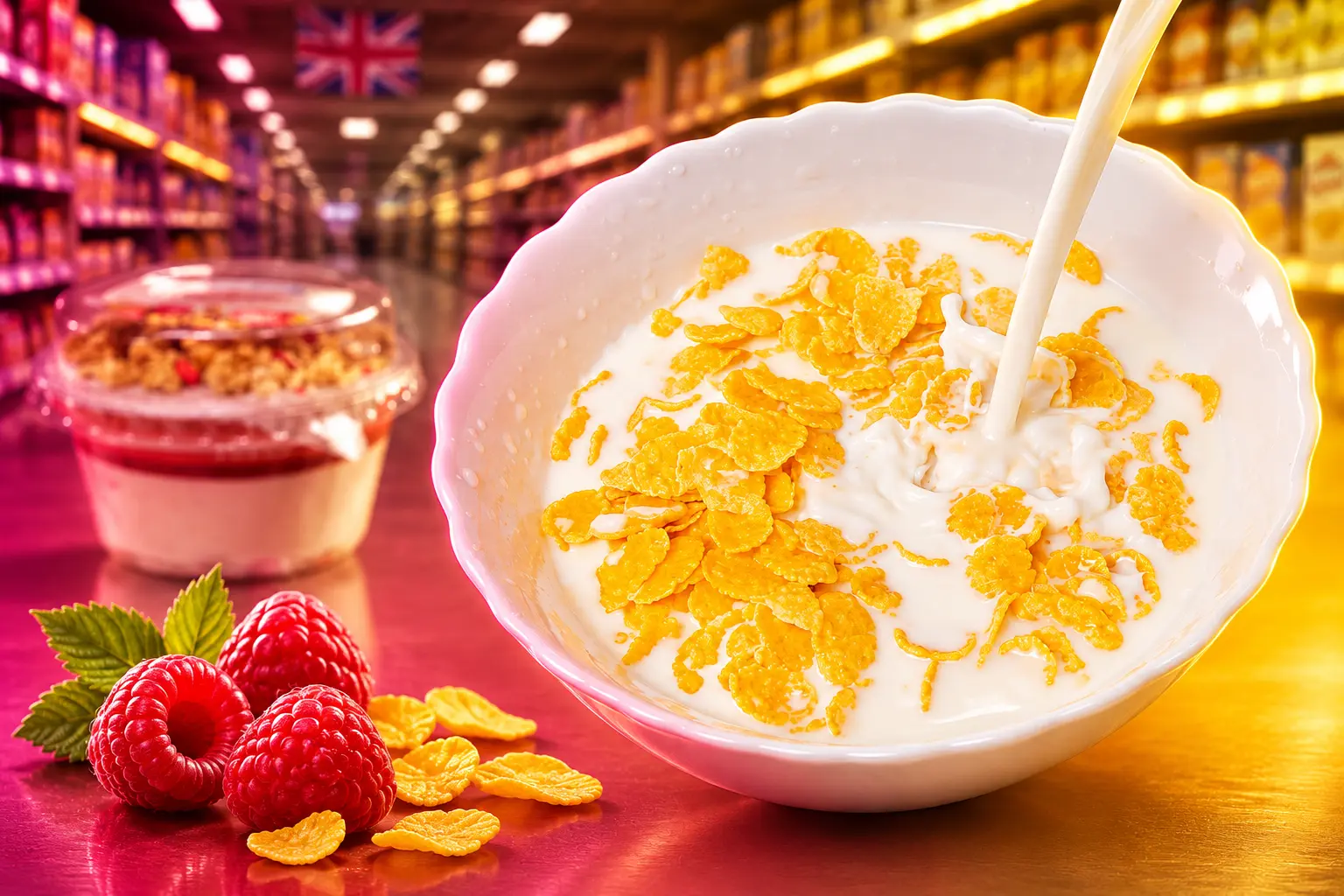
The Breakfast Aisle, Not the Sweet Aisle
Confectionery, cakes and biscuits barely shifted, because most of those lines already failed the 2004/5 test and already sit inside the advertising and promotions net. The new score does not so much catch chocolate as recatch breakfast.
Soft drinks keep the steepest fall, from two in three passing to about one in 17. Cereals and yogurts, the lines companies spent years cutting sugar in, lose about 40 percentage points of passes each. Pizzas and morning goods, the pastries and rolls sold at the front of the store, drop with them.
That pattern is what makes the study a media-rules story. Cakes were already locked out of daytime TV and paid social. A strawberry yogurt, a bran flake and a juice drink often were not. Under NPM 2018 those are the SKUs that flip, which means the 9pm watershed and the online ban would start covering the aisle that still buys airtime.
The public row already treats that flip as a category error. High-fibre flakes are sold as a gut-health staple, yet free-sugar scoring can still fail them because processing and added glucose count, even when the fibre bonus is larger than it was in 2004/5. The Oxford numbers give that row a shape: cereals do not collapse as far as drinks, but they do not keep the pass they hold now.
How NPM 2018 Scores Free Sugar and Fibre
The Department of Health and Social Care published the 2018 model on 27 January 2026, after accepting expert-group advice that followed a 2018 consultation. The 2004/5 model, built for Ofcom’s children’s advertising rules, still uses total sugars. Dietary advice has not. The Scientific Advisory Committee on Nutrition told health departments in 2015 that free sugars should supply no more than 5% of energy, and the National Diet and Nutrition Survey 2019 to 2023 found children still take in about double that. Average fibre intake is about half the 30g a day advice.
The study’s own line on the gap is blunt. “Replacing total sugars with free sugars, together with stricter scoring thresholds, meant many of the products scored more points for sugar under the new model,” the researchers wrote.
WHAT CHANGED IN THE 2018 SCORE
- Free sugars: The switch from total sugars to free sugars scores added sugars plus sugars in juices, purees, honey and syrups, with 0 points only at or under 0.9g per 100g.
- Fibre: The cap rises to 10 points, reached above 6.0g of AOAC fibre per 100g, which is the level that supports a high-fibre claim and partly offsets cereals and savoury snacks.
- The fail line: A food is less healthy at 4 points or more, a drink at 1 point or more, which is why the drinks column falls further than the food columns.
- Other dials: Energy is scored against 8,400 kJ, salt replaces sodium, protein is aligned to 45g, and seeds join fruit, vegetables and nuts.
Free sugars are not a line on the pack. The Oxford team estimated them from ingredient lists by subtracting sugars from milk and whole fruit from declared total sugars, then tested how far the overall findings moved when those guesses changed. The Institute of Grocery Distribution, which walked grocers through the paper, stressed that this was a research method, not a signed-off regulatory calculator. Retailers usually see supplier sheets, not recipes, and two firms can land on different free-sugar figures for the same SKU.
The 9pm Watershed Already Runs on the Old Score
The classification fight is not theoretical. The Health and Care Act 2022 put a 9pm watershed for less healthy food on TV and on-demand, and a 24-hour ban on paid-for online ads of identifiable products, into the Communications Act. Those limits came into force across the UK on 5 January 2026, using the 2004/5 nutrient profiling technical guidance from 2011.
Ofcom polices the broadcast and on-demand side. Brand ads that do not make a specific less-healthy product identifiable are carved out, which is why a logo can still run in daytime when the chocolate bar cannot. In store and online, placement limits have been in force in England since October 2022 for larger retailers, and volume deals such as buy-one-get-one-free were restricted there from October 2025.
NPM 2018 does not automatically rewrite any of that. DHSC opened a consultation on 25 March 2026 on applying the new model to the advertising and promotions rules in England, proposed a 12-month start-up window, and closed the call on 17 June 2026. As of the Oxford paper’s November 2026 release, the department had not published its response.
THE HFSS RULEBOOK SINCE 2004
- 2004 to 2005: The Food Standards Agency builds the nutrient profiling model so Ofcom can spot less-healthy foods in children’s advertising.
- 2015: SACN’s Carbohydrates and Health report caps free sugars at 5% of energy and lifts the fibre target, the trigger for a model review.
- 23 March 2018: Public Health England consults on a draft 2018 model; DHSC later accepts the expert-group version.
- 5 January 2026: TV watershed and paid-online bans take effect UK-wide on the 2004/5 score.
- 27 January 2026: The government publishes NPM 2018 as guidance, still not applied to policy.
- 25 March 2026: Consultation opens on applying NPM 2018 to advertising and promotions; it closes 17 June 2026 with a 12-month rollout on the table.
If ministers accept the Oxford map, the live ban does not get a new penalty. It gets a new product list, and that list is heavy with lines that currently still qualify as healthy enough to promote.
Fifty Times the Official Cost per Product
The Food and Drink Federation commissioned Oxford Economics to audit the impact assessment that sat with that consultation. The two sides are not measuring the same pile of products. Oxford’s supermarket sweep lifts the failing share from 58% to 72% on a SKU count. The FDF survey, covering about 15,000 manufacturer lines, puts the rise in restricted products at 40%, against the department’s 22%.
WHAT MANUFACTURERS TOLD OXFORD ECONOMICS
- Restricted lines: A 40% increase in products pulled into advertising and promotions limits, against the impact assessment’s 22%.
- One-off bill: Surveyed makers put one-off costs of around £2,800 on each newly affected product, against £53 in the official assessment, about 50 times higher.
- Investment: Firms in the survey pointed to a 6% fall in investment, and some said they had already delayed spend.
- Choice: More than one in 10 of their products would be withdrawn because they cannot be recut to pass.
Oxford Economics warned that the calorie-saving maths in the official assessment spans checkout drops of 16% to 90% and compensation rates of 0% to 100%, a range so wide the health gain is not nailed down. It also said a two-extremes shelf, fully compliant lines at one end and openly failing ones at the other, can follow if the in-between recipes are delisted.
Kate Halliwell, chief scientific officer at the FDF, put the timing objection on the record when the consultation opened, arguing that swapping the score so soon after the advertising law took effect would waste the recipe work already done, and that the department had proposed a 12-month implementation period that ignored how slow reformulation is.
Suggesting a 12-month implementation period clearly demonstrates government does not understand the scale of the change they are proposing or the complexities of reformulation.
Kate Halliwell, Chief Scientific Officer, Food and Drink Federation
The Oxford paper is cooler on how many recipes can actually be nudged over the line. Failing products sitting close to the pass/fail threshold rise only from 10% under the old model to 13% under the new one. The authors say a similar share might be reformulated to pass. Being close on paper is not the same as being easy in a vat. Cutting free sugar in a fruit yogurt often means cutting puree, which is the flavour people bought.
Wales and Scotland Did Not Wait for London
Grocers are already running more than one clock. England has had placement limits since October 2022 and volume-price limits since October 2025. Wales brought in promotion and placement rules in March 2026. Scotland’s rules took effect on 1 October 2026, still on NPM 2004/5. Northern Ireland’s consultation on its own package closed on 21 October 2026, with the final design not yet set.
If England moves to NPM 2018 and the other nations stay on 2004/5, or if mandatory health reporting later uses a different score from the advertising score, the same yogurt can be legal to promote in one nation and banned from an aisle-end in another. That is a data-system problem before it is a public-health one, because free sugars still have to be built from recipes that are not on the label.
Campaign groups wanted the 2018 model published because it tracks SACN’s free-sugar cap instead of total sugars. Industry groups wanted the 12-month fuse lengthened and the impact assessment rewritten. The Oxford sweep does not settle that fight. It shows where the extra red cards would fall if the fuse is lit: not on the sweets that already failed, but on the breakfast and drinks lines that still pass the score the watershed uses now.
DHSC has not issued its response to the March 2026 consultation. Until it does, the 5 January advertising law keeps using 2004/5, and 72% remains a modelled shelf, not the live one.

COP31 Collapses After a Pact That Would Not Name Oil

Voyager 1 Crosses a Light-Day on an Empty Carrier

Earth’s 2.12-Degree Day Previews Heat Due in 2027

The Fed Is Hiking Into Wall Street’s AI Correction

Cyberleek Bets a GTA 6 Xbox Dump on $15 Million

The Last Manual V-12 Lamborghini Cannot Come to America

Permafrost Thaw Runs Fastest in Mountains, Not Arctic Soils

Rune Bets on Hillerød for His Achilles Comeback

JBS’s Pilgrim’s Pride Bid Still Needs the 18 Percent

Murphy Defends a British Open Title Nobody Keeps
-
 AUTO3 months ago
The Last Manual V-12 Lamborghini Cannot Come to America
-
 NEWS3 months ago
Rune Bets on Hillerød for His Achilles Comeback
-
 NEWS3 months ago
Permafrost Thaw Runs Fastest in Mountains, Not Arctic Soils
-
 NEWS3 months ago
Murphy Defends a British Open Title Nobody Keeps
-
 BUSINESS3 months ago
JBS’s Pilgrim’s Pride Bid Still Needs the 18 Percent
-

 BUSINESS3 months ago
Influencer Investors Trade Cash Fees for Illiquid Equity
-

 NEWS3 months ago
The Roman Space Telescope Flies After Four Budget Fights
-

 BUSINESS3 months ago
Software Stocks Rally as Underweight Funds Face Dreamforce