
ENTERTAINMENT
The Book He Sold Helped Convict Him of Killing Tupac
A Las Vegas jury convicted Duane Davis of Tupac Shakur’s murder in under three hours, using the memoir and interviews he sold for years.

A Las Vegas jury took less than three hours on August 31 to convict Duane “Keffe D” Davis of first-degree murder in the 1996 killing of Tupac Shakur. Prosecutors never said the 63-year-old former South Side Compton Crips leader pulled the trigger. They played the tapes and the 2019 book in which he described handing a Glock into the back seat of a white Cadillac, then going hunting for Shakur after a beating at the MGM Grand.
Davis recanted once he was charged. His lawyer told jurors the stories were a hustle for leverage and cash. The panel came back the same afternoon.
Less Than Three Hours After Closings
Twelve jurors, drawn from a panel of 16 with four alternates, returned a guilty verdict on murder with a deadly weapon after nine days of testimony. The state called 24 witnesses and the defense called three. Davis did not take the stand. Judge Carli Kierny ordered him held without bail and set sentencing for October 13. He faces a possible life term and has said he will appeal after that hearing.
The extra gang count that had ridden with the murder charge was dropped the same night, the state said, because of witness logistics. What remained was the killing itself.
Clark County District Attorney Steve Wolfson, speaking the next morning, said even his own prosecutors had not expected a verdict that fast. He was not in the Regional Justice Center on Monday and had figured the jury would still be out Tuesday or Wednesday.
THE VERDICT IN BRIEF
- The charge: First-degree murder with a deadly weapon in the September 7, 1996, Las Vegas drive-by that killed Shakur at 25.
- The clock: Less than three hours of talks after closings, on a case that sat nearly 30 years without an arrest.
- The room: Shakur’s sister Sekyiwa “Set” Shakur cried and hugged the state’s lawyers; Davis’s son covered his face with one hand.
- The next date: Sentencing on October 13, with an appeal already promised.
Wolfson told reporters the speed sent its own message about how hard the choice had been. “The strength of our case was Mr. Davis,” he said, “and all of the interviews and the book-writing and the podcasts and his mouth.”
Defense lawyer Michael Sanft had spent closings asking the jury to find anything besides those words. No hotel camera put Davis in Las Vegas that night, he said. No phone record did. No recovered car. No gun.
They have nothing in this case that says that man was here in Las Vegas on Sept. 7, 1996.
Michael Sanft, defense attorney, closing argument
Chief Deputy District Attorney Binu Palal’s answer was that Nevada does not need a second witness if the jury believes a defendant’s own account. “The core facts remain. The material facts remain,” Palal said. One fact, he argued, never moved: Davis kept placing himself in the Cadillac.
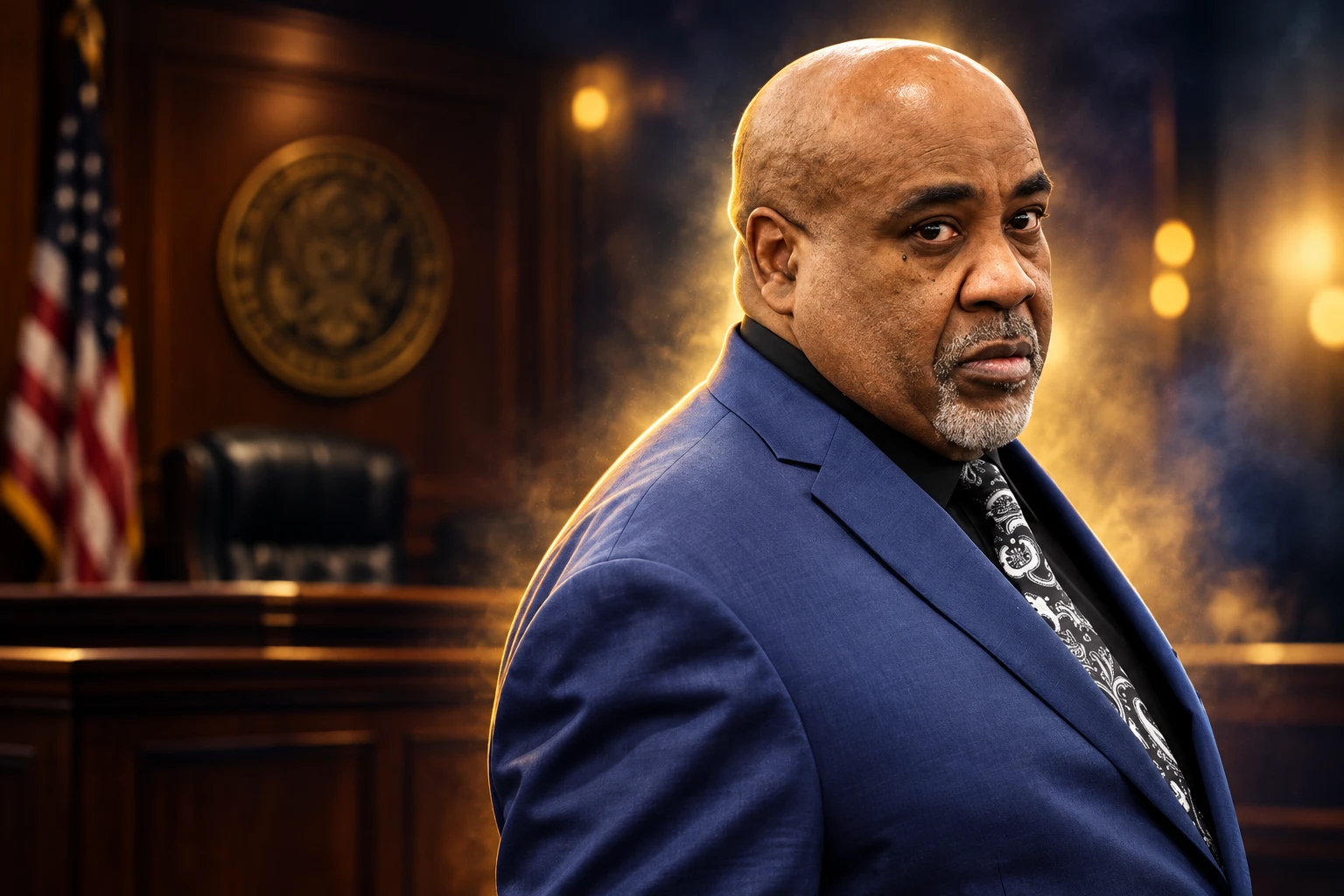
The Book He Told People to Buy
Palal held up Compton Street Legend, the 2019 memoir that carries Davis’s name, and played a clip in which Davis told people to buy it if they wanted the “real truth.” The book has a disclaimer that some facts were changed. Palal told jurors the hotels and some names moved around; the central story did not.
He reached for a comparison the overflow room would not miss.
Many years ago, OJ Simpson wrote the book, If I Did It. Duane Davis wrote the book, I Did It.
Binu Palal, chief deputy district attorney, closing argument
In the memoir Davis writes that he was one of the only living eyewitnesses to the killing, that the beating of his nephew Orlando “Baby Lane” Anderson gave his crew “the ultimate green light,” and that the shooting started when Shakur reached under the seat.
No words were exchanged, the time for talking had passed, the shit was on! Tupac made an erratic move and began to reach down beneath his seat. It was the first and only time in my life that I could relate to the police command to, Keep your hands where I can see them. Instead, Pac pulled out a strap, and that’s when the fireworks started. One of my guys from the back seat grabbed the Glock and started bustin’ back.
Duane Davis, Compton Street Legend, 2019
Sanft read from the same pages and argued they were fiction written to make a buck, possibly by a ghostwriter. Davis had said from jail that he did not write the book and that it was “fictionalized to make a profit.” Kierny had already ruled that he adopted the words as his own by selling them as the truth.
Chief Deputy District Attorney Marc DiGiacomo, in rebuttal, pointed to a scrapbook of Shakur clippings that investigators tied to Davis. “This guy’s scrapbooking his murder, for God’s sake,” he told the jury. He had said at an earlier hearing that the paper trail was the reason there was a trial at all.
Had he decided to never write the book, he would not, probably, have ever been prosecuted for the crime.
Marc DiGiacomo, chief deputy district attorney, Clark County District Court
Palal rejected the idea that a paid story could not also be a confession. “It is an entirely different proposition to be profiting from a murder,” he said. “And that is what Mr. Davis is doing.” The quieter point, the one that kept surfacing after the verdict, is that he did not have to keep talking once the 2008 police session was over.
The Other Three in the Cadillac Are Dead
Davis is the first person charged in Shakur’s killing and the only one of the four men the state puts in that Cadillac who is still alive. Las Vegas police have described him as the shot caller who passed the murder weapon, not as the person who squeezed it. The other three died years before the 2023 indictment, which is why a memoir and a stack of tapes became the case file.
WHO WAS IN THE WHITE CADILLAC
| Name | Seat, per Davis and the state | What happened to him |
|---|---|---|
| Duane “Keffe D” Davis | Front passenger; accused of passing the Glock | Arrested September 29, 2023; guilty August 31, 2026 |
| Terry “Bubble Up” Brown | Driver; Davis said he ordered the U-turn | Shot dead at a Compton marijuana shop on September 23, 2015, at 53 |
| Orlando “Baby Lane” Anderson | Back seat; long named as the gunman | Killed in a Compton car-wash shooting on May 29, 1998; he had denied the Tupac hit |
| Deandrae “Freaky” Smith | Back seat beside Anderson | Died of natural causes in 2004 at 30, per the Los Angeles County coroner |
The man prosecutors say originally supplied Davis with the gun is dead too. The Cadillac was never recovered. The.40 Glock 22 was never recovered. A hotel bill later turned up in a search of Davis’s world, though witnesses at trial could not pin down its date or where the slip is now.
What the MGM Grand Fight Set Off
The state’s timeline starts years before the book. In May 1996, Anderson was accused of jumping Trevon “Tray” Lane, a Death Row associate, over a chain at a shoe store, an insult Palal called an ultimate sign of disrespect inside that feud. On September 7, 1996, after Mike Tyson beat Bruce Seldon at the MGM Grand, cameras caught Shakur, Death Row boss Marion “Suge” Knight, and others beating Anderson in the casino.
THE NIGHT OFF THE STRIP
- September 7, 1996: After the Tyson fight, Shakur’s group attacks Anderson at the MGM Grand. Palal told jurors Davis then got a gun, gathered his people, and “went hunting” for Shakur and Knight.
- Later that night: Shakur rides in the passenger seat of Knight’s black BMW, headed toward a club. A white Cadillac pulls up on the right at a red light just off the Strip. A large arm comes out a rear window with a.40 Glock 22. Shakur is hit four times. Knight is wounded and lives.
- September 13, 1996: Shakur dies at 25 after surgeons remove a lung; respiratory failure leads to cardiac arrest. He was in the middle of a commercial peak that included the double album All Eyez on Me.
Palal walked the jury through the U-turn. The Cadillac, in Davis’s own tellings, was going the other way when the group spotted Shakur hanging out a window. They did not keep driving. “It’s a plan, not an impulse,” Palal said. Under Nevada law, he added, you can be guilty of murder without being the person who fires. “When you have the shot caller sitting shotgun when shots are fired, there’s no doubt he’s responsible.”
Shakur, the son of Black Panther parents, had already become one of the defining rappers of the decade, and the killing froze him there. He was later inducted into the Rock and Roll Hall of Fame in 2017, with Snoop Dogg doing the honors, and his catalog sold more than 75 million records, with All Eyez on Me and his Greatest Hits each passing 10 million. The open file around his death fed a cottage industry of books and films. Davis joined that market, then became its defendant.
A Proffer Could Not Survive a Book Tour
The first detailed confession was not written for a bookstore. On December 18, 2008, facing a federal drug case that could have meant 25 years to life, Davis sat down with Los Angeles investigators who were also poking at the 1997 killing of Christopher Wallace, the Notorious B.I.G. He opened with a line the jury later heard on tape: “Don’t bullshit me, and I won’t bullshit you all.” Former LAPD detective Greg Kading told him nothing in that session would be used against him.
Davis volunteered the Tupac shooting. He said he was in the car, that he handed the gun back, and that Anderson “leaned over on the window. He rolled down the window, popped ’em.” He added, “If they drove on my side, I would have popped ’em.” Investigators have said they were not even asking about Shakur when he started talking. Davis was later ruled out in Wallace’s killing.
A proffer is a limited deal, sometimes called queen-for-a-day. It covers that session. It is not a lifetime pass, and it was not a Nevada grant. Davis repeated the story to Las Vegas detectives in 2009, then kept repeating it on camera and in print. DiGiacomo told jurors that once the book and the TV appearances were out, the 2008 shield no longer blocked those words.
DAVIS ON THE RECORD
- December 18, 2008: Recorded proffer in a lawyer’s office; he names Anderson as the shooter and places himself in the front passenger seat.
- 2009: He retells the U-turn and the shooting to Las Vegas police, who were not parties to the Los Angeles deal.
- 2018: On-camera interviews, including a BET series, in which he puts himself in the Cadillac and cites “the code of the streets” when asked who fired.
- 2019: Compton Street Legend goes on sale; he later says a ghostwriter made it up for money.
Kierny allowed the police interviews and the book at trial after the defense tried to bury both. She found the police statements voluntary, even while flagging that Davis had been told in 2008 he would not be prosecuted for what he said that day. Former Clark County District Attorney David Roger, watching the verdict, put the same idea in blunter terms: if Davis’s ego and need for money had not pushed him into the spotlight, he might still have been walking around Henderson.
From jail, Davis had insisted the old deal still bound everyone. “A deal is a deal,” he said. “I’m not even supposed to be in jail.” The jury was asked to decide whether the man on those tapes was a fabulist or a shot caller. It did not take an afternoon.
Who Pulled the Trigger Was Never the Charge
The indictment did not name a single gunman. It said Davis gave the pistol to Smith “and/or” Anderson so they would carry out the shooting. That hedge was not a slip. It was the point of charging the man who, in the state’s theory, ran the car.
For years the street version was simple: Anderson, the nephew, did the shooting. Davis said so in 2008, when Kading later argued he had to tell the truth because the drug case was hanging over him. After that, Davis got vaguer. In some interviews he would not name the back-seat shooter. In the book the gun is grabbed by “one of my guys.”
Grand jury witness Denvonta Lee, a former Davis associate who was not in the Cadillac, told a different story. He said Smith took the gun from Anderson because Anderson did not have a clear shot out the left-rear window, fired, and let Anderson take the credit. Palal told the sitting jury it did not matter which dead man held the Glock.
Who fired is not the question.
Binu Palal, chief deputy district attorney, closing argument
Anderson denied any role before he was killed in 1998. Smith and Brown never stood trial. James “Mob James” McDonald, who worked security around Knight’s club, testified that people in that circle thought they already knew who had done it that night, naming Davis and Anderson. Sanft spent the trial asking whether any of that, without a gun or a car or a living passenger besides his client, was enough. The state’s backup was the body of talk Davis had put on tape and on paper.
DiGiacomo called the file a slam dunk even without new forensics, because Davis had admitted the core of it “seven, eight times over the course of 30 years” and nothing in the record put him somewhere else. “Mr. Davis is attempting to escape responsibility for a crime everybody knows he committed, even him,” he said.
Life Without Parole Is on the October Calendar
Nevada treats first-degree murder as a category A felony. A person convicted of it can be sent to state prison for life without the possibility of parole, for life with parole after 20 years, or for a flat 50 years with parole also opening at 20. Death is on the books only with aggravating facts that outweigh mitigation; that path was not the one argued to this jury. Kierny will choose among the prison terms on October 13. Davis was 63 at verdict. An appeal, the judge said, comes after sentencing.
Wolfson spent part of his Tuesday briefing reading a statement from Shakur’s siblings, including Set and Mopreme, who said they were elated and relieved and who pointed back to their mother Afeni Shakur’s long fight over the case. They also said the verdict was not the end of the story. Shakur’s cousin Zayd Akinyela had already told reporters, while testimony was still going, that the family had been waiting 30 years to grieve properly.
The file that remains is the one the wire version of this story likes to call closed. The gunman in the back seat is still two names, or one unnamed “guy,” depending on which Davis you read. Wallace’s killing is still without a conviction. The Cadillac is still missing. What the state finally had, after a search warrant in Henderson in July 2023 and an arrest on September 29, 2023, was a defendant who had spent a decade and a half selling the night as content.
Sekyiwa Shakur cried and reached for the prosecutors when the clerk read the verdict. Davis’s son put a hand over his face. October 13 is on the calendar, and the same book the state walked to the jury box will be in the appeal briefs too.

Bass Persuades Takes the Record Drop After a No. 1 Debut

DIGITALEUROPE Says Europe Must Buy From Its Scaleups

Refugees Lose Medicaid While Green Cards Sit in Line

Ring Smart Lock Puts Your Door on Amazon Sidewalk

Sicario 3 Moves Ahead Without Taylor Sheridan Writing

Permafrost Thaw Runs Fastest in Mountains, Not Arctic Soils

Rune Bets on Hillerød for His Achilles Comeback

The Last Manual V-12 Lamborghini Cannot Come to America

The Roman Space Telescope Flies After Four Budget Fights

JBS’s Pilgrim’s Pride Bid Still Needs the 18 Percent
-
 NEWS2 months ago
Rune Bets on Hillerød for His Achilles Comeback
-
 AUTO2 months ago
The Last Manual V-12 Lamborghini Cannot Come to America
-
 NEWS2 months ago
Permafrost Thaw Runs Fastest in Mountains, Not Arctic Soils
-
 NEWS2 months ago
The Roman Space Telescope Flies After Four Budget Fights
-
 NEWS2 months ago
Murphy Defends a British Open Title Nobody Keeps
-
 BUSINESS2 months ago
JBS’s Pilgrim’s Pride Bid Still Needs the 18 Percent
-

 BUSINESS2 months ago
Influencer Investors Trade Cash Fees for Illiquid Equity
-

 BUSINESS2 months ago
Software Stocks Rally as Underweight Funds Face Dreamforce