
BUSINESS
Bessent Seated Siluanov, Then Said the War Comes First
Scott Bessent sat Russia’s finance minister at the Asheville G20, cut off deal talks, and left Europe holding an empty photo spot.

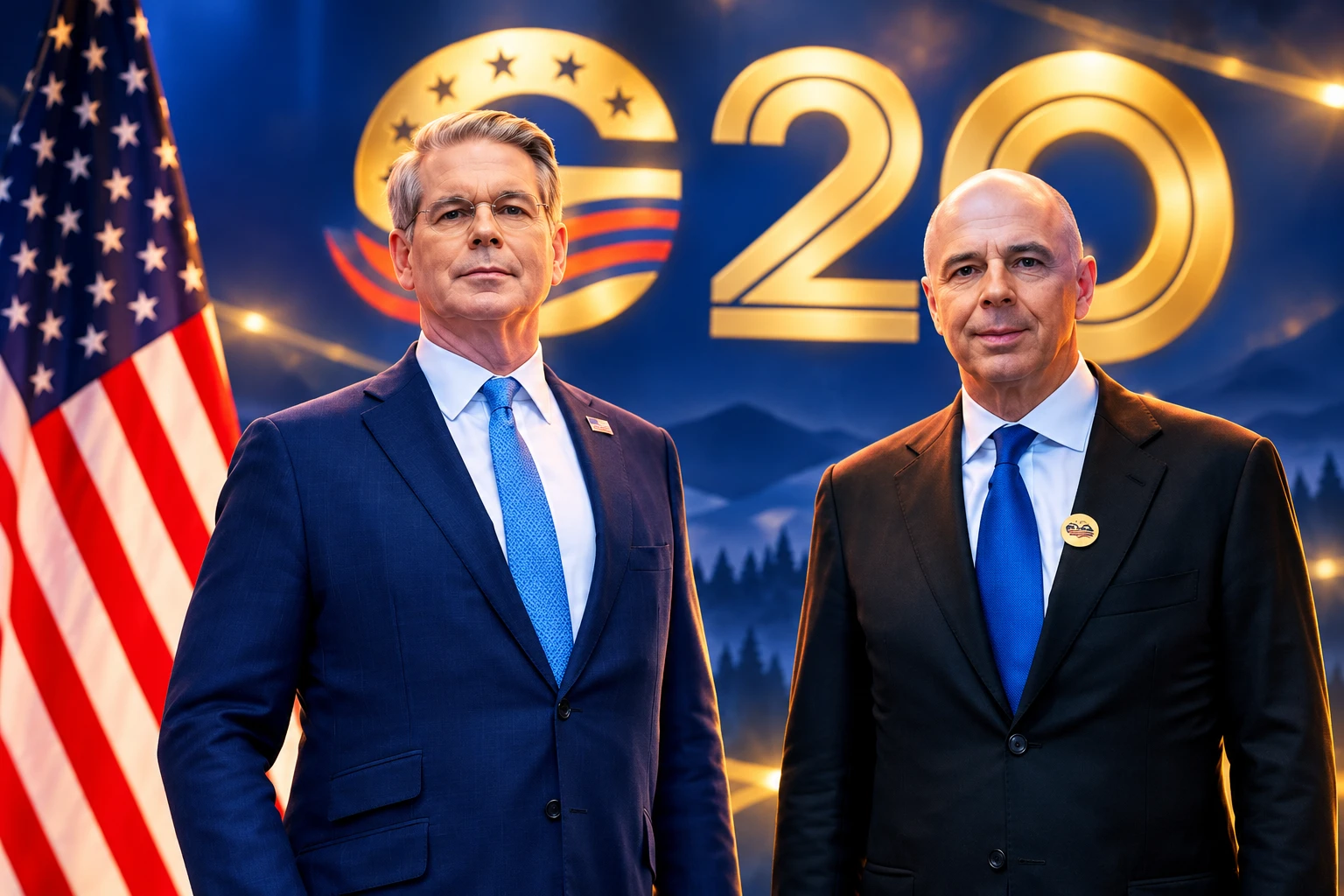
U.S. Treasury Secretary Scott Bessent told Russia’s finance minister on Aug. 31 that no economic relief is possible until the war in Ukraine ends. He said it in a side meeting Washington had set up after seating Anton Siluanov at the U.S.-hosted G20 table.
European ministers then kept Siluanov out of the group photograph. Treasury had already licensed seaborne Russian oil during the Hormuz shock, a window that sent money to Moscow.
Washington Put Siluanov Back at the Table
The two-day finance ministers meeting in Asheville, North Carolina, ran Aug. 31 and Sept. 1, after deputies met Aug. 29 and 30. Treasury picked the city as a marker for western North Carolina’s rebuild after Hurricane Helene. Growth, debt, and energy trade were the advertised file. Russia’s chair became the fight.
Siluanov has run Russia’s finance ministry since 2011. His in-person G20 return, on U.S. soil, was the first since Russia’s full-scale invasion of Ukraine in 2022. Allies in the room said they had no warning. Erin Browne, Treasury’s undersecretary for international affairs, said Russia was invited because it is a G20 member and that “it’s important to have dialogue even during times of conflict.”
President Donald Trump, asked about the invitation, said, “We like getting along with everybody. One of the reasons that I’m so successful, I get along with everybody.” A U.S. official said the Bessent-Siluanov session focused on Trump’s peace plan for Ukraine. Russia’s Finance Ministry said the two men discussed financial cooperation on the U.S.-Russia track and inside the G20.
Those two readouts already pulled in opposite directions. One framed the sit-down as a war-ending pitch. The other framed it as ordinary business among finance chiefs. The photograph Treasury later released of the two men together did more work than either statement.
Nothing Is Possible Until the War Is Over
A person familiar with the meeting said that when Siluanov tried to raise other areas of interest, Bessent cut in and said nothing is possible until the war is over. The same person said Bessent made clear the United States “will not provide Russia with economic relief until the war in Ukraine is over.”
Browne called the session productive and said the men discussed “Trump’s plan for peace and economic growth.” She said Bessent told Siluanov “the war needs to end.” Asked later what Siluanov said back, Bessent answered, “Many conversations are best done privately.”
He did not announce any change in U.S. sanctions on Russia. The oil majors hit in 2025 stayed listed. The argument in the room was over whether the seat itself counted as relief.
On Sept. 1, after the meeting closed, Bessent went further in public and said the minister he had just met “is unsanctioned.” OpenSanctions, a sanctions database, still listed Siluanov on the SDN file as of Aug. 24, 2026, tracing the entry to Treasury’s April 2022 round. That clash sat in the open: a host calling his guest clean, a file that still carried the name.
The Family Photo Went Ahead Without Russia
German Finance Minister Lars Klingbeil, who is also vice chancellor, told Siluanov in an early session to end the war and said Germany would keep supporting Ukraine. He then went after the hosts for treating the Russian as a regular guest.
Receiving the Russian finance minister here sends a signal I find troubling. I would have wanted greater clarity from the American side that he should not be received here as a normal guest.
Lars Klingbeil, German finance minister, in Asheville
European delegations, Klingbeil said, had already talked on Sunday evening, with European Central Bank President Christine Lagarde among those in the huddle. They agreed a channel for a frank message could be useful. They also agreed the family photo was not that channel.
WHAT EUROPE DID IN THE ROOM
- The photo: Ministers threatened to skip the traditional group picture if Siluanov stood in it, and organizers took the shot without him.
- Poland’s line: Finance Minister Andrzej Domanski said, “We do not trust Russia. They lie constantly, and you need to be really, really cautious while discussing with them.”
- The EU’s line: Economy Commissioner Valdis Dombrovskis said it was not the time to “normalize” Russia, and that officials had “problems discussing sensible diplomatic matters with representatives of a country waging an aggressive war and which are killing civilians on a daily basis.”
- Canada’s line: Finance Minister François-Philippe Champagne said Russia’s attendance “created a lot of discomfort around the table, not only from Canada, but from colleagues around the table.”
- The next package: Klingbeil said Europe was preparing further sanctions and wanted Washington in on the work, even as he called the Asheville invite “quite troubling.”
Ukraine’s finance minister, Serhiy Marchenko, was due to join a Group of 7 finance session by video on the sidelines, with France in the G7 chair. Ukraine itself had no in-person seat in the larger G20 room where Siluanov sat and spoke.
Hormuz Licenses Already Let Russian Cargoes Move
The interrupt landed on a sanctions file that had already been bent for oil. On Oct. 22, 2025, Treasury’s Office of Foreign Assets Control added Rosneft and Lukoil, Russia’s two largest oil companies, to the SDN list. That was the year’s hardest U.S. hit on Russian oil.
By December 2025, Urals crude had fallen below $50 a barrel and Russia’s fossil-fuel export take had dropped to its lowest level since the invasion, according to Gonzalo Saiz Erausquin at the Royal United Services Institute. Then the U.S.-Israeli war with Iran closed the Strait of Hormuz, Brent moved above $100, and Russian barrels stopped looking like a problem to squeeze.
Treasury answered with a general license for Russian crude and products already loaded on tankers, so buyers could take those cargoes without violating the Rosneft and Lukoil listings. Bessent extended that window more than once, including a May 18 round that ran through June 17, 2026. Democratic senators called the extension an “indefensible gift” to Vladimir Putin. RUSI’s July commentary said the general licences to service Russian oil generated billions in revenue for the Kremlin and its war machine.
THE OIL SANCTIONS AND THE LICENSES
| Date | U.S. action |
|---|---|
| Oct. 22, 2025 | OFAC adds Rosneft and Lukoil to the SDN list |
| March 2026 | First general license for seaborne Russian oil already on tankers |
| April 2026 | Waiver renewed, after which Bessent said it would not be renewed |
| May 18, 2026 | New license runs through June 17 for cargoes loaded by April 17 |
| June 17, 2026 | The seaborne-oil license expires |
| Aug. 31, 2026 | Bessent tells Siluanov nothing is possible until the war ends |
The last tanker license had been dead for 75 days when the two men sat down. The Rosneft and Lukoil listings were still live. So was the memory of the cash those cargoes produced while Hormuz was shut. The G7 price cap had started at $60 a barrel; the EU and UK later cut the oil price cap to $44.10 outside the G7 framework. About 30 percent of Russian crude exports in April still moved on G7 tankers, a share RUSI said made cap compliance hard to believe.
Why Siluanov Walked Into a U.S. Room
Russia never left the G20 after 2022. It lost its G8 seat after the 2014 annexation of Crimea and kept the wider G20 chair. What changed in Asheville was the body in the seat, on American soil, with the host’s blessing and a one-on-one on the schedule.
FROM THE 2022 WALKOUT TO THE ASHEVILLE SEAT
- April 2022: Treasury lists Siluanov. Officials from the United States, Britain, Canada, and the ECB walk out of a Washington G20 session as he delivers remarks by video, with then-Secretary Janet Yellen among those who leave.
- 2022 to 2025: Russia stays in the G20 on paper. Siluanov does not appear in person at these finance meetings.
- Oct. 22, 2025: The second Trump Treasury hits Rosneft and Lukoil after talks to end the Ukraine war stall.
- March to June 2026: Hormuz licenses let loaded Russian cargoes move, then expire on June 17.
- Aug. 24, 2026: Treasury launches Operation Economic Outcast against Iran’s financial ties abroad.
- Aug. 31, 2026: Siluanov sits in Asheville, meets Bessent, and is kept out of the family photo.
Congress has been arguing over a new Russia sanctions bill while that sequence ran. Europe’s next package is the other live file. Neither moved in the Asheville readout. The thing that moved was the guest list.
Nineteen Names on the Chair’s Statement
When the meeting closed, Bessent pointed to process. “I would point out that we had 19 of 20 countries agree, so that there has been no impact,” he told reporters. He was talking about the G20 chair’s statement from Asheville, which China did not back in full.
The paper never named Russia’s war as a stand-alone item. It said the global economy had stayed resilient “in the face of multiple shocks, including ongoing wars and conflicts.” It flagged “continued disruptions to energy trade” and said “the free, safe, and predictable navigation through the Strait of Hormuz and worldwide, and the resolution of ongoing wars and conflicts are essential to sustaining durable growth.”
That is as close as the text came to Ukraine. The rest of the document ran through growth, imbalances, financial literacy, and sovereign debt, the agenda Washington wanted on the nameplate. Bessent, at the same press conference, called China’s cheap export model unsustainable and said the holdout was “the country with the largest unsustainable current account surplus.”
I know that some Europeans had a sour taste, but I think it’s very important to engage. Otherwise, if both fighters go in a corner, then there will never be a resolution to this horrible conflict.
Scott Bessent, U.S. Treasury secretary, press conference in Asheville, Sept. 1, 2026
He tied the invite to Trump’s habit of talking to adversaries. “This horrible conflict between Russia and Ukraine, if the sides don’t talk, if we are not engaged, then how can it be solved?” he said. The chair’s statement gave him a 19-name sheet to hold up. It did not give Europe a line that Siluanov had been received as anything other than a guest.
Iran Faced a Sanctions Blitz in the Same Month
Eight days before Siluanov sat down, Bessent’s department rolled out Operation Economic Outcast, an “economic onslaught” aimed at Iran’s remaining financial ties, with new sector listings and dozens of designations. RUSI’s July paper had already drawn the contrast: since January 2025 the United States had not added a single designation against Russia’s shadow fleet, while it built a wide campaign against Iranian oil networks, then used Russian cargoes as spare barrels when Hormuz closed.
The Asheville week made that split visible in a single building. Iran was the target of a maximum-pressure drive the Treasury secretary wanted the G20 to back. Russia was the government whose finance minister got a bilateral, a plenary mic, and a hard sentence about the war with no new listing attached.
Europe’s leverage in that room was the photograph and the next sanctions package. Washington’s leverage was the guest list and the oil file it had already opened and closed. Siluanov flew home with the seat, the interrupt, and no family-photo slot. Bessent kept the Rosneft and Lukoil listings in place and offered no fresh waiver. The argument that remains is whether the welcome was the concession Europe said it was, or whether the cut-off line was the whole policy, spoken in a room the host had already unlocked.

Bass Persuades Takes the Record Drop After a No. 1 Debut

DIGITALEUROPE Says Europe Must Buy From Its Scaleups

Refugees Lose Medicaid While Green Cards Sit in Line

Ring Smart Lock Puts Your Door on Amazon Sidewalk

Sicario 3 Moves Ahead Without Taylor Sheridan Writing

Permafrost Thaw Runs Fastest in Mountains, Not Arctic Soils

Rune Bets on Hillerød for His Achilles Comeback

The Last Manual V-12 Lamborghini Cannot Come to America

The Roman Space Telescope Flies After Four Budget Fights

JBS’s Pilgrim’s Pride Bid Still Needs the 18 Percent
-
 NEWS2 months ago
Rune Bets on Hillerød for His Achilles Comeback
-
 AUTO2 months ago
The Last Manual V-12 Lamborghini Cannot Come to America
-
 NEWS2 months ago
Permafrost Thaw Runs Fastest in Mountains, Not Arctic Soils
-
 NEWS2 months ago
The Roman Space Telescope Flies After Four Budget Fights
-

 NEWS2 months ago
Murphy Defends a British Open Title Nobody Keeps
-
 BUSINESS2 months ago
JBS’s Pilgrim’s Pride Bid Still Needs the 18 Percent
-

 BUSINESS2 months ago
Influencer Investors Trade Cash Fees for Illiquid Equity
-
 BUSINESS2 months ago
Rubicon Research Q1 Tests Its Specialty Pharma Bet