
BUSINESS
Labor Day Gas Hits $4.15 as Diesel Sets a Record
Regular gasoline averaged $4.15 on Labor Day, a holiday first, while diesel’s $5.90 all-time high is the freight cost still rolling into grocery aisles.

The U.S. national average for regular gasoline reached $4.15 a gallon on Labor Day, the first time the holiday has ever cleared $4. AAA put the prior Labor Day mark at $3.82, set on September 3, 2012.
Diesel printed an all-time high of $5.90 the same Monday, a quieter record that already rides on the trucks that stock grocery aisles. Drivers paid about 30% more than the $3.20 average a year earlier, and the usual post-summer fade never showed up.
Americans Paid $4.15 on Labor Day
AAA’s live fuel board dated September 7 put regular at $4.1505 a gallon, up from $4.08 a week earlier and $4.04 a month earlier. The club’s September 3 travel note had already warned of the highest gas prices ever for Labor Day, with a national average then at $4.14 and crude still in the $90 range. On the holiday itself the average ticked a penny higher and stayed there.
The holiday has never before averaged above $4. AAA expected nearly 40 million people to drive, and a typical 14-gallon fill cost more than $13 extra versus a year ago, AAA spokesman Doug Shupe said. California averaged $5.86, Indiana $3.43. A station on Western Avenue in Chicago’s Ukrainian Village posted $5.59 on Monday morning.
AAA NATIONAL AVERAGES ON SEPTEMBER 7
| Fuel | Sept. 7 | Week earlier | Year earlier | Record (date) |
|---|---|---|---|---|
| Regular | $4.15 | $4.08 | $3.20 | $5.02 (June 14, 2022) |
| Diesel | $5.90 | $5.60 | $3.71 | $5.90 (Sept. 7, 2026) |
Regular is still well short of that June 2022 peak, and it is down from this year’s high of $4.56 in May. The political problem is the calendar. Patrick De Haan, head of petroleum analysis at GasBuddy, said gasoline, while not at all-time records, is at its highest level this late in the calendar year. He had flagged in August that Labor Day was on course to beat the 2012 mark.
Brittany Moye, an AAA spokesperson, said gasoline demand typically falls after the summer driving season, often leading to lower prices, but this year’s elevated crude costs have offset that seasonal trend. Randi O’Brien, 57, filling a truck at a Phillips 66 near Evergreen, Colorado, put it more bluntly: “It’s completely out of control.”
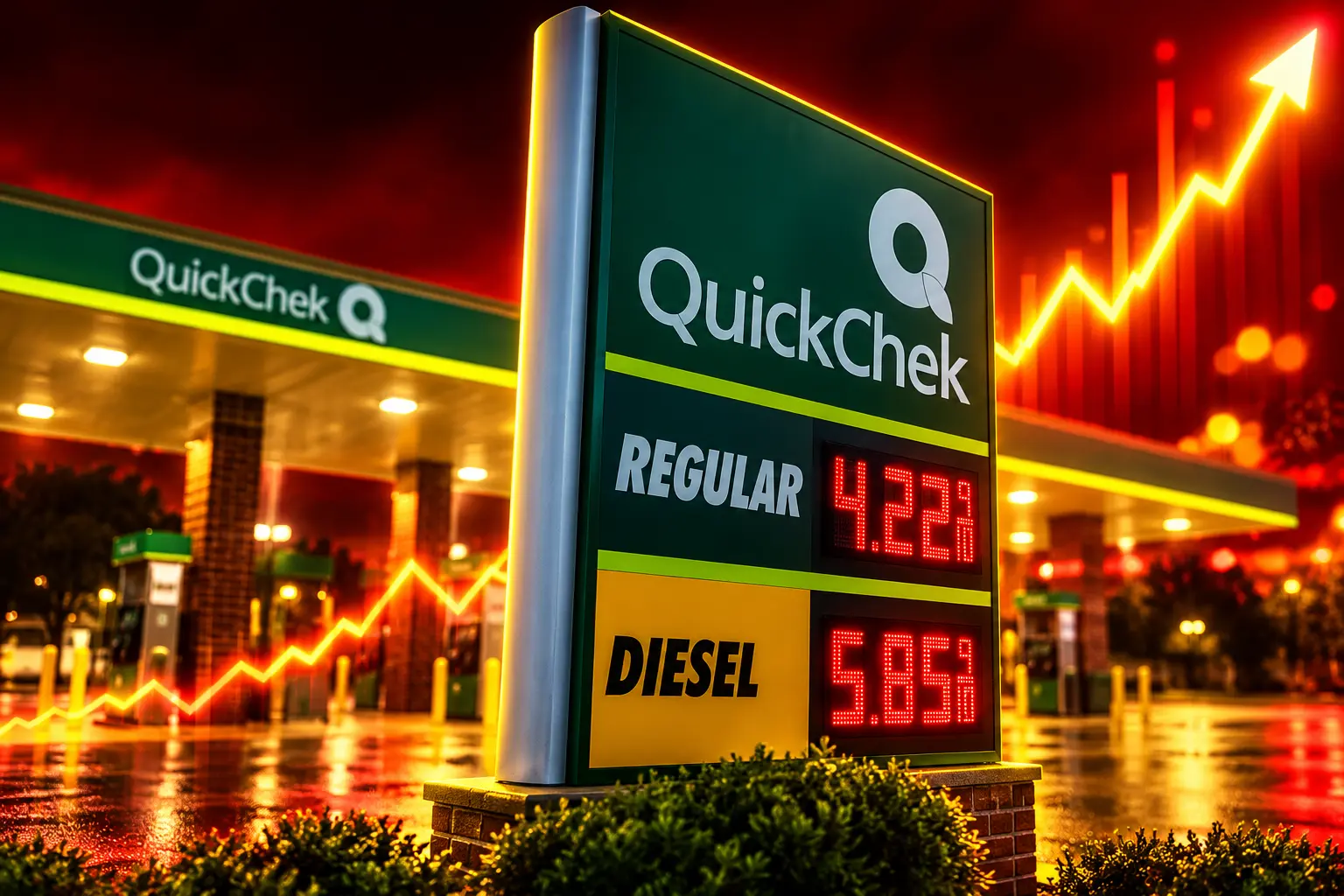
Diesel’s All-Time High Is $5.90 a Gallon
AAA now lists $5.9015, dated September 7, as the highest recorded national diesel average. The fuel was $5.60 a week earlier and $3.71 a year earlier, a $2.19 jump, or 59%. Diesel had already set a record at $5.85 on September 4, then added another nickel over the weekend.
That is a different kind of print than $4.15 gasoline. Regular’s Labor Day record is a holiday first and still sits 87 cents under the 2022 all-time high. Diesel has no such cushion. Trucks, trains, farm equipment, and the vans that move packages all burn it, so the bill does not stay at the pump.
Energy Secretary Chris Wright, asked on September 6 about that $5.89 reading, pointed at Russian plants hit by Ukrainian strikes. Russia used to be a meaningful diesel exporter, he said, and now exports none and has become a gasoline importer. Global refining capacity, he said, is why gasoline and diesel prices are high, even more than oil prices.
Hormuz Traffic Collapsed After February
Crude is still the largest piece of the retail gallon, and the U.S. benchmark was around $92 a barrel on Labor Day morning, against about $67 before U.S. and Israeli strikes on Iran began on February 28. Brent, the international gauge, was around $97, up from about $72. Oil accounts for about half of what drivers pay; refining, taxes, and marketing make up the rest, according to the U.S. Energy Information Administration.
The physical cut is in the waterway. EIA’s August Short-Term Energy Outlook estimated crude oil and petroleum liquids through the Strait of Hormuz at 4.9 million barrels a day in the second quarter, down from 21.6 million barrels a day in the fourth quarter of 2025, a 77% drop. First-quarter volumes had already fallen to 14.9 million. Flows through Bab el-Mandeb rose to 8.1 million barrels a day from 5.4 million as some cargoes rerouted, including Saudi crude moved on the East-West pipeline to Yanbu on the Red Sea.
Before the war, EIA’s chokepoint series put Hormuz at 20.9 million barrels a day in the first half of 2025, equal to about 20 percent of global petroleum liquids consumption. Tom Seng, a professor of energy finance at Texas Christian University, said everything points to the Iran war and the Strait of Hormuz. Wright said on September 6 that U.S. transits through the strait were averaging over 9 million barrels a day, the highest since the fighting started, and still far below the prewar run rate.
FROM THE FIRST STRIKES TO THE HOLIDAY PRINT
- February 28, 2026: U.S. and Israeli strikes on Iran begin. WTI is near $67 a barrel and Brent near $72; U.S. regular is about $3 a gallon.
- May 2026: National regular hits this year’s high of $4.56 a gallon as Hormuz volumes stay suppressed.
- August 20, 2026: EPA, in consultation with the Energy Department, issues a national fuel waiver to pull winter gasoline forward.
- September 1, 2026: The earlier winter-blend window opens, with the federal piece of the waiver running through September 15.
- September 6, 2026: Wright says two-month gasoline futures are down more than 30 cents and that prices are more likely to fall than rise.
- September 7, 2026: Labor Day. AAA prints $4.15 regular, a holiday record, and $5.90 diesel, an all-time high.
EIA also recorded a draw in U.S. government stocks, from 413 million barrels in the first quarter to 321 million in the second. Andy Lipow, president of Lipow Oil Associates in Houston, said the market still has a Middle East supply cut at the same time refineries in the Middle East and Russia have been damaged.
Refineries Are Already Running Flat Out
U.S. plants were running at 98% of capacity heading into the holiday, the highest utilization since 2018, with little spare room if a hurricane or a Texas heat failure takes units offline. The White House has leaned on waivers, jawboning, and new barrels rather than an export ban. Wright said the way to solve a supply shortage is to grow supply, and that an export curb remains among “all options” while the working plan is maximum production.
THE BIND THAT KEPT $4 GAS IN PLACE
- Hormuz volumes: Second-quarter flows were 4.9 million barrels a day, against 21.6 million before the war.
- Russian diesel: Wright said Russia now exports no diesel after refinery damage, tightening a fuel the U.S. trucking fleet cannot skip.
- U.S. run rates: Refineries at 98% have almost no spare capacity left to cover the next outage.
- Winter-blend waiver: EPA pulled cheaper winter gasoline forward to September 1, a seasonal lever that usually arrives later.
- Western Hemisphere barrels: Wright said Venezuelan oil exports are up 50% in eight months of U.S. involvement, a claim that still has to show up as cheaper gallons.
Administrator Lee Zeldin said the August 20 waiver would increase domestic gasoline supply by hundreds of thousands of barrels a day by ending the summer-blend rule early. The federal piece runs through September 15, with extra days in Texas, Arizona, and California. Wright said New York, Connecticut, California, and several other Democratic-led states had declined to adopt the new blending standards.
What Energy Secretary Wright Is Promising
On September 6, Wright was asked whether gasoline could rise further after he had said five months earlier that prices had peaked. He first declined to forecast, then pointed at the futures strip, then guessed that the seasonal turn plus the blend change would do the work. Treasury Secretary Scott Bessent had talked about $3 gas by September 20; Wright would not underwrite that date.
Look, I don’t want to have an opinion on that, but if you look at the futures market right now, what can you buy gasoline for two months in advance from where we are today? It’s down more than 30 cents a gallon from where it is today.
Chris Wright, U.S. energy secretary, on State of the Union
Pressed again, he said gasoline production is about to go up and demand is about to go down, so if he had to guess, prices are “more likely to go down than go up.” He also argued that 17 years of Democratic policy had attacked hydrocarbons and closed refineries, and he accused California Gov. Gavin Newsom of strangling two more plants in the past 12 months. The earlier switch to winter-blend gasoline is the near-term lever he can actually pull without a ceasefire.
That hedge sits next to a holiday the White House already owns. Regular has never been $4 on Labor Day. Diesel has never been $5.90 on any day in AAA’s series. A futures contract two months out can be 30 cents cheaper and still leave September’s print in the cut of every midterm ad.
Grocery Aisles Inherit the Diesel Record
The gasoline number is the one on the corner sign. The diesel number is the one in the invoice for milk, lumber, and two-day shipping. Most heavy trucks run diesel, and when that fuel is $2.19 above last year, the surcharge does not wait for November. Wright himself noted that diesel powers the farm equipment, trains, and trucks that move produce to stores.
U.S. plants can only run so hard, and finished fuel has been pulled into a world that is short of Russian and Middle East barrels. Seng warned that a hurricane or a breakdown in the Texas heat would make prices even harder to unwind. De Haan’s August call was that both gasoline and diesel were heading for their highest Labor Day levels on record; gasoline did that as a holiday mark, and diesel did it as an all-time mark.
The cheap-energy pitch of 2024 assumed more U.S. crude would show up as cheaper gallons. What showed up instead was a war that pinched the world’s oil chokepoint, a refining system already at 98%, and a diesel market that lost its Russian export slice. Drill rights in Alaska and a Venezuela deal do not refine themselves into ultra-low-sulfur diesel by Monday morning of a holiday weekend.
A $4 Pump Heads Into the Midterms
Republican pollster Frank Luntz has said Labor Day is the point where gas prices are baked into the election. November is two months away. Wright’s futures strip says the gallon gets cheaper. The AAA board on September 7 says the holiday already printed the first $4 Labor Day and the highest diesel average on record.
The White House can still get a ceasefire, more Hormuz transits, and that winter-blend barrel. It cannot unwind a weekend that 40 million drivers already paid for, or a $5.90 diesel invoice that is already moving through freight. The next EIA Short-Term Energy Outlook is due September 9. Until then, the working figures remain the ones on the AAA board: $4.15 for regular, $5.90 for diesel, and a seasonal drop that did not arrive.

Bass Persuades Takes the Record Drop After a No. 1 Debut

DIGITALEUROPE Says Europe Must Buy From Its Scaleups

Refugees Lose Medicaid While Green Cards Sit in Line

Ring Smart Lock Puts Your Door on Amazon Sidewalk

Sicario 3 Moves Ahead Without Taylor Sheridan Writing

Permafrost Thaw Runs Fastest in Mountains, Not Arctic Soils

Rune Bets on Hillerød for His Achilles Comeback

The Last Manual V-12 Lamborghini Cannot Come to America

The Roman Space Telescope Flies After Four Budget Fights

Murphy Defends a British Open Title Nobody Keeps
-
 NEWS2 months ago
Permafrost Thaw Runs Fastest in Mountains, Not Arctic Soils
-
 NEWS2 months ago
Rune Bets on Hillerød for His Achilles Comeback
-
 AUTO2 months ago
The Last Manual V-12 Lamborghini Cannot Come to America
-
 NEWS2 months ago
The Roman Space Telescope Flies After Four Budget Fights
-
 NEWS2 months ago
Murphy Defends a British Open Title Nobody Keeps
-

 BUSINESS2 months ago
JBS’s Pilgrim’s Pride Bid Still Needs the 18 Percent
-

 BUSINESS2 months ago
Influencer Investors Trade Cash Fees for Illiquid Equity
-

 BUSINESS2 months ago
Software Stocks Rally as Underweight Funds Face Dreamforce